Zaleya decandra
(L.) Burm.f.
Many stamen horse purslane

Wikimedia Commons - Vinayaraj

Wikimedia Commons - Jayachandranjay
What to Eat
Edible parts: Leaves
The young leaves are eaten as a vegetable.
Where to Find It
A tropical plant. It grows near Mumbai. It grows in wet places.
Asia, India, Indonesia, Myanmar, SE Asia, Sri Lanka, Timor,
How to Identify
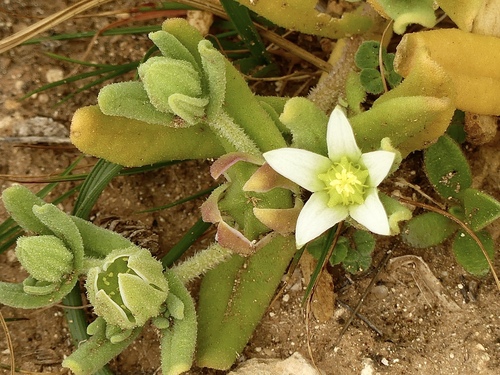
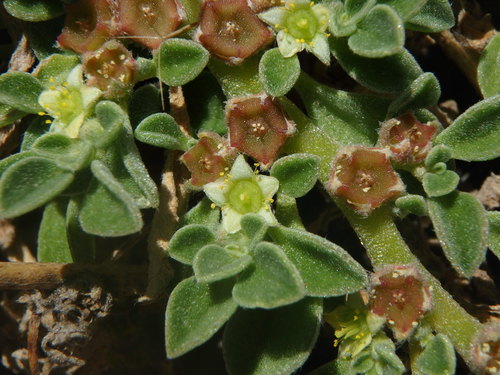
A herb. It is succulent and lies along the ground. The stems are long, angular and branched. The leaves are simple and opposite. They are 2-4 cm long by 1-2 cm wide and unequal. The flowers are 4 mm across and without petals. They are in clusters in the axils of leaves. The fruit is a 4 seeded capsule. It is 4.5 mm long. It has a cap that opens releasing the seeds. The seeds are kidney shaped and 1.5 mm across.
Nutrition Score: 39/100
| Part | Moisture | kJ | kcal | Protein | Vit A | Vit C | Iron | Zinc |
|---|---|---|---|---|---|---|---|---|
| Leaves | 91.3 | 100 | 24 | 2 | — | 70 | 38.5 | — |
How to Grow
It can be grown by seeds or cuttings.
Production
Harvested leaves can only be stored for a few days.
Other Information
Famine food
Names & Synonyms
Bhadurai keerai, Bilikommae, Charanai, Gaija soppu, Ghetuli, Gadabani, Koni dagu, Maha sarana, Pasalai, Tella garjala, Thellagalijeru, Vellai-shaaranai, Vellaisharunnai
References (9)
- Ambasta, S.P. (Ed.), 2000, The Useful Plants of India. CSIR India. p 646 (As Trianthema decandra)
- GAMMIE (As Trianthema decandra)
- Karthi, Sathya, & Salome, 2014, Uncultivated Edible Greens from Small Millet Farms Tamil Nadu India. IDRC (As Trianthema decandra)
- Kuhnlein, H. V., et al, 2009, Indigenous Peoples' food systems. FAO Rome p 193 (As Trianthema decandra)
- Mant. pl. 1:70. 1767 (As Trianthema decandra)
- Rajapaksha, U., 1998, Traditional Food Plants in Sri Lanka. HARTI, Sri Lanka. p 18 (As Trianthema decandra)
- Rasingam, L., 2012, Ethnobotanical studies on the wild edible plants of Irula tribes of Pillur Valley, Coimbatore district, Tamil Nadu, India. Asian Pacific Journal of Tropical Biomedicine. (2012) S1493-S1497
- Reddy, K. N. et al, 2007, Traditional knowledge on wild food plants in Andhra Pradesh. Indian Journal of Traditional Knowledge. Vol. 6(1): 223-229 (As Trianthema decandra)
- Singh, H.B., Arora R.K.,1978, Wild edible Plants of India. Indian Council of Agricultural Research, New Delhi. p 40 (As Trianthema decandra)