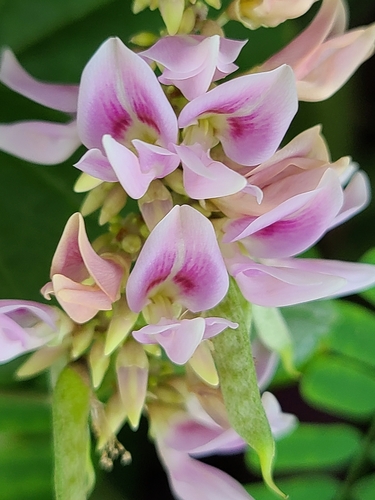
Trifolium incarnatum
L.
Crimson clover, Italian Clover

(c) Greg Peterson, some rights reserved (CC BY-NC-SA)

(c) Ashley M Bradford, some rights reserved (CC BY-NC)
What to Eat
Edible parts: Seeds, Flowers, Leaves
The seeds can be sprouted and eaten in salads, or dried and ground into a nutritious flour. Dried flower heads make a tea substitute.
Where to Find It
It is a temperate plant. It will grow in most soils. It needs an open, sunny position. It is resistant to frost but sensitive to drought. Tasmania Herbarium.
Albania, Asia, Australia, Austria, Balkans, Belgium, Britain, Bulgaria, China, Crete, Czech, Denmark, Europe*, Finland, France, Germany, Greece, Hungary, India, Italy, Korea, Macedonia, Mediterranean, Netherlands, North America, Norway, Pakistan, Poland, Portugal, Romania, Russia, Slovenia, Spain, Switzerland, Tasmania, Turkey, Türkiye, Yugoslavia,
How to Identify
An annual herb. It is an erect plant. The stems are hairy. The leaves are divided into 3 leaflets. The leaflets are also hairy. The leaflets have teeth near their ends and can vary in shape. The leafy structure at the base of the leaf (stipule) is round and wavy. The flowers are small. They are in oblong heads. These occur singly at the ends of stalks. The flowers are dark red.
How to Grow
Succeeds in a moist, well-drained circum-neutral soil in full sun. Succeeds in poor soils. The ssp. molinerli is the form of this species that is native to Britain, whilst ssp. incarnatum is naturalized in S. Britain and is the form grown as a green manure crop. It grows well in an apple orchard, the trees will produce tastier fruit that stores better. It should not be grown with camellias or gooseberries because it harbours a mite that can cause fruit drop in the gooseberries and premature budding in the camellias. Fairly resistant to 'clover rot'. This species has a symbiotic relationship with certain soil bacteria, these bacteria form nodules on the roots and fix atmospheric nitrogen. Some of this nitrogen is utilized by the growing plant but some can also be used by other plants growing nearby. Buttercups growing nearby depress the growth of the nitrogen bacteria by means of a root exudate. When removing plant remains at the end of the growing season, it is best to only remove the aerial parts of the plant, leaving the roots in the ground to decay and release their nitrogen.
Propagation: Pre-soak seed for 12 hours in warm water, then sow in spring to early summer in situ. Seed can also be sown in early autumn as a winter green manure.
Medicinal Uses
None known.
Other Uses
Used as a green manure — it grows relatively quickly, suppresses weeds effectively, and fixes nitrogen. It is also included in grass seed mixes for soil reclamation projects.
Wikipedia
Source ↗Trifolium incarnatum, known as crimson clover is a species of herbaceous flowering plant in the family Fabaceae, native to most of Europe and southwest Asia.
Other Information
It is cultivated.
Notes
There are about 240 Trifolium species. They are mostly temperate.
Names & Synonyms
Rdeča detelja, Scarlet clover
References (20)
- Ambasta, S.P. (Ed.), 2000, The Useful Plants of India. CSIR India. p 651
- Blamey, M and Grey-Wilson, C., 2005, Wild flowers of the Mediterranean. A & C Black London. p 103
- Bremness, L., 1994, Herbs. Collins Eyewitness Handbooks. Harper Collins. p 273
- Facciola, S., 1998, Cornucopia 2: a Source Book of Edible Plants. Kampong Publications, p 111
- Flora of Pakistan. www.eFloras.org
- http://www.botanic-gardens-ljubljana.com/en/plants
- Hussey, B.M.J., Keighery, G.J., Cousens, R.D., Dodd, J., Lloyd, S.G., 1997, Western Weeds. A guide to the weeds of Western Australia. Plant Protection Society of Western Australia. p 162
- Kermath, B. M., et al, 2014, Food Plants in the Americas: A survey of the domesticated, cultivated and wild plants used for Human food in North, Central and South America and the Caribbean. On line draft. p 875
- Lamp, C & Collet F., 1989, Field Guide to Weeds in Australia. Inkata Press. p 309
- Lazarides, M. & Hince, B., 1993, Handbook of Economic Plants of Australia, CSIRO. p 239
- Loughmiller, C & L., 1985, Texas Wildflowers. A Field Guide. University of Texas, Austin. p 139
- Paczkowska, G . & Chapman, A.R., 2000, The Western Australian Flora. A Descriptive Calatogue. Western Australian Herbarium. p 452
- Plants for a Future database, The Field, Penpol, Lostwithiel, Cornwall, PL22 0NG, UK. http://www.scs.leeds.ac.uk/pfaf/
- Sp. pl. 2:769. 1753
- Tasmanian Herbarium Vascular Plants list p 32
- USDA, ARS, National Genetic Resources Program. Germplasm Resources Information Network - (GRIN). [Online Database] National Germplasm Resources Laboratory, Beltsville, Maryland. Available: www.ars-grin.gov/cgi-bin/npgs/html/econ.pl (10 April 2000)
- Wiersema, J. H. & Leon, B., 2013, World Economic Plants. A Standard Reference CRC Press. 2nd Ed. p 695
- World Checklist of Useful Plant Species 2020. Royal Botanic Gardens, Kew
- www.ediblewildfood.com
- Zeven, A. C. & de West, J. M. J., 1982, Dictionary of cultivated plants and their regions of diversity. Wageningen. p 115