Trifolium repens
L.
White clover, Dutch clover, Shamrock

(c) Tom Grant (aka Sthiramani), some rights reserved (CC BY-NC-ND)

(c) Hornbeam Arts, some rights reserved (CC BY-NC)
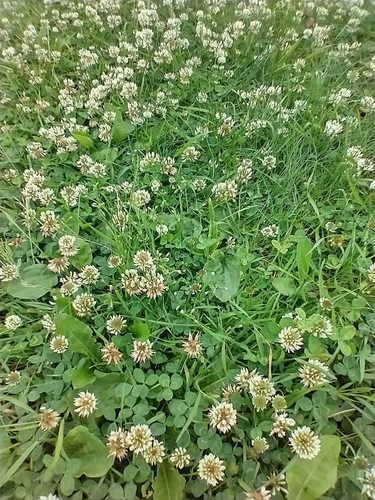
(c) Tom Norton, some rights reserved (CC BY), uploaded by Tom Norton
What to Eat
Edible parts: Flowers, Shoots - tea, Seeds, Pods, Root, Leaves
Young leaves are best harvested before flowering and can be eaten raw or cooked as a potherb, used in salads, soups, or cooked like spinach. Flowers and seed pods, dried and ground into a flour, are considered very wholesome and nutritious; the powder can also be sprinkled over cooked foods such as boiled rice. Young flowers are good raw in salads. The root is edible when cooked. Dried leaves impart a vanilla flavour to cakes and baked goods, and dried flowering heads can be used as a tea substitute.
Known Hazards
Where to Find It
It is a temperate plant. It does best in heavy, clay soils. It needs an open, sunny position. It suits high rainfall areas. It is resistant to frost. It suits hardiness zones 4-10. Tasmania Herbarium. In Yunnan.
Afghanistan, Africa, Andorra, Argentina, Armenia, Asia, Australia, Balkans, Bolivia, Bosnia, Brazil, Britain, Canada, Caucasus, Central Asia, Chile, China, Dominican Republic, East Africa, Easter Island, Eurasia, Europe*, Falklands, France, Greece, Hungary, Iceland, India, Iraq, Ireland, Italy, Korea, Latvia, Lord Howe Island, Luxembourg, Macedonia, Mediterranean, Mexico, Middle East, Mongolia, Mozambique, Myanmar, Nepal, North America, Pakistan, Portugal, North Africa, North America, Norway, Romania, Russia, Scandinavia, SE Asia, Siberia, Sikkim, Slovenia, South America, Spain, St Helena, Switzerland, Tajikistan, Tasmania, Turkey, Türkiye, Uruguay, USA, Vietnam, West Indies, Zimbabwe,
How to Identify
A creeping or erect herb. It keeps growing from year to year. It grows 20 cm high. The stems are creeping and hairless and root at the nodes. The leaves have 3 leaflets. The leaflets can be oval or heart shaped. They have a dent in at the ends. They are hairless. They are on long stalks and usually have a white band. The flowers are white and in a round head. It is on a stalk that is longer than the leaves. The pods are narrowly oblong. They are 4-5 mm long. There are 2-5 seeds.
How to Grow
Succeeds in a moist, well-drained circum-neutral soil in full sun, preferring a sweet calcareous clay soil. Succeeds in poor soils. A very important food plant for the caterpillars of many butterfly and moth species it is also a good bee plant. A good companion plant in the lawn, tolerating trampling, but it dislikes growing with henbane or members of the buttercup family. It grows well in an apple orchard, the trees will produce tastier fruit that stores better. It should not be grown with camellias or gooseberries because it harbours a mite that can cause fruit drop in the gooseberries and premature budding in the camellias. Polymorphic, there are many subspecies and varieties. Some varieties have also been selected for use in lawn mixes. This species has a symbiotic relationship with certain soil bacteria, these bacteria form nodules on the roots and fix atmospheric nitrogen. Some of this nitrogen is utilized by the growing plant but some can also be used by other plants growing nearby. Buttercups growing nearby depress the growth of the nitrogen bacteria by means of a root exudate.
Propagation: Pre-soak seed for 12 hours in warm water, then sow in spring in situ. If seed is scarce, sow in pots in a cold frame instead. Prick seedlings out into individual pots when large enough to handle, and plant out in late spring. Can also be propagated by division in spring.
Medicinal Uses
The plant is antirheumatic, antiscrofulous, depurative, detergent, and tonic. An infusion has been used to treat coughs, colds, fevers, and leucorrhoea. A tincture of the leaves is applied as an ointment for gout, and an infusion of the flowers has been used as an eyewash.
Other Uses
Makes a good green manure, especially useful for over-wintering in mixtures with Lolium perenne, and produces good bulk. It hosts clover rot, however, so should not be used too frequently. Can be undersown with cereals or grown with tomatoes in a greenhouse by sowing before transplanting the tomatoes. Fairly deep-rooting though not especially fast-growing. Works well as a fast ground-cover plant in a sunny position and serves as a nectary. Acts as a dynamic accumulator, drawing minerals and nutrients from the soil into a more bioavailable form for use as fertilizer or mulch.
Wikipedia
Source ↗Trifolium repens, the white clover, is a herbaceous perennial plant in the bean family Fabaceae (otherwise known as Leguminosae). It is native to Europe, including the British Isles, and central Asia and is one of the most widely cultivated types of clover. It has been widely introduced worldwide as a forage crop, and is now also common in most grassy areas (lawns and gardens) of North America, Australia and New Zealand. The species includes varieties often classed as small, intermediate and large, according to height, which reflects petiole length. The term 'white clover' is applied to the species in general, 'Dutch clover' is often applied to intermediate varieties (but sometimes to smaller varieties), and 'ladino clover' is applied to large varieties.
Other Information
It is sold in local markets. It is cultivated.
Notes
There are about 240 Trifolium species. They are mostly temperate.
Names & Synonyms
Baltais abolins, Bijela djetelina, Che-ba- bo, Dhungri jhar, Ereqnuk, Kvitklover, Lohere, Shautal, Shotal, Shotaleo, Teen patey, Tokkipul, Trebol amargo, Trebol blanco, Trebol rastrero, Trevo-branco
References (50)
- Ambasta, S.P. (Ed.), 2000, The Useful Plants of India. CSIR India. p 651
- Benvenuti, S. & Mazzoncini, M., 2021, The Biodiversity of Edible Flowers: Discovering New Tastes and New Health Benefits. Frontiers in Plant Science Article 569499.
- Bhatia, H., et al, 2018, Traditionally used wild edible plants of district Udhampur, J&K, India. Journal of Ethnobiology and Ethnomedicine (2018) 14:73
- Bremness, L., 1994, Herbs. Collins Eyewitness Handbooks. Harper Collins. p 222
- Cakir, E. A., 2017, Traditional knowledge of wild edible plants of Iğdır Province (East Anatolia, Turkey). Acta Soc Bot Pol. 2017;86(4):3568
- Cormack, R. G. H., 1967, Wild Flowers of Alberta. Commercial Printers Edmonton, Canada. p 186
- Cundall, P., (ed.), 2004, Gardening Australia: flora: the gardener's bible. ABC Books. p 1429
- Dashorst, G.R.M., and Jessop, J.P., 1998, Plants of the Adelaide Plains & Hills. Botanic Gardens of Adelaide and State Herbarium. p 90
- Denes, A., et al, 2012, Wild plants used for food by Hungarian ethnic groups living in the Carpathian Basin. Acta Societatis Botanicorum Poloniae 81 (4): 381-396
- Diaz-Betancourt, M., et al, 1999, Weeds as a future source for human consumption. Rev. Biol. Trop. 47(3):329-338
- Ertug, F, Yenen Bitkiler. Resimli Türkiye Florası -I- Flora of Turkey - Ethnobotany supplement
- Facciola, S., 1998, Cornucopia 2: a Source Book of Edible Plants. Kampong Publications, p 111
- Flora of Australia Volume 49, Oceanic Islands 1, Australian Government Publishing Service, Canberra. (1994) p 193
- Geng, Y., et al, 2016, Traditional knowledge and its transmission of wild edibles used by the Naxi in Baidi Village, northwest Yunnan province. Journal of Ethnobiology and Ethnomedicine. 12:10
- Girard, N. J., 2020, Sustainable Foraging of Wild Edible Plants in Norway. A Biocultural Approach. M. Sc. thesis Norwegian University. p 131
- Haj, F., et al, 2012, Species Diversity and Ethno Botanical Classes of the Flora of Allai Valley District Battagram Pakistan. International Journal of Plant Research 2012, 2(4): 111-123
- Harris, S., Buchanan, A., Connolly, A., 2001, One Hundred Islands: The Flora of the Outer Furneaux. Tas Govt. p 242
- Hedrick, U.P., 1919, (Ed.), Sturtevant's edible plants of the world. p 654
- http://nordicfood lab/org/blog/2102/9/wild-edible-plants-an-overview
- http://www.botanic-gardens-ljubljana.com/en/plants
- Hussey, B.M.J., Keighery, G.J., Cousens, R.D., Dodd, J., Lloyd, S.G., 1997, Western Weeds. A guide to the weeds of Western Australia. Plant Protection Society of Western Australia. p 160
- Hyde-Wyatt, B.H. & Morris D.I., 1975, Tasmanian Weed Handbook. Dept of Ag Tasmania. p 105
- Irving, M., 2009, The Forager Handbook, A Guide to the Edible Plants of Britain. Ebury Press p 240
- Jackes, D. A., 2007, Edible Forest Gardens
- Kermath, B. M., et al, 2014, Food Plants in the Americas: A survey of the domesticated, cultivated and wild plants used for Human food in North, Central and South America and the Caribbean. On line draft. p 876
- Khan, A. H., et al, 2023, Traditional foraging for ecological transition? Wild food ethnobotany among three ethnic groups in the highlands of the eastern Hindukush, North Pakistan. Journal of Ethnobiology and Ethnomedicine 19:9
- Kim, H. & Song, M., 2013, Ethnobotanical analysis for traditional knowledge of wild edible plants in North Jeolla Province (Korea). Genetic. Resour. Crop Evol. (2013) 60:1571-1585
- Kiple, K.F. & Ornelas, K.C., (eds), 2000, The Cambridge World History of Food. CUP p 1759
- Lamp, C & Collet F., 1989, Field Guide to Weeds in Australia. Inkata Press. p 309
- Lim, T. K., 2015, Edible Medicinal and Non Medicinal Plants. Volume 9, Modified Stems, Roots, Bulbs. Springer p 82
- Malezas Comestibles del Cono Sur, INTA, 2009, Buernos Aires
- Michael, P., 2007, Edible Wild Plants and Herbs. Grub Street. London. p 63
- Molares, S. & Ladio, A., 2012, The Usefulness of Edible and Medicinal Fabaceae in Argentine and Chilean Patagonia: Environmental Availability and Other Sources of Supply. Evidence-Based Complementary and Alternative Medicine. Volume 2012, Article ID 901918, 12 pages, Hindawi Publishing Corporation.
- Nanagulyan, S., et al, 2020, Wild plants and fungi sold in the markets of Yerevan (Armenia). Journal of Ethnobiology and Ethnomedicine 16:26
- Paczkowska, G . & Chapman, A.R., 2000, The Western Australian Flora. A Descriptive Calatogue. Western Australian Herbarium. p 452
- Plants for a Future database, The Field, Penpol, Lostwithiel, Cornwall, PL22 0NG, UK. http://www.scs.leeds.ac.uk/pfaf/
- Pruse, B., et al, 2021, Active Wild Food Practices among Culturally Diverse Groups in the 21st Century across Latgale, Latvia. Biology 2021, 10, 551.
- Redzic, S. J., 2006, Wild Edible Plants and their Traditional Use in the Human Nutrition in Bosnia-Herzegovina. Ecology of Food and Nutrition, 45:189-232
- Redzic, S., 2010, Use of Wild and Semi-Wild Edible Plants in Nutrition and Survival of People in 1430 Days of Siege of Sarajevo during the War in Bosnia and Herzegovina (1992–1995). Coll. Antropol 34 (2010) 2:551-570
- Sher, Z., Hussain, F., & Ibrar, M., 2014, Traditional knowledge on plant resources of Ashezai and Salarzai Valleys, District Buner, Pakistan. African Journal of Plant Science. Vol. 8(1), pp. 42-53, January 2014
- Sp. pl. 2:767. 1753
- Stern, G., 1986, Australian Weeds. A Source of Food and Medicine. Harper & Row. p 213
- Tasmanian Herbarium Vascular Plants list p 32
- Tardio, J., et al, Ethnobotanical review of wild edible plants in Spain. Botanical J. Linnean Soc. 152 (2006), 27-71
- Upson, R., & Lewis R., 2014, Updated Vascular Plant Checklist and Atlas for the Falkland Islands. Falklands Conservation and Kew.
- Urgamal, M., Oyuntsetseg, B., Nyambayar, D. & Dulamsuren, Ch. 2014. Conspectus of the vascular plants of Mongolia. (Editors: Sanchir, Ch. & Jamsran, Ts.). Ulaanbaatar, Mongolia. “Admon“ Press. 334pp. (p. 121-143).
- Whitney, C. W., et al, 2012, A Survey of Wild Collection and Cultivation of Indigenous Species in Iceland. Human Ecology 40:781-787
- World Checklist of Useful Plant Species 2020. Royal Botanic Gardens, Kew
- Zeven, A. C. & de West, J. M. J., 1982, Dictionary of cultivated plants and their regions of diversity. Wageningen. p 115
- Zizka, G., 1991, Flowering Plants of Easter Island. Palmarum Hortus Francofurtensis




