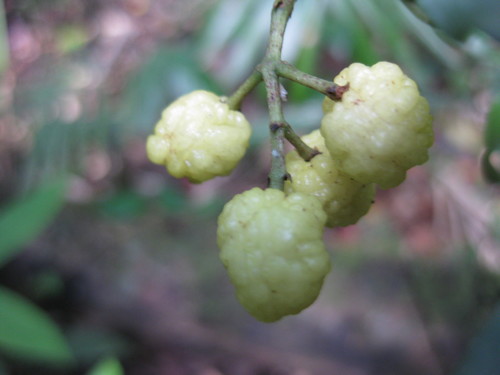
Triphasia trifolia
(Burm.f.) P.Wilson
Lime berry

(c) jovanz7, some rights reserved (CC BY-NC)

(c) Dr M Chin Sue Min, some rights reserved (CC BY-NC), uploaded by Dr M Chin Sue Min

(c) Axelander~commonswiki, some rights reserved (CC BY)
What to Eat
Edible parts: Fruit
The fruit is eaten raw or cooked. Fully ripe, it is red, fleshy, aromatic, juicy, and somewhat mucilaginous with an agreeable sweet flavour. The fruit is about 15mm in diameter and can also be pickled or made into jams.
Where to Find It
A tropical plant. It grows in tropical Asia. They are widely distributed in the settled areas of the Philippines and are sometimes cultivated. Mainly in lowland coastal areas.
Africa, Asia, Bangladesh, Belize, Britain, British Indian Ocean Terr., BIOT, Central America, China*, Cuba, Dominican Republic, Europe, Fiji, Guam, Guiana, Guianas, Guyana, Haiti, Hawaii, India, Indochina, Indonesia, Malaysia, Maldives, Mariana Islands, Mexico, Myanmar, North America, Pacific, Papua New Guinea, PNG, Philippines, Puerto Rico, SE Asia, Sierra Leone, Singapore, South America, Suriname, Thailand, USA, Vietnam, Virgin Islands, West Africa, West Indies,
How to Identify
A small spiny shrub up to 7 m high with slender zigzag twigs. There are 2 spines near each leaf. The leaves have 3 leaflets and are small and dark green with slightly toothed edges. Flowers are in axils of leaves and are white and about 1 cm across. The small berry is green when young and turns red when ripe. They are 1-2 cm across. The skin has glands in it and the 3 sections of the fruit have 1-3 slimy seeds inside.
How to Grow
Plants are grown from seed. It can be grown as a hedge.
Propagation: No specific information is available for this species. It is suggested to sow seed in a warm greenhouse as soon as it is ripe where possible, otherwise in early spring in a warm greenhouse. When large enough to handle, prick seedlings out into individual pots and grow them on in the greenhouse for at least their first two winters. Plant out into permanent positions in late spring or early summer after the last expected frosts, and consider providing cold protection for at least their first winter outdoors.
Medicinal Uses
The leaves are applied to the body to treat diarrhoea, colic, and skin diseases.
Other Uses
The leaves are used as an aromatic bath and as cosmetics. A gum runs from the stem, though no specific uses for this gum are recorded. The plant is noted for being scented.
Wikipedia
Source ↗Triphasia trifolia (syn. Limonia trifolia Burm. f., Triphasia aurantiola Lour.; also called limeberry, lime berry, "sweet lime" or limoncitong kastila) is a species of Triphasia in the family Rutaceae, native to tropical southeastern Asia, especially in Indonesian islands and Philippines and possibly elsewhere. Triphasias are very close relatives of citrus.
Other Information
It is widely cultivated. A minor cultivated fruit in some coastal villages in Papua New Guinea.
Names & Synonyms
Aramaralu, Cheeninaranghi, Chin-ke-limbu, Chinese lime, Jeruk kingkip, Jeruk kingkit, Kaadusirinimbu, Kaliyage, Kingkip, Kudhilunboa, Limau kaya, Limau kelinket, Limau kerisek, Limau kia, Limau kikir, Limau kingkip, Limon china, Limoncillo, Limon-cito, Manao tet, Myrtle-lime, Quum quat
References (36)
- Altschul, S.V.R., 1973, Drugs and Foods from Little-known Plants. Notes in Harvard University Herbaria. Harvard Univ. Press. Massachusetts. no. 1941
- Ambasta, S.P. (Ed.), 2000, The Useful Plants of India. CSIR India. p 652
- Arora, R. K., 2014, Diversity in Underutilized Plant Species - An Asia-Pacific Perspective. Bioversity International. p 90
- Brown, W.H., 1920, Wild Food Plants of the Philippines. Bureau of Forestry Bulletin No. 21 Manila. p 78
- Burkill, H. M., 1985, The useful plants of west tropical Africa, Vol. 4. Kew.
- Burkill, I.H., 1966, A Dictionary of the Economic Products of the Malay Peninsula. Ministry of Agriculture and Cooperatives, Kuala Lumpur, Malaysia. Vol 2 (I-Z) p 2224
- Coronel, R.E., 1982, Fruit Collections in the Philippines. IBPGR Newsletter p 10
- Facciola, S., 1998, Cornucopia 2: a Source Book of Edible Plants. Kampong Publications, p 221
- French, B.R., 1986, Food Plants of Papua New Guinea, A Compendium. Asia Pacific Science Foundation p 233
- Hedrick, U.P., 1919, (Ed.), Sturtevant's edible plants of the world. p 656 (As Triphasia aurantiola)
- Kermath, B. M., et al, 2014, Food Plants in the Americas: A survey of the domesticated, cultivated and wild plants used for Human food in North, Central and South America and the Caribbean. On line draft. p 879
- Kiple, K.F. & Ornelas, K.C., (eds), 2000, The Cambridge World History of Food. CUP p 1802
- Little, E. L., et al, 1974, Trees of Puerto Rico and the Virgin Islands. USDA Handbook 449. Forestry Service. p 334
- Macmillan, H.F. (Revised Barlow, H.S., et al) 1991, Tropical Planting and Gardening. Sixth edition. Malayan Nature Society. Kuala Lumpur. p 311
- Martin, F. W., et al, 1987, Perennial Edible Fruits of the Tropics. USDA Handbook 642 p 75
- Monsalud, M.R., Tongacan, A.L., Lopez, F.R., & Lagrimas, M.Q., 1966, Edible Wild Plants in Philippine Forests. Philippine Journal of Science. p 539
- NYBG herbarium "edible"
- Omawale, 1973, Guyana's edible plants. guyana University, Georgetown p 3
- Pasha, M. K. & Uddin, S. B., 2019, Minor Edible Fruits of Bangladesh. Bangladesh J. Plant Taxon. 26(2): 299–313
- Peekel, P.G., 1984, (Translation E.E.Henty), Flora of the Bismarck Archipelago for Naturalists, Division of Botany, Lae, PNG. p 278, 275
- Phon, P., 2000, Plants used in Cambodia. © Pauline Dy Phon, Phnom Penh, Cambodia. p 608
- Plants for a Future database, The Field, Penpol, Lostwithiel, Cornwall, PL22 0NG, UK. http://www.scs.leeds.ac.uk/pfaf/
- Plants of Haiti Smithsonian Institute http://botany.si.edu/antilles/West Indies
- Purseglove, J.W., 1968, Tropical Crops Dicotyledons, Longmans. p 494
- Reis, S. V. and Lipp, F. L., 1982, New Plant Sources for Drugs and Foods from the New York Botanical Garden herbarium. Harvard. p 145
- Segura, S., et al, 2018, The edible fruit species in Mexico. Genet Resour Crop Evol (2018) 65:1767–1793
- Smith, A.C., 1985, Flora Vitiensis Nova, Lawaii, Kuai, Hawaii, Volume 3 p 514
- Staples, G.W. and Herbst, D.R., 2005, A tropical Garden Flora. Bishop Museum Press, Honolulu, Hawaii. p 510
- Sujanapal, P., & Sankaran, K. V., 2016, Common Plants of Maldives. FAO & Kerala FRI, p 279
- Sukarya, D. G., (Ed.) 2013, 3,500 Plant Species of the Botanic Gardens of Indonesia. LIPI p 729
- Tanaka,
- Topp, J. M. W., 1988, An Annotated Check List of the Flora of Diego Garcia, British Ocean Territory. Atoll Research Bulletin No. 313
- Torreya 9:33. 1909
- USDA, ARS, National Genetic Resources Program. Germplasm Resources Information Network - (GRIN). [Online Database] National Germplasm Resources Laboratory, Beltsville, Maryland. Available: www.ars-grin.gov/cgi-bin/npgs/html/econ.pl (10 April 2000)
- Wiersema, J. H. & Leon, B., 2013, World Economic Plants. A Standard Reference CRC Press. 2nd Ed. p 697
- World Checklist of Useful Plant Species 2020. Royal Botanic Gardens, Kew