Ullucus tuberosus
Caldas
Ulluco
(c) jose_balderrama, some rights reserved (CC BY-NC), uploaded by jose_balderrama

(c) GIANELLA CURASCO HUAMAN, some rights reserved (CC BY-NC)

(c) GIANELLA CURASCO HUAMAN, some rights reserved (CC BY-NC)
What to Eat
Edible parts: Leaves, Tubers, Root, Vegetable
The tubers are eaten cooked; they are starchy and mucilaginous and can grow up to 8cm long. Ulluco is a staple food in South America and is prepared in most of the ways that potatoes are, tasting very much like potato when boiled and fried. In the Andes, a popular dish called 'chuño' is made by alternately freezing and drying the tubers. The tubers contain approximately 14% carbohydrate, 1–2% protein, and almost no fat or fibre. They are a reasonable source of vitamin C at around 23mg per 100g fresh weight. Tubers store well and last up to 12 months under cool conditions. The leaves can be eaten raw or cooked; they are mucilaginous and not particularly exciting, but contain about 12% protein by dry weight.
Where to Find It
A tropical plant. It grows well in cool moist climates in the tropics. It will probably suit high altitude places. In the Andes it grows at altitudes of 1,000-4,000 m. It can stand light frosts. It shows drought resistance and has low fertility demands. It gives low tuber yields under long day conditions.
Andes, Argentina, Bolivia, Central America, Chile, Colombia, Ecuador, New Zealand, Nicaragua, Pacific, Papua New Guinea, PNG, Peru, South America, Venezuela,
How to Identify
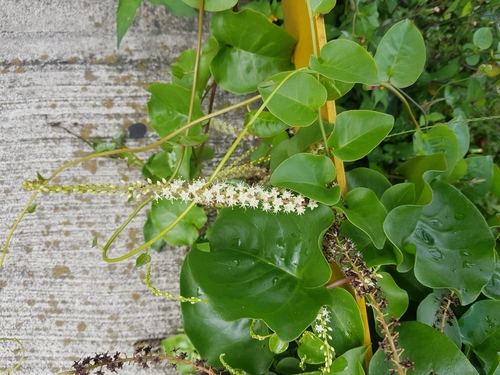
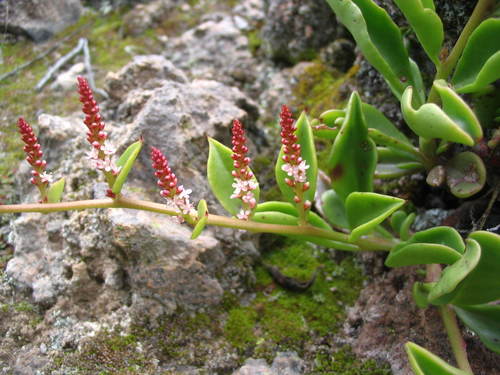
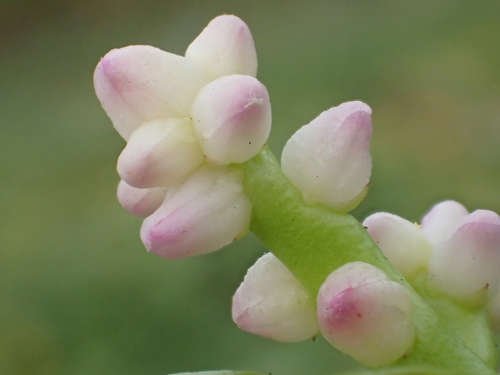
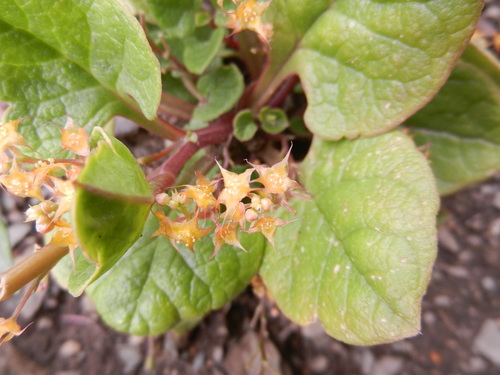
A small herb with creeping pink stems. It is erect and compact. It puts up branches which can be 30-50 cm high. The stems form roots where they touch the ground. At the end of its growth plants are lying along the ground. The leaves are broad and heart shaped. In some kinds the leaves have red spots or a reddish blue edge. Small tubers form on the ends of the roots. Often they are yellow but shape and colour vary with variety. Flowers are in the axils of leaves. They are small and star shaped. Seeds are occasionally produced in a triangular capsule. These seeds will grow after their dormancy period has passed (2-3 months). Aerial tubers sometimes also occur. There are about 50-70 cultivated varieties.
Nutrition Score: 5/100
| Part | Moisture | kJ | kcal | Protein | Vit A | Vit C | Iron | Zinc |
|---|---|---|---|---|---|---|---|---|
| Tuber | 80 | — | — | 1 | — | — | — | — |
How to Grow
Prefers a rich light soil with plenty of leaf mould. Produces reasonable yields in marginal soils. Established plants are moderately drought tolerant. Prefers a pH in the range 5.5 to 6.5. Ulluco is often cultivated for its edible tubers in S. America, it has been tried, unsuccessfully, as a potato substitute in Britain. It is about as hardy as the potato plant in Britain, the foliage withstanding light frosts and the tubers tolerating colder conditions. One report says that plants are very frost-resistant but that has not been our experience. The tubers are not formed until late in the season so a mild autumn is required for good yields. The tubers are formed at the roots and also from shoots growing out of the leaf axils and into the soil. Earthing up the stems as tubers form in late summer can improve yields. Average yields are 5 - 9 tonnes per hectare but there is a lot of potential to increase this Slugs are very fond of this plant and will soon completely destroy it if given a chance. Plants do not usually produce fertile seed but researchers in Finland have obtained seed under controlled circumstances.
Propagation: Seed propagation information is lacking for this species, but seed could be tried in a warm greenhouse in early spring — prick out seedlings into individual pots as soon as large enough to handle and grow on in pots in the greenhouse or plant into greenhouse soil for the first year. Division of tubers in late autumn is straightforward: harvest after the top growth has been killed by autumn frosts, store in a cool but frost-free place over winter, and plant out in April. Cuttings taken in summer are very easy — a stem with just one leaf node is sufficient for rooting.
Medicinal Uses
No medicinal uses are currently known for this species.
Other Uses
No other uses are currently known for this species.
Wikipedia
Source ↗Perennial herb reaching 0.3m tall. Hardy to UK zone 9 and frost tender. Hermaphrodite flowers. Grows in light sandy and medium loamy soils tolerating nutritionally poor conditions. Adapts to mildly acid, neutral, and mildly alkaline pH. Requires full sun and prefers moist soil though can tolerate some drought.
Production
Tubers mature in about 4-6 months but can be 7-8 months. It the dry high altitude Andes tubers are frozen then dried.
Other Information
It is a commercially cultivated vegetable. One variety has been introduced and is being tried out in Papua New Guinea. It is an important food plant in the Andes, especially Peru. 30,000 tons are sold in local markets each year in Peru.
Names & Synonyms
Chigua, Chugua, Chuguas, Hubas, Illako, Melloco, Melloco, Michini, Michurui, Micuche, Miguri, Muchuchi, Oca quina, Olloco, Olluco, Papa lisa, Papas lisas, Ruba, Rubia, Ryba, Timbos, Tiquino, Ullucu, Ulluma, Zanahoria lisas
References (31)
- Castillo, R. O., 1995, Plant Genetic Resources in the Andes: Impact, Conservation, and Management. Crop Science 35:355-360
- Facciola, S., 1998, Cornucopia 2: a Source Book of Edible Plants. Kampong Publications, p 47
- Franquemont, C., et al, 1990, The Ethnobotany of Chinchero, an Andean Community in Southern Peru. Fieldiana Botany No. 24 p 43
- French, B.R., 1986, Food Plants of Papua New Guinea, A Compendium. Asia Pacific Science Foundation p 24
- Hermandez Bermejo, J.E., and Leon, J. (Eds.), 1994, Neglected Crops. 1492 from a different perspective. FAO Plant Production and Protection Series No 26. FAO, Rome. p18, 159
- Heywood, V.H., Brummitt, R.K., Culham, A., and Seberg, O. 2007, Flowering Plant Families of the World. Royal Botanical Gardens, Kew. p 57
- Kay, D.E., 1973, Root Crops, Digest 2, Tropical Products Institute, London, p 183
- Kays, S. J., and Dias, J. C. S., 1995, Common Names of Commercially Cultivated Vegetables of the World in 15 languages. Economic Botany, Vol. 49, No. 2, pp. 115-152
- Kermath, B. M., et al, 2014, Food Plants in the Americas: A survey of the domesticated, cultivated and wild plants used for Human food in North, Central and South America and the Caribbean. On line draft. p 887
- Kew Plants of the World Online
- Kiple, K.F. & Ornelas, K.C., (eds), 2000, The Cambridge World History of Food. CUP p 1874
- Lim, T. K., 2015, Edible Medicinal and Non Medicinal Plants. Volume 9, Modified Stems, Roots, Bulbs. Springer p 84
- Macmillan, H.F. (Revised Barlow, H.S., et al), 1991, Tropical Planting and Gardening. Sixth edition. Malayan Nature Society. Kuala Lumpur. p 366
- Martin, F.W. & Ruberte, R.M., 1979, Edible Leaves of the Tropics. Antillian College Press, Mayaguez, Puerto Rico. p 182
- Plants for a Future database, The Field, Penpol, Lostwithiel, Cornwall, PL22 0NG, UK. http://www.scs.leeds.ac.uk/pfaf/
- PROSEA handbook Volume 9 Plants yielding non-seed carbohydrates. p 182
- Purseglove, J.W., 1968, Tropical Crops Dicotyledons, Longmans. p 628
- Semanario nueva reyno Grenada 185. 1809 [As Caldas]
- Smith, P.M., 1979, Ullucu, in Simmonds, N.W., (ed), Crop Plant Evolution. Longmans. London. p 303 and (Also as Ullucus aborigineus)
- Smith, K., 1998. Growing Uncommon Fruits and Vegetables. New Holland. p 33
- Smith, N., Mori, S.A., et al, 2004, Flowering Plants of the Neotropics. Princeton. p 45
- Tapia, M. E., The role of under-utilised plant species with regard to increased food security and improved health of poor poeople, in mountain regions. IIAP-PNUD/Peru
- Terra, G.J.A., 1973, Tropical Vegetables. Communication 54e Royal Tropical Institute, Amsterdam, p 80
- Thomas, E., et al, 2008, The Relationship Between Plant Use and Plant Diversity in the Bolivian Andes, with Special Reference to Medicinal Plant Use. Hum Ecol (2008) 36:861–879
- Tindall, H.D., 1983, Vegetables in the tropics. Macmillan p. 71
- Torre, de la L., et al, 2008, Enciclopedia de las Plantas Útiles del Ecuador. Herbario QCA. Pontificia Universidad Católica del Ecuador. p 238
- Ulian, T., et al, 2020, Unlocking plant resources to support food security and promote sustainable agriculture. Plants, People, Planet. 2020;2:421–445.
- USDA, ARS, National Genetic Resources Program. Germplasm Resources Information Network - (GRIN). [Online Database] National Germplasm Resources Laboratory, Beltsville, Maryland. Available: www.ars-grin.gov/cgi-bin/npgs/html/econ.pl (10 April 2000)
- van Wyk, B., 2005, Food Plants of the World. An illustrated guide. Timber press. p 371
- Wiersema, J. H. & Leon, B., 2013, World Economic Plants. A Standard Reference CRC Press. 2nd Ed. p 704
- World Checklist of Useful Plant Species 2020. Royal Botanic Gardens, Kew