Urceola lucida
(A. DC.) Benth. ex Kurz
ApocynaceaeFruit
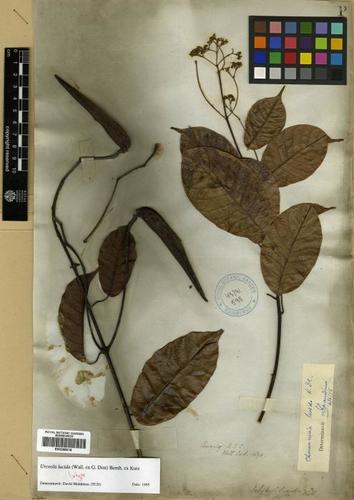
iNaturalist · cc-by-nc
(c) Royal Botanic Garden Edinburgh, some rights reserved (CC BY-NC)
(c) Royal Botanic Garden Edinburgh, some rights reserved (CC BY-NC)
What to Eat
Edible parts: Fruit
The curved fruits are edible and traditionally used as a substitute for tamarind.
Where to Find It
A tropical plant. It grows in forests up to 900 m above sea level.
Asia, India, Indochina, Indonesia, Malaysia, Myanmar, SE Asia, Singapore,
Countries: United Arab Emirates, Afghanistan, Armenia, Azerbaijan, Bangladesh, Bahrain, Brunei, Bhutan, China, Georgia, Indonesia, Israel, India, Iraq, Iran, Jordan, Japan, Kyrgyzstan, Cambodia, North Korea, South Korea, Kuwait, Kazakhstan, Laos, Lebanon, Sri Lanka, Myanmar, Mongolia, Maldives, Malaysia, Nepal, Oman, Philippines, Pakistan, Qatar, Saudi Arabia, Singapore, Syria, Thailand, Tajikistan, Timor-Leste, Turkmenistan, Turkey, Taiwan, Uzbekistan, Vietnam, Yemen
How to Identify
An evergreen climbing shrub. The leaves are papery and narrowly oval. They are 10-14 cm long. The flowers are in panicles in the axils of leaves and at the ends of branches. The fruit are curved follicles.
How to Grow
Plants can be grown from seed.
Other Uses
The latex contains 55 - 83% crude rubber known as 'Rangoon rubber'.
Names & Synonyms
Kyet-paung
Chavannesia esculenta A. DC.Urceola esculenta (A. DC.) Benth. ex Kurzand others
References (3)
- Ambasta, S.P. (Ed.), 2000, The Useful Plants of India. CSIR India. p 662 (As Urceola esculenta)
- Forest. fl. Burma 2:184. 1877 (As Urceola esculenta)
- Macmillan, H.F. (Revised Barlow, H.S., et al) 1991, Tropical Planting and Gardening. Sixth edition. Malayan Nature Society. Kuala Lumpur. p 311 (As Urceola esculenta)


