Acacia notabilis
F. Muell.
Black wattle, Flinder’s wattle

(c) ozzielabrat, some rights reserved (CC BY-NC), uploaded by ozzielabrat
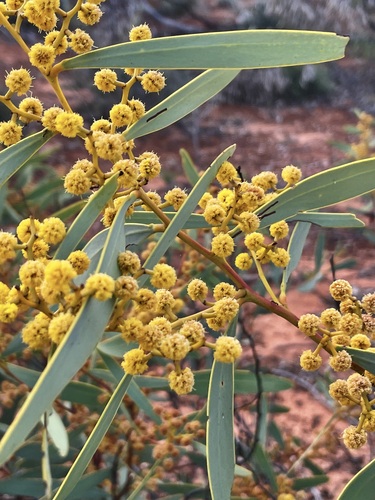
(c) Dr Manfred Jusaitis, some rights reserved (CC BY-NC), uploaded by Dr Manfred Jusaitis

(c) Asimakis Patitsas, some rights reserved (CC BY-NC), uploaded by Asimakis Patitsas
What to Eat
Edible parts: Seeds
The seeds are eaten.
Where to Find It
It occurs naturally in Australia. It prefers medium to light soils. It requires an open sunny position. It is drought and frost resistant. It suits hot dry locations. It grows in areas with rainfall between 25 and 50 mm. In the Inland Botanical Gardens Mildura.
Australia*,
How to Identify
A shrub or small tree. It grows 5 m tall. There are prickles along the stem. The leaves are twice divided and there are 8-18 pairs of pinnae. There are up to 50 pairs of pinnules on each pinnae. The flowers are yellow. They are in large clusters at the ends of branches. The pods are flattened.
How to Grow
It is grown from seed. The seed need treatment to break the hard seed coat. Normally this is by putting the seeds in very hot water and letting the water cool down overnight then planting the seeds immediately.
Wikipedia
Source ↗Acacia notabilis, known colloquially as mallee golden wattle, Flinders wattle or stiff golden wattle, is a species of Acacia native to Australia.
Notes
There are about 1,350 Acacia species. Over 1,000 occur in Australia. Also as Mimosaceae.
Names & Synonyms
Notable Wattle, Stiff Golden Wattle
References (8)
- Bodkin, F., 1991, Encyclopedia Botanica. Cornstalk publishing, p 27
- Cherikoff V. & Isaacs, J., The Bush Food Handbook. How to gather, grow, process and cook Australian Wild Foods. Ti Tree Press, Australia p 42, 188
- Dashorst, G.R.M., and Jessop, J.P., 1998, Plants of the Adelaide Plains & Hills. Botanic Gardens of Adelaide and State Herbarium. p 78
- Elliot, W.R., & Jones, D.L., 1982, Encyclopedia of Australian Plants suitable for cultivation. Vol 2. Lothian. p 90
- Fragm. 1:6. 1858
- Hall, N. et al, 1972, The Use of Trees and Shrubs in the Dry Country of Australia, AGPS, Canberra. p 348
- Lord, E.E., & Willis, J.H., 1999, Shrubs and Trees for Australian gardens. Lothian. p 40
- World Checklist of Useful Plant Species 2020. Royal Botanic Gardens, Kew