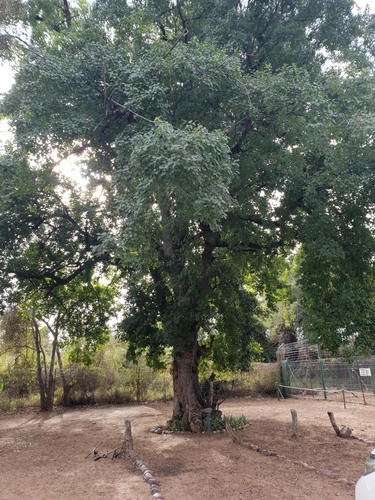
Ventilago denticulata
Willd.
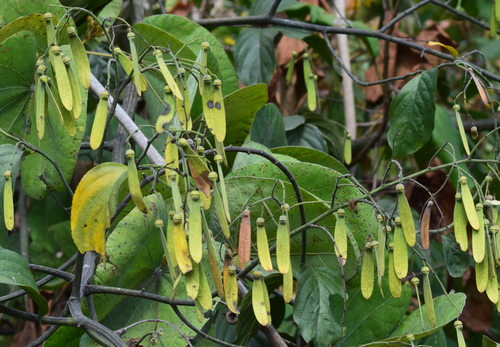
(c) Aniruddha Singhamahapatra, some rights reserved (CC BY-NC), uploaded by Aniruddha Singhamahapatra
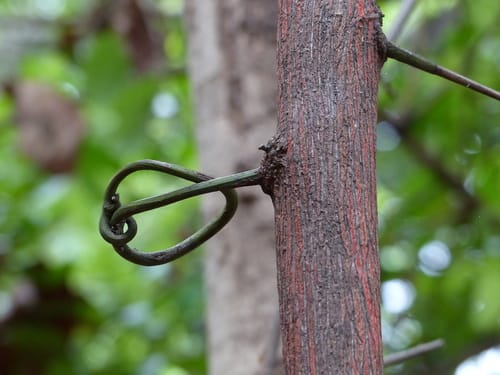
(c) Radha Veach, some rights reserved (CC BY-NC)
What to Eat
Edible parts: Seeds - oil, Seeds, Root
The seeds are cooked and eaten, and a fatty oil extracted from the seeds is used for cooking.
Where to Find It
It grows in the tropics. It grows up to 400 m above sea level.
Asia, Bhutan, China, Himalayas, India, Indochina, Laos, Myanmar, Nepal, Northeastern India, SE Asia,
How to Identify
A woody climber or shrub. The stems are ribbed. The branches have fine hairs. The leaves are narrowly oval and 4-13 cm long by 3-6 cm wide. They taper to the tip. There are rounded teeth along the edge. The young leaves are hairy. The fruit are about 2.5 cm long. The nut is 5-6 mm across and the lower half is enclosed in a cup. It has wings.
Wikipedia
Source ↗Ventilago denticulata is a species of tree with a wide distribution in East, Southeast, and South Asia, and including in Indo-China, China (Guangxi, Guizhou, and Yunnan), and most of India.
Notes
There are 30-40 Ventilago species.
Names & Synonyms
Birmanal, Bong-asarjom, Deosarai, Errashiratalatige, Gapsandiballi, Harug tsuratichekka, Kala lag, Kalibel, Kantamali, Karkandichayeh, Kayel, Keonti, Kuriyadi, Pitti, Pittoli, Raidhani, Raktapita, Ruktupita, Sakalyel, Sanga-sarjom, Suratchekka, Tar, Verrachictali
References (5)
- Ambasta, S.P. (Ed.), 2000, The Useful Plants of India. CSIR India. p 670
- Dey, A. & Mukhererjee, A., 2015, Living and Survival Amidst Hunger: Wild Edible Botanicals as a Prime Forest Productivity in the Rural Purulia District, West Bengal, India from Colonial to Present. Research Journal of Forestry 9(3): 71-86 (As Ventilago calyculata)
- Ges. Naturf. Freunde Berlin Neue Schriften 3:417. 1801
- Kahlon, L. K. & Singh, R., 2019, Traditional knowledge & Dynamics of edible plants of primitive tribal group ‘Paudi Bhuyan’ with changing demography migration patterns in Northern Odisha. Indian Journal of Traditional Knowledge Vol 18(1), pp 7-15
- Pandy, R. K. & Saini, S. K., 2007, Edible plants of tropical forests among tribal communities of Madhya Pradesh. Indian Journal of Traditional Knowledge. 6(1), pp 185-190