Vicia bungei
Ohwi
Three-toothed wild pea

(c) Chuangzao, some rights reserved (CC BY-NC), uploaded by Chuangzao

(c) Zinogre, some rights reserved (CC BY-SA)
What to Eat
Edible parts: Leaves
The young plant is used as a potherb, and the leaves are edible.
Where to Find It
It is a temperate plant. In China it grows on sandy and rocky sea shores and mountain slopes. It grows from sea level to 4,200 m above sea level. In Sichuan and Yunnan.
Asia, China, Korea, Manchuria,
How to Identify
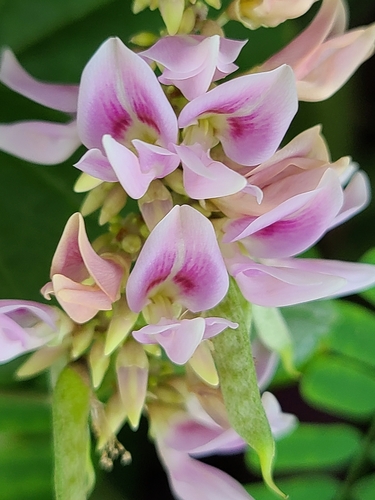
A climber. It grows 20-40 cm high. The stems are slender. The are 4 sides and branched. The leaves have leaflets along the stalk. There is a tendril at the end. There are 6-10 leaflets and they are oblong and 1-3 cm long by 3-8 mm wide. The flowers are purple-blue. The pods are flat and oblong. They are 3-4 cm long by 6-8 mm wide. There are 3-8 seeds. They are 3 mm across.
Medicinal Uses
The young plant has traditional uses as a potherb.
Notes
There are about 140 Vicia species. They are mostly temperate.
Names & Synonyms
References (2)
- Hu, Shiu-ying, 2005, Food Plants of China. The Chinese University Press. p 486
- Plants for a Future database, The Field, Penpol, Lostwithiel, Cornwall, PL22 0NG, UK. http://www.scs.leeds.ac.uk/pfaf/