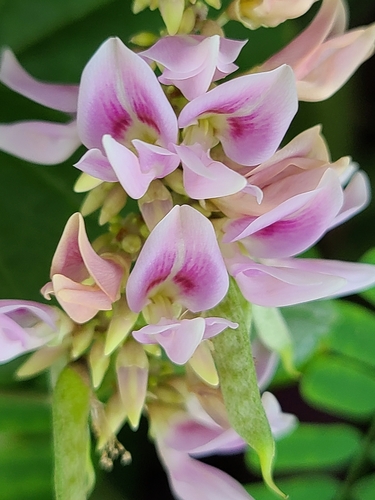
Vigna lanceolata
Benth.
Bush potato, Pencil yam, Maloga bean

(c) Zig Madycki, some rights reserved (CC BY-NC-ND), uploaded by Zig Madycki
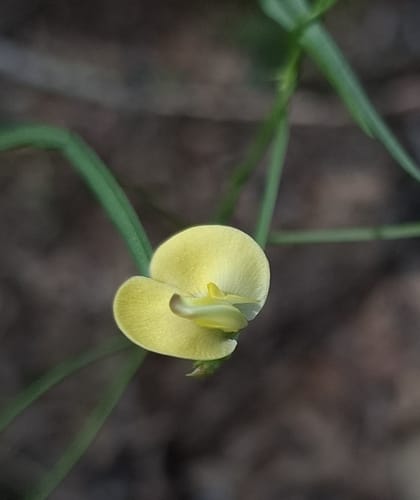
(c) Karl Tattersall, some rights reserved (CC BY-SA)
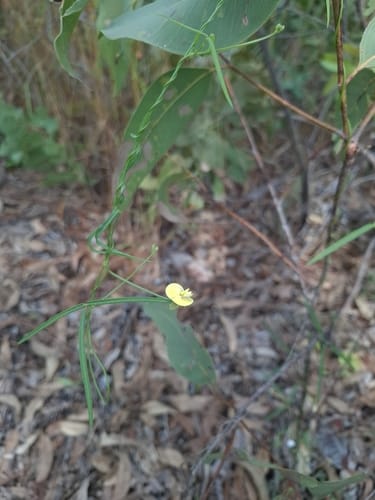
(c) Karl Tattersall, some rights reserved (CC BY-SA)
What to Eat
Edible parts: Root, Pods
The tuber is peeled and cooked before eating. The pods are also edible.
Where to Find It
A tropical plant. It grows in monsoon forest and woodland. In tropical Queensland it grows from sea level to 840 m altitude. It can grow in arid places.
Australia*,
How to Identify
A climbing plant. There is a tuber under the ground from which the shoots re-grow each year. The stems can have a few hairs. The leaves are compound and alternate. The leaf stalks are 2-6 mm long. The leaflets are 2-10 cm long and 1-3 cm wide. They can have hairs. The midrib on the upper side is often silver coloured. The flowers are in a group in the axils of leaves. The flowers are yellow or pale purple. The standard is 6-10 mm long. The fruit is a pod. It is green with dark mottles. The pod is 2-5 cm long and 3-6 mm wide. There are 3-8 seeds.
Nutrition Score: 42/100
| Part | Moisture | kJ | kcal | Protein | Vit A | Vit C | Iron | Zinc |
|---|---|---|---|---|---|---|---|---|
| Bean | 78.3 | 336 | 80 | 2.4 | — | 1 | — | — |
| Root | 78.6 | 295 | 71 | 2.3 | — | 1 | 15.4 | 0.6 |
Wikipedia
Source ↗Vigna lanceolata, known as the pencil yam, native bean, Maloga bean, parsnip bean, Ngarlajiyi, small yam, yam, bush carrot, Wapurtali, Wapirti, and Wajaraki is an Australian native plant. Its name in the Arrernte language of Central Australia is Merne arlatyeye. Bush carrot is an important bush tucker food for Australian Aboriginal people, and there are many Dreaming rituals around it. It is still commonly eaten in the desert today. It is a slender twining plant with yellow pea flowers throughout the year. Aboriginal people from the desert dig them up in creekbeds. They look for the white roots, then cook them in the hot earth beside the fire until they are just firm. Esteemed artist Emily Kngwarreye had an individual Dreaming around the pencil yam. This meant she had been given stories about the origins of the pencil yam, and was entitled to tell these stories and paint the yam.
Notes
There are about 150 Vigna species. They are mostly in the tropics.
Names & Synonyms
Arlatyey, Barddjubarr, Limbuk, Gingin, Maloga Vigna, Mili
References (33)
- Bindon, P., 1996, Useful Bush Plants. Western Australian Museum. p 262
- Cherikoff V. & Isaacs, J., The Bush Food Handbook. How to gather, grow, process and cook Australian Wild Foods. Ti Tree Press, Australia p 191
- Cooper, W. and Cooper, W., 2004, Fruits of the Australian Tropical Rainforest. Nokomis Editions, Victoria, Australia. p 218
- Crawford, I. M., 1982, Traditional Aboriginal Plant Resources in the Kalumburu Area: Aspects in Ethno-economics. Records of the Western Australian Museum Supplement No. 15
- Cribb, A.B. & J.W., 1976, Wild Food in Australia, Fontana. p 144
- Dunlop, C.R., Leach, G.J. & Cowie, I.D., 1995, Flora of the Darwin Region. Vol 2. Northern Territory Botanical Bulletin No 20. p 113
- Garde, M., et al, 2003, A Preliminary List of Kundedjnjenghmi Plant Names. Northern Land Council. (Arnhem Land, Australia)
- Green, J., (Ed.), 2003, Anmatyerr Plant Stories. AID Press. p 2
- Hardwick, G., 2001, Economically Useful Plants for Northern Australia: Master Species List. Crusader eBooks.
- Hedrick, U.P., 1919, (Ed.), Sturtevant's edible plants of the world. p 679
- Hiddins, L., 1999, Explore Wild Australia with the Bush Tucker Man. Penguin Books/ABC Books. p 150
- Isaacs, J., 1987, Bush Food, Aboriginal Food and Herbal Medicine. Weldons. p 97
- Jones, D.L. & Gray, B., 1977, Australian Climbing Plants. Reed. p 61
- Kenneally, K.E., Edinger, D. C., and Willing T., 1996, Broome and Beyond, Plants and People of the Dampier Peninsula, Kimberley, Western Australia. Department of Conservation and Land Management. p 162
- Kiple, K.F. & Ornelas, K.C., (eds), 2000, The Cambridge World History of Food. CUP p 1808
- Latz, P.K., 1996, Bushfires and Bushtucker: Aboriginal plant use in Central Australia. IAD Press Alice Springs p 296
- Latz, P & Wightman, G., 1995, Desert Bush Tucker Identikit. Common Native Food Plants of Central Australia. Parks & Wild Commission Northern territory. p 44
- Lazarides, M. & Hince, B., 1993, Handbook of Economic Plants of Australia, CSIRO. p 246
- Levitt, D., 1981, Plants and people. Aboriginal uses of plants on Groote Eylandt. Australian Institute of Aboriginal Studies, Canberra. p 115 (As var. filiformis)
- Lim, T. K., 2015, Edible Medicinal and Non Medicinal Plants. Volume 9, Modified Stems, Roots, Bulbs. Springer p 85
- Low, T., 1991, Wild Food Plants of Australia. Australian Nature FieldGuide, Angus & Robertson. p 162
- Low, T., 1992, Bush Tucker. Australia’s Wild Food Harvest. Angus & Robertson. p 98, 99
- T. L. Mitchell, J. exped. trop. Australia 350. 1848
- Paczkowska, G . & Chapman, A.R., 2000, The Western Australian Flora. A Descriptive Calatogue. Western Australian Herbarium. p 453
- Macmillan, H.F. (Revised Barlow, H.S., et al) 1991, Tropical Planting and Gardening. Sixth edition. Malayan Nature Society. Kuala Lumpur. p 330
- RIRDC, 2010, New Root Vegetables for the Native Food Industry, Australian Government RIRDC Publication 9/161
- Smith, Nicholas et al. 1993, Ngarinyman Ethnobotany: Aboriginal Plant Use from the Victoria River Area Northern Australia. Northern Territory Botanical Bulletin No 16. Parks and Wildlife Commission of the Northern Territory. p 47
- Vigilante, T., et al, 2013, Island country: Aboriginal connections, values and knowledge of the Western Kimberley islands in the context of an island biological survey. Records of the Western Australian Museum Supplement 81: 145-182
- Wheeler, J.R.(ed.), 1992, Flora of the Kimberley Region. CALM, Western Australian Herbarium, p 456
- Wightman, Glenn et al. 1994, Gurindji Ethnobotany: Aboriginal Plant Use from Daguragu Northern Australia. Northern Territory Botanical Bulletin No 18. Parks and Wildlife Commission of the Northern Territory. p 53
- Wightman, Glenn et al. 1992. Mudburra Ethnobotany: Aboriginal Plant Use from Kulumindini (Elliott) Northern Australia. Northern Territory Botanical Bulletin No 14. Parks and Wildlife Commission of the Northern Territory. p 33.
- World Checklist of Useful Plant Species 2020. Royal Botanic Gardens, Kew
- Yunupinu Banjgul, Laklak Yunupinu-Marika, et al. 1995, Rirratjinu Ethnobotany: Aboriginal Plant Use from Yirrkala, Arnhem Land, Australia. Northern Territory Botanical Bulletin No 21. Parks and Wildlife Commission of the Northern Territory. p 76.