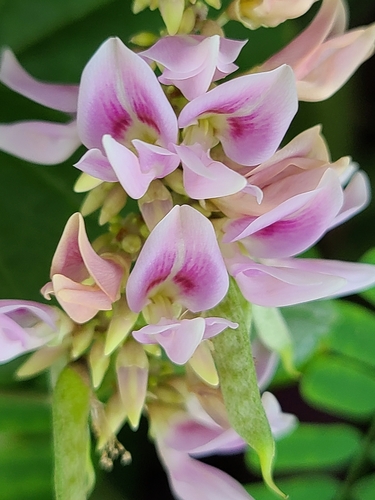
Vigna mungo
(L.) Hepper
Mung bean, Urd, Black gram

no rights reserved, uploaded by S.MORE
(c) along2022, some rights reserved (CC BY-NC)
(c) along2022, some rights reserved (CC BY-NC)
What to Eat
Edible parts: Leaves, Seeds, Pods, Vegetable
Young seedpods are cooked and used as a vegetable; they measure approximately 40–70mm long and 5mm wide. The dried seeds are boiled and used in a variety of recipes, or ground into a flour as a protein-enhancing additive for bread and similar foods. In India they are an essential ingredient of idli and dosa — acid-leavened fermented cakes made from rice and dhal. The ellipsoid seeds, usually black and up to 5mm long, are the primary edible part. Young leaves are also eaten.
Where to Find It
A tropical plant. Mainly coastal but probably will grow up to 1800 m altitude in the tropics. It suits dry areas. It is drought resistant. It is grown in areas with rainfall of 900 mm per year. It cannot stand frost or long periods of cloud. It is not suited to the wet tropics. In Nepal they grow to 2000 m altitude. It suits hardiness zones 10-12.
Afghanistan, Africa, Asia, Australia, Bangladesh, Central Africa, Central Asia, Congo, Cuba, East Africa, East Timor, Egypt, Fiji, Gabon, Himalayas, India, Indochina, Iran, Japan, Kenya, Madagascar, Malawi, Marianas, Mauritius, Middle East, Mozambique, Myanmar, Nepal, North Africa, Northeastern India, Pacific, Pakistan, Papua New Guinea, PNG, Pakistan, Philippines, SE Asia, Sikkim, Solomon Islands, South Africa, Southern Africa, Sri Lanka, Sudan, Tajikistan, Tanzania, Timor-Leste, Uganda, Vanuatu, Vietnam, West Indies,
How to Identify
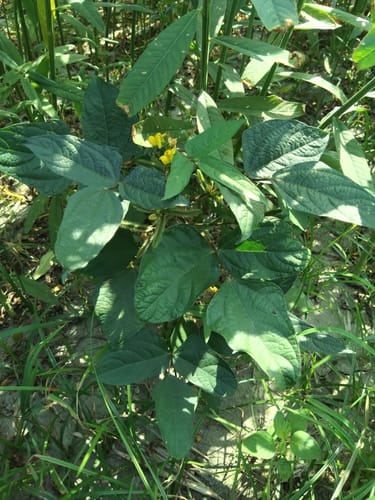
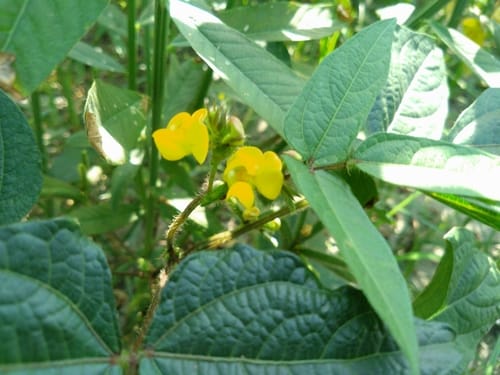
A small annual bean with hairy pods. It is an erect herb 20-80 cm tall. Sometimes the stems are twining. The stems have dense yellow or rusty hairs. Leaves have 3 leaflets. The leaflets are oval and 3-10 cm long by 1-5.5 cm wide. The leaf stalks are long but the leaflets stalks are short. Flowers are yellow. They are 1-2 cm long in dense flower clusters. The fruit is a pod 4-7 cm long. They are 5-6 mm wide. Seeds are small and black. There are 4 to 10 seeds per pod. Seeds are 4-4.5 mm long by 4 mm wide. They have square ends.
Nutrition Score: 64/100
| Part | Moisture | kJ | kcal | Protein | Vit A | Vit C | Iron | Zinc |
|---|---|---|---|---|---|---|---|---|
| Seeds - raw | 12 | 981 | 235 | 22 | 24 | — | 8 | — |
| Seeds young sprouted cooked | 93.4 | 88 | 21 | 2 | 1 | 11.4 | 0.7 | 0.5 |
How to Grow
It is grown from seed. Seed collection is easy. Seed can be broadcast or sown as individual plants 25 cm apart.
Propagation: Pre-soak seed for 12 hours in warm water and sow in situ. The seed generally sprouts within 7–10 days.
Medicinal Uses
In traditional medicine, the seed is valued for its suppurative, cooling, and astringent properties. It is ground into a powder, moistened, and applied as a poultice on abscesses.
Other Uses
Plants are grown as a green manure, and are commonly intercropped in the wet season in India with sugar cane, cotton, groundnut, sorghum, or pigeon pea. In the dry season the plant is often sole cropped on rice fallow. The seed flour is rich in saponins and can be used as a soap substitute, leaving skin smooth and soft.
Wikipedia
Source ↗The black gram or urad bean (Vigna mungo) is a bean grown in South Asia. Like its relative the mung bean, it has been reclassified from the genus Phaseolus to Vigna. The product sold as black gram is usually the whole urad bean, whereas the split bean (the interior being white) is called white lentil. It should not be confused with the much smaller true black lentil (Lens culinaris). Black gram originated in South Asia, where it has been in cultivation from ancient times and is one of the most highly prized pulses of India. It is very widely used in Indian cuisine. In India the black gram is one of the important pulses grown in both kharif and rabi seasons. This crop is extensively grown in the southern part of India and the northern part of Bangladesh and Nepal. In Bangladesh and Nepal it is known as mash daal. It is a popular daal (legume) side dish in South Asia that goes with curry and rice as a platter. Black gram has also been introduced to other tropical areas such as the Caribbean, Fiji, Mauritius, Myanmar and Africa mainly by Indian immigrants during the Indian indenture system.
Production
Flowering commences after 6 weeks. Plants are self pollinated. Pods are ready to harvest 2 to 4 months after planting. Pods shatter easily. It is easiest to pull the whole plant, dry them for a week then thresh out the seeds. Seed yields of 450-560 kg per hectare after 80-120 days are common. 100 seeds weigh about 4 g.
Other Information
It is a commercially cultivated vegetable. It is being encouraged and grown in a number of coastal areas in Papua New Guinea. It is a very important crop in India for dahl and porridge.
Notes
There are about 150 Vigna species. They are mostly in the tropics.
Names & Synonyms
Adad, Akwa sos, Arad, Banmasyang, Dau muong-an, Dengu, Karu-minimulu, Maga, Mas, Mash kalai, Masha, Matimah, Mat-pe, Minumulu, Nallaminumulu, Pani-payir, Tikari kalai, Uddu, Udid, Ulundu, Ullundu, Undu, Urad, Urd dhal, Urdi, Uzhunnu
References (42)
- Ambasta, S.P. (Ed.), 2000, The Useful Plants of India. CSIR India. p 677
- Burkill, I.H., 1966, A Dictionary of the Economic Products of the Malay Peninsula. Ministry of Agriculture and Cooperatives, Kuala Lumpur, Malaysia. Vol 2 (I-Z) p 1739 (As Phaseolus mungo)
- Cobley, L.S. (rev. Steele, W.M.) 2nd Ed., 1976, An Introduction to the Botany of Tropical Crops. Longmans. p 95
- Cundall, P., (ed.), 2004, Gardening Australia: flora: the gardener's bible. ABC Books. p 1471
- Dangol, D. R., 2002, Economic uses of forest plant resources in western Chitwan, Nepal. Banko Janakari, 12(2): 56-64 (As Phaseolus mungo)
- Facciola, S., 1998, Cornucopia 2: a Source Book of Edible Plants. Kampong Publications, p 112
- FAO, 1988, Traditional Food Plants, FAO Food and Nutrition Paper 42. FAO Rome p 498
- Flora of Pakistan. www.eFloras.org
- French, B.R., 1986, Food Plants of Papua New Guinea, A Compendium. Asia Pacific Science Foundation p 45
- French, B.R., 2010, Food Plants of Solomon Islands. A Compendium. Food Plants International Inc. p 60
- Hedrick, U.P., 1919, (Ed.), Sturtevant's edible plants of the world. p 480 (As Phaseolus mungo)
- ILDIS Legumes of the World http:www:ildis.org/Legume/Web
- Jansen, P.C.M., 2006. Vigna mungo (L.) Hepper. [Internet] Record from Protabase. Brink, M. & Belay, G. (Editors). PROTA (Plant Resources of Tropical Africa), Wageningen, Netherlands. < http://database.prota.org/search.htm>. Accessed 23 October 2009
- Jardin, C., 1970, List of Foods Used In Africa, FAO Nutrition Information Document Series No 2.p 30, 109
- Jha, P. K., et al, 1996, Plant genetic resources of Nepal: A guide for plant breeders of agricultural, horticultural and forestry crops. Euphytica 87:189-210
- Kays, S. J., and Dias, J. C. S., 1995, Common Names of Commercially Cultivated Vegetables of the World in 15 languages. Economic Botany, Vol. 49, No. 2, pp. 115-152
- Kermath, B. M., et al, 2014, Food Plants in the Americas: A survey of the domesticated, cultivated and wild plants used for Human food in North, Central and South America and the Caribbean. On line draft. p 910
- Kew Bull. 11:128. 1956
- Khanal, R., et al, 2014, Documenting abundance and use of underutilized plant species in the mid hill region of Nepal. ECOPRINT 21: 63-71, 2014
- Kohila, A. & Kensa, V. M., 2019, Survey of Wild Edible Plants of Dhanakarkulam Panchayath, Tirunelveli District, Tamil Nadu, India. Kong. Res. J. 6(2): 20-27, 2019
- Lazarides, M. & Hince, B., 1993, Handbook of Economic Plants of Australia, CSIRO. p 246
- Macmillan, H.F. (Revised Barlow, H.S., et al) 1991, Tropical Planting and Gardening. Sixth edition. Malayan Nature Society. Kuala Lumpur. p 330
- Manandhar, N.P., 2002, Plants and People of Nepal. Timber Press. Portland, Oregon. p 476
- Martin, F.W. & Ruberte, R.M., 1979, Edible Leaves of the Tropics. Antillian College Press, Mayaguez, Puerto Rico. p 201
- Medhi, P. & Borthakur, S. K., 2012, Phytoresources from North Cachur Hills of Assam -3: Edible plants sold at Hflong market. Indian Journal or Natural Products and Resources. 3(1) pp 84-109 (As Phaseolus mungo)
- Pham-Hoang Ho, 1999, An Illustrated Flora of Vietnam. Nha Xuat Ban Tre. p 958
- Polunin, O., & Stainton, A., 2006, Flowers of the Himalaya, Oxford India Paperbacks. p 101
- Purseglove, J.W., 1968, Tropical Crops Dicotyledons, Longmans. p 301
- Rajapaksha, U., 1998, Traditional Food Plants in Sri Lanka. HARTI, Sri Lanka. p 244 (As Phaseolus mungo)
- Rashid, H. E., 1977, Geography of Bangladesh. Westview. p 256 (As Phaseolus mungo)
- Ruiters-Welcome, A. K., 2019, Food plants of southern Africa. Ph.D. thesis. Univ. of Johannesburg p 63
- Shah, S. K., 2014, Dietary contribution of underutilized minor crops and indigenous plants collected from uncultivated lands and forests in Nepal. in Promotion of Underutilized Indigenous Food Resources for Food Security and Nutrition in Asia and Pacific. FAO. Bangkok p 64 (As Phaseolus mungo)
- Solomon, C., 2001, Encyclopedia of Asian Food. New Holland. p 208 (As Phaseolus mungo)
- Termote, C., et al, 2014, Assessing the potential of wild foods to reduce the cost of a nutritionally adequate diet: An example from eastern Baringo District, Kenya. Food and Nutrition Bulletin, vol. 35, no. 4 (As Phaseolus aureus)
- Terra, G.J.A., 1973, Tropical Vegetables. Communication 54e Royal Tropical Institute, Amsterdam, p 65 (As Phaseolus mungo)
- USDA, ARS, National Genetic Resources Program. Germplasm Resources Information Network - (GRIN). [Online Database] National Germplasm Resources Laboratory, Beltsville, Maryland. Available: www.ars-grin.gov/cgi-bin/npgs/html/econ.pl (10 April 2000)
- van Wyk, B., 2005, Food Plants of the World. An illustrated guide. Timber press. p 380
- Verdcourt, B., 1979, Manual of New Guinea Legumes. Botany Bulletin No 11, Division of Botany, Lae, Papua New Guinea. p 521
- Welcome, A. K. & Van Wyk, B.-E., 2019, An inventory and analysis of the food plants of southern Africa. South African Journal of Botany 122 (2019) 136–179
- Wiersema, J. H. & Leon, B., 2013, World Economic Plants. A Standard Reference CRC Press. 2nd Ed. p 720
- World Checklist of Useful Plant Species 2020. Royal Botanic Gardens, Kew
- Zeven, A. C. & de West, J. M. J., 1982, Dictionary of cultivated plants and their regions of diversity. Wageningen. p 76