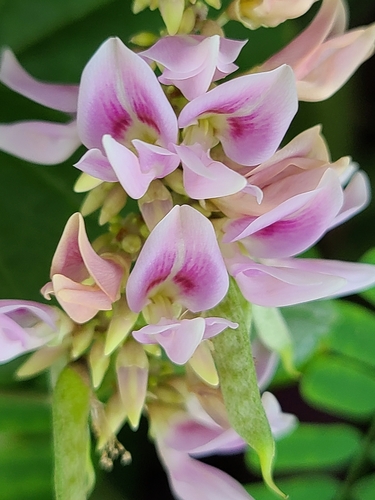
Vigna trilobata
(L.) Verdc.
Arak moth, Jangli moth, Jungle mat bean, African gram
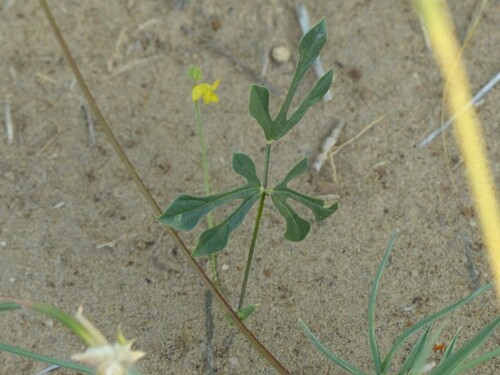
(c) Radha Veach, some rights reserved (CC BY-NC), uploaded by Radha Veach
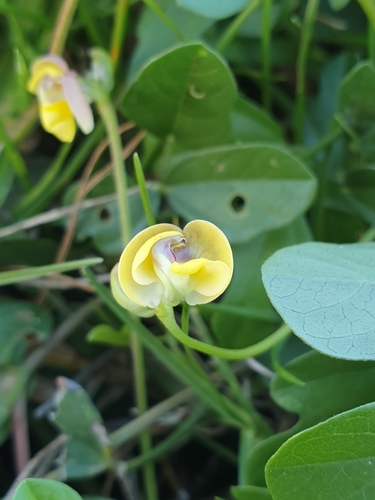
(c) Aravinth, some rights reserved (CC BY), uploaded by Aravinth
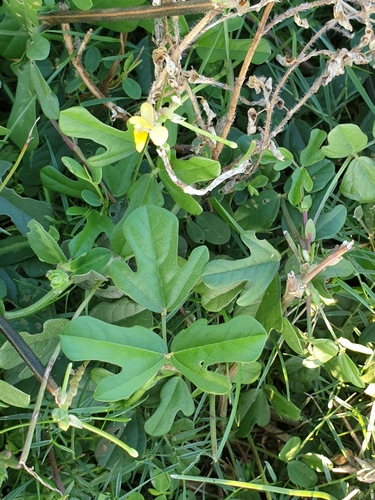
(c) Aravinth, some rights reserved (CC BY), uploaded by Aravinth
What to Eat
Edible parts: Seeds, Pods, Leaves, Fruit, Tuber
Vigna trilobata is cultivated in India, Pakistan, and Sudan for short-term pasturage. It is valued highly as it is very tolerant of grazing and is very palatable, even being a human food alternative. However, it tends to have a very low yield.
Where to Find It
It grows in tropical places. It grows on grassland and sandy ridges. In Papua New Guinea is occurs from sea level to 5 m altitude. In India it grows up to 2,000 m altitude. In Yunnan.
Afghanistan, Africa, Asia, Australia, Bangladesh, Bhutan, China, East Africa, Himalayas, India, Indochina, Indonesia, Madagascar, Mauritius, Malaysia, Myanmar, Nepal, Pacific, Pakistan, Papua New Guinea, PNG, SE Asia, Sri Lanka, Uganda, Vietnam, West Africa,
How to Identify
A climbing herb. It grows to 50 cm high. The stems are hairy. The leaflets usually have deep lobes. The lobes are wider at the top. They are 0.8-4.5 cm long and 0.6-4 cm wide. They have fine hairs. The leaf stalk is 0.8-11 cm long. The flowers occur as a few together on short stalks. The flowers are white. The fruit are pods 1.5-4 cm long and 0.3 mm wide.
How to Grow
A plant of the drier tropics, where it is found at elevations up to 2,100 metres. It grows best in areas where annual daytime temperatures are within the range 22 - 31°c, but can tolerate 18 - 35°c. The plant can survive temperatures down to about -1°c. It prefers a mean annual rainfall in the range 700 - 900mm, but tolerates 520 - 1,440mm. Succeeds in full sun and in light shade. Succeeds in a range of soils, including heavy clay soils that crack in dry conditions. Plants can tolerate occasional waterlogging of the soil. Tolerant of moderate levels of salt in the soil. Prefers a pH in the range 7 - 8.5, tolerating 6.5 - 9. Established plants are very drought tolerant. This species has a symbiotic relationship with certain soil bacteria, these bacteria form nodules on the roots and fix atmospheric nitrogen. Some of this nitrogen is utilized by the growing plant but some can also be used by other plants growing nearby.
Other Uses
The plants ability to thrive under drought conditions and to produce high levels of nitrogen in the soil make it an excellent pioneer green manure crop in semi-arid regions.
Wikipedia
Source ↗Vigna trilobata, the three-lobe-leaf cowpea or jungle mat bean, is a regenerating annual (though occasionally perennial) herb found in India, Pakistan, Sri Lanka, Burma, Afghanistan and the Malay archipelago.
Notes
There are about 150 Vigna species. They are mostly in the tropics.
Names & Synonyms
Ceruvidukol, Elipayer, Jangli mug, Kattupayaru, Mataki, Mathan, Minima, Mudhaparni, Mugam, Mugan, Mugni, Mukni, Mungi, Naripayer, Panipayer, Pillipesara, Rakhalkalai, Ranmatki, Taw-matpe, Trianguli
References (23)
- Ambasta, S.P. (Ed.), 2000, The Useful Plants of India. CSIR India. p 677
- Arora, R. K., 2014, Diversity in Underutilized Plant Species - An Asia-Pacific Perspective. Bioversity International. p 19
- Burkill, H. M., 1985, The useful plants of west tropical Africa, Vol. 3. Kew.
- Flora of Pakistan. www.eFloras.org
- GAMMIE, (As Phaseolus trilobus)
- GUPTA & KANODIA, (As Phaseolus trilobus)
- Hedrick, U.P., 1919, (Ed.), Sturtevant's edible plants of the world. p 480 (As Phaseolus trilobus)
- Hussey, B.M.J., Keighery, G.J., Cousens, R.D., Dodd, J., Lloyd, S.G., 1997, Western Weeds. A guide to the weeds of Western Australia. Plant Protection Society of Western Australia. p 164
- Jardin, C., 1970, List of Foods Used In Africa, FAO Nutrition Information Document Series No 2.p 28 (As Phaseolus trilobus)
- Kermath, B. M., et al, 2014, Food Plants in the Americas: A survey of the domesticated, cultivated and wild plants used for Human food in North, Central and South America and the Caribbean. On line draft. p 911
- Paczkowska, G . & Chapman, A.R., 2000, The Western Australian Flora. A Descriptive Calatogue. Western Australian Herbarium. p 453
- Prachi, K., et al, 2012, Underutilized wild fruits of North Maharashtra. Journal of Research in Plant Sciences. (2012) 1:071-076
- Ramachandran, V.S. and Nair, V.J., 1981, Ethnobotanical studies in Cannanore District, Kerala State (India). J Econ. Tax. Bot. Vol 2 pp 65-72
- Rubaihayo, E. B., Conservation and use of traditional vegetables in Uganda. Bioversity International. (As Phaseolus trilobus)
- Sarvalingam, A., et al, 2014, Wild edible plant resources used by the Irulas of the Maruthamalai Hills, Southern Western Ghats, Coimbatore, Tamil Nadu. Indian Journal of Natural Products and Resources 5(2):198-201 (As Dolichos trilobatus)
- SAXENA,
- SHANKARNARAYAN & SAXENA,
- Singh, H.B., Arora R.K.,1978, Wild edible Plants of India. Indian Council of Agricultural Research, New Delhi. p 85
- Singh, V. and Singh, P., 1981, Edible Wild Plants of Eastern Rajasthan. J. Econ. Tax. Bot. Vol 2 pp 197-207 (As Phaseolus trilobus)
- Taxon 17:172. 1968
- Verdcourt, B., 1979, Manual of New Guinea Legumes. Botany Bulletin No 11, Division of Botany, Lae, Papua New Guinea. p 525
- WATT, (As Phaseolus trilobus)
- World Checklist of Useful Plant Species 2020. Royal Botanic Gardens, Kew