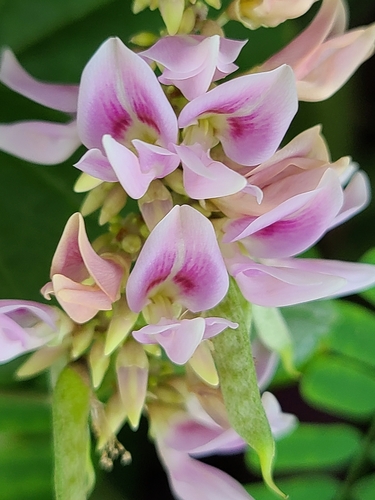
Vigna umbellata
(Thunb.) Ohwi & H. Ohashi
Rice bean, Climbing-mountain-bean

(c) Chuangzao, some rights reserved (CC BY-NC), uploaded by Chuangzao
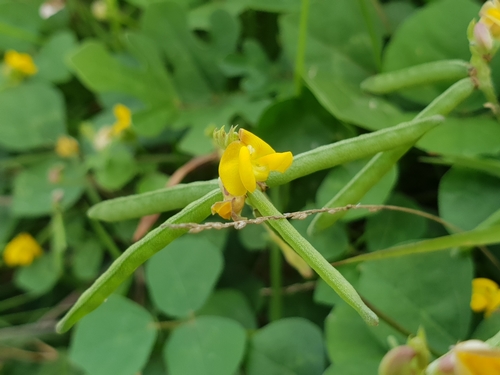
(c) Aravinth, some rights reserved (CC BY), uploaded by Aravinth
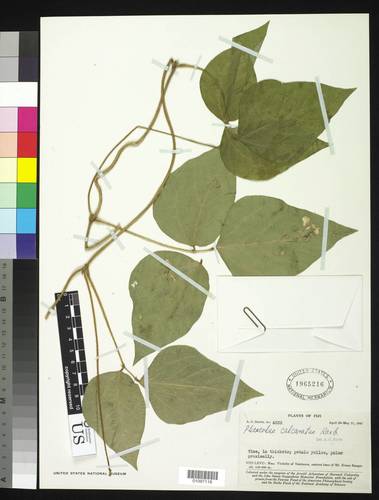
(c) Smithsonian Institution, National Museum of Natural History, Department of Botany, some rights reserved (CC BY-NC-SA)
What to Eat
Edible parts: Seeds, Leaves, Pods, Sprouted Seeds, Vegetable
The young pods and ripe seeds are eaten cooked; dried seeds are boiled and served with rice or used in soups and stews. Young leaves are also eaten. Seeds are used for sprouting.
Where to Find It
A tropical plant. It grows from 0-1800 m altitude in the tropics. It suits wet climates. It occasionally becomes self sown in coastal grasslands. It needs a sunny protected position. They are drought and frost tender. It can grow in arid places.
Africa, Angola, Asia, Australia, Bangladesh, Bhutan, Brazil, Cambodia, Cameroon, Central Africa, China, Congo, Costa Rica, Cuba, East Africa, East Timor, Fiji, Ghana, Haiti, Himalayas, India, Indochina, Indonesia, Japan, Kenya, Korea, Laos, Liberia, Madagascar, Malaysia, Mali, Mauritius, Myanmar, Nepal, Northeastern India, Pacific, Pakistan, Papua New Guinea, PNG, Philippines, Reunion, SE Asia, Sierra Leone, Sikkim, Solomon Islands, Sri Lanka, Taiwan, Tanzania, Thailand, Timor-Leste, Vietnam, West Africa, West Indies, West Timor, Zambia,
How to Identify
A herb. It is a climbing bean plant with a slender hairy vine. It is twining and an annual plant. It grows from seed each year. It grows to 1.5-3 m long. Stems are hairy. Leaves have 3 leaflets which can vary in shape. They are mostly oval and 3-13 cm long by 1.5-7 cm wide. They taper towards the tip and are rounded at the base. Usually they are hairy. The leaf stalks are 3-16 cm long. Flowers are about 1.5 cm long in dense cone shaped clusters. These flowering stalks can be 3-10 cm long. The flowers are yellow. The fruit are straight pods about 10 cm long and 5 mm wide. Seeds are small (5-8 mm long) and yellow to brown. The pods split open easily. The seeds can be yellow, green, brown, red, black or mottled.
How to Grow
It is grown by seeds. Seed collection is easy. Seeds often have a hard skin which must be broken (eg by scraping) before seeds will germinate easily.
Propagation: Seed - sow in situ.
Other Uses
The plant is sown as a cover crop, green manure and living hedge. As a green manure, rice bean can already be ploughed at about 30 days after sowing. Rice bean is mostly grown as an intercrop, especially of maize.
Wikipedia
Source ↗Vigna umbellata, previously Phaseolus calcaratus, is a warm-season annual vine legume with yellow flowers and small edible beans. It is commonly called ricebean or rice bean. To date, it is little known, little researched, and little exploited. It is regarded as a minor food and fodder crop and is often grown as intercrop or mixed crop with maize (Zea mays), sorghum (Sorghum bicolor) or cowpea (V. unguiculata), as well as a sole crop in the uplands, on a very limited area. Like the other Asiatic Vigna species, ricebean is a fairly short-lived warm-season annual. Grown mainly as a dried pulse, it is also important as a fodder, a green manure and a vegetable. Ricebean is most widely grown as an intercrop, particularly of maize, throughout Indo-China and extending into southern China, India, Nepal and Bangladesh. In the past it was widely grown as lowland crop on residual soil water after the harvest of long-season rice, but it has been displaced to a great extent where shorter duration rice varieties are grown. Ricebean grows well on a range of soils. It establishes rapidly and has the potential to produce large amounts of nutritious animal fodder and high quality grain.
Other Information
It is a commercially cultivated vegetable. Seen occasionally in several areas in Papua New Guinea but only of minor importance as a food.
Notes
There are about 150 Vigna species. They are mostly in the tropics.
Names & Synonyms
Beli, Be-nauk, Be-pwe, Be-sang, Be-te, Be-tyel, Dau-gao, Dau nhonhe, Frijol de arroz, Ghurush, Gurounsk, Haricot riz, Kachang enjing, Kachang ruji, Kachang sepalit, Kachang uchi, Katjang otji, Mambi-bean, Masyan, Masyang ko dal, Mugi tasud, Ning krung-shapre, Oriental-bean, Pau maia, Pe-nauk-saung, Pe-yin, Red bean, Reisbohne, Rumbaiya, Sanndaek angkat miehs, Shima tsuru azuki, Sita mas, Sutri, Tua deng, Tua pe, Tua pi
References (49)
- Ambasta, S.P. (Ed.), 2000, The Useful Plants of India. CSIR India. p 678
- Anderson, E. F., 1993, Plants and people of the Golden Triangle. Dioscorides Press. p 224
- Behera K. K., et al, 2008, Wild Edible Plants of Mayurbhanj District, Orissa, India. J. Econ. Taxon. Bot. Vol. 32 (Suppl.) pp 305-314 (As Vigna ricciardiana)
- Bodkin, F., 1991, Encyclopedia Botanica. Cornstalk publishing, p 1017
- Bodner, C. C. and Gereau, R. E., 1988, A Contribution to Bontoc Ethnobotany. Economic Botany, 43(2): 307-369
- Burkill, H. M., 1985, The useful plants of west tropical Africa, Vol. 3. Kew.
- Burkill, I.H., 1966, A Dictionary of the Economic Products of the Malay Peninsula. Ministry of Agriculture and Cooperatives, Kuala Lumpur, Malaysia. Vol 2 (I-Z) p 1736 (As Phaseolus calcaratus)
- Dey, A. & Mukhererjee, A., 2015, Living and Survival Amidst Hunger: Wild Edible Botanicals as a Prime Forest Productivity in the Rural Purulia District, West Bengal, India from Colonial to Present. Research Journal of Forestry 9(3): 71-86
- Facciola, S., 1998, Cornucopia 2: a Source Book of Edible Plants. Kampong Publications, p 113
- French, B.R., 1986, Food Plants of Papua New Guinea, A Compendium. Asia Pacific Science Foundation p 47
- Grubben, G. J. H. and Denton, O. A. (eds), 2004, Plant Resources of Tropical Africa 2. Vegetables. PROTA, Wageningen, Netherlands. p 565
- Hedrick, U.P., 1919, (Ed.), Sturtevant's edible plants of the world. p 282 (As Dolichos umbellatus)
- Hedrick, U.P., 1919, (Ed.), Sturtevant's edible plants of the world. p 476 (As Phaseolus calcaratus)
- Hu, Shiu-ying, 2005, Food Plants of China. The Chinese University Press. p 472 (As Delandia umbellata)
- Hwang, H., et al, 2013, A Study on the Flora of 15 Islands in the Western Sea of Jeollanamdo Province, Korea. Journal of Asia-Pacific Biodiversity Vol. 6, No. 2 281-310
- ILDIS Legumes of the World http:www:ildis.org/Legume/Web
- Jardin, C., 1970, List of Foods Used In Africa, FAO Nutrition Information Document Series No 2.p 30 (As Vigna calcaratus)
- J. Jap. Bot. 44:31. 1969
- Jha, P. K., et al, 1996, Plant genetic resources of Nepal: A guide for plant breeders of agricultural, horticultural and forestry crops. Euphytica 87:189-210
- Kays, S. J., and Dias, J. C. S., 1995, Common Names of Commercially Cultivated Vegetables of the World in 15 languages. Economic Botany, Vol. 49, No. 2, pp. 115-152
- Kermath, B. M., et al, 2014, Food Plants in the Americas: A survey of the domesticated, cultivated and wild plants used for Human food in North, Central and South America and the Caribbean. On line draft. p 911
- Khanal, R., et al, 2014, Documenting abundance and use of underutilized plant species in the mid hill region of Nepal. ECOPRINT 21: 63-71, 2014
- Kiple, K.F. & Ornelas, K.C., (eds), 2000, The Cambridge World History of Food. CUP p 1844 (As Phaseolus calcaratus)
- Kumar, A., et al, 2012, Ethnobotanical Edible Plant Biodiversity of Lepcha Tribes. Indian Forester, 138 (9):798-803
- Kuo, W. H. J., (Ed.) Taiwan's Ethnobotanical Database (1900-2000), http://tk.agron.ntu.edu.tw/ethnobot/DB1.htm
- Lazarides, M. & Hince, B., 1993, Handbook of Economic Plants of Australia, CSIRO. p 247
- Lembogi Biologi Nasional, 1980m Sayur-sayuran. Balai Pustaka, Jakarta. p 40
- Macmillan, H.F. (Revised Barlow, H.S., et al) 1991, Tropical Planting and Gardening. Sixth edition. Malayan Nature Society. Kuala Lumpur. p 330
- Martin, F.W. & Ruberte, R.M., 1979, Edible Leaves of the Tropics. Antillian College Press, Mayaguez, Puerto Rico. p 200 (As Phaseolus calcaratus)
- McMakin, P.D., 2000, Flowering Plants of Thailand. A Field Guide. White Lotus. p 97 (As Phaseolus calcaratus)
- Medhi, P. & Borthakur, S. K., 2012, Phytoresources from North Cachur Hills of Assam -3: Edible plants sold at Hflong market. Indian Journal or Natural Products and Resources. 3(1) pp 84-109
- Ochse, J.J. et al, 1931, Vegetables of the Dutch East Indies. Asher reprint. p 407 (As Phaseolus calcaratus)
- Peters, C. R., O'Brien, E. M., and Drummond, R.B., 1992, Edible Wild plants of Sub-saharan Africa. Kew. p 140
- Pham-Hoang Ho, 1999, An Illustrated Flora of Vietnam. Nha Xuat Ban Tre. p 961
- Phon, P., 2000, Plants used in Cambodia. © Pauline Dy Phon, Phnom Penh, Cambodia. p 627
- Plants of Haiti Smithsonian Institute http://botany.si.edu/antilles/West Indies
- Purseglove, J.W., 1968, Tropical Crops Dicotyledons, Longmans. p 294 (As Phaseolus calcaratus)
- Rajerison, R., 2006. Vigna umbellata (Thunb.) Ohwi & H.Ohashi. [Internet] Record from Protabase. Brink, M. & Belay, G. (Editors). PROTA (Plant Resources of Tropical Africa), Wageningen, Netherlands. < http://database.prota.org/search.htm>. Accessed 23 October 2009
- Rashid, H. E., 1977, Geography of Bangladesh. Westview. p 262 (As Phaseolus richardiana)
- Royal Botanic Gardens, Kew (1999). Survey of Economic Plants for Arid and Semi-Arid Lands (SEPASAL) database. Published on the Internet; http://www.rbgkew.org.uk/ceb/sepasal/internet [Accessed 1st May 2011]
- Solomon, C., 2001, Encyclopedia of Asian Food. New Holland. p 211 (As Phaseolus calcaratus)
- Terra, G.J.A., 1973, Tropical Vegetables. Communication 54e Royal Tropical Institute, Amsterdam, p 65 (As Phaseolus calcaratus)
- Tindall, H.D., 1983, Vegetables in the Tropics, Macmillan p 274 (As Phaseolus calcaratus)
- USDA, ARS, National Genetic Resources Program. Germplasm Resources Information Network - (GRIN). [Online Database] National Germplasm Resources Laboratory, Beltsville, Maryland. Available: www.ars-grin.gov/cgi-bin/npgs/html/econ.pl (10 April 2000)
- van Wyk, B., 2005, Food Plants of the World. An illustrated guide. Timber press. p 380
- Verdcourt, B., 1979, Manual of New Guinea Legumes. Botany Bulletin No 11, Division of Botany, Lae, Papua New Guinea. p 525
- Wiersema, J. H. & Leon, B., 2013, World Economic Plants. A Standard Reference CRC Press. 2nd Ed. p 721
- Woodward, P., 2000, Asian Herbs and Vegetables. Hyland House. p 133
- World Checklist of Useful Plant Species 2020. Royal Botanic Gardens, Kew