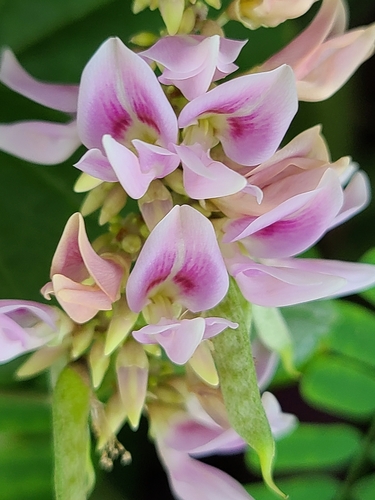
Acacia olgana
Maconochie
Mt Olga wattle

(c) Rob Shepherd, some rights reserved (CC BY-NC), uploaded by Rob Shepherd

(c) p7doherty, some rights reserved (CC BY-NC)

(c) hsauquet, some rights reserved (CC BY-NC), uploaded by hsauquet
What to Eat
Edible parts: Seeds, Grubs
The seeds are eaten, and grubs associated with the plant are also consumed.
Where to Find It
It grows in subtropical locations. It occurs in the ranges of central Australia. It suits dry arid conditions. It needs good drainage and a sunny position.
Australia*,
How to Identify
A shrub or small tree. It grows 5 m tall. There are prickles along the stem. The leaves are twice divided and there are 8-18 pairs of pinnae. There are up to 50 pairs of pinnules on each pinnae. The flowers are yellow. They are in large clusters at the ends of branches. The pods are flattened.
How to Grow
It is grown from seed.
Wikipedia
Source ↗Acacia olgana, commonly known as Kata Tjuta wattle or Mount Olga wattle, is a shrub or tree in the genus Acacia that is found in central Australia.
Notes
There are about 1,350 Acacia species. Over 1,000 occur in Australia. Also as Mimosaceae.
Names & Synonyms
Kaliwara
References (6)
- Cherikoff V. & Isaacs, J., The Bush Food Handbook. How to gather, grow, process and cook Australian Wild Foods. Ti Tree Press, Australia p 42, 188
- Elliot, W.R., & Jones, D.L., 1982, Encyclopedia of Australian Plants suitable for cultivation. Vol 2. Lothian. p 91
- Lang, P. J., et al, 1986, Anangu Pitjantjatjara Lands Biological Survey. p 41
- Lister, P.R., P. Holford, T. Haigh, and D.A. Morrison, 1996, Acacia in Australia: Ethnobotany and potential food crop. p. 228-236. In: J. Janick (ed.), Progress in new crops. ASHS Press, Alexandria, VA.
- Paczkowska, G . & Chapman, A.R., 2000, The Western Australian Flora. A Descriptive Catalogue. Western Australian Herbarium. p 318
- Pennock, A., et al, Australian Dry-zone Acacias for Human Food: Proceedings of a Workshop.