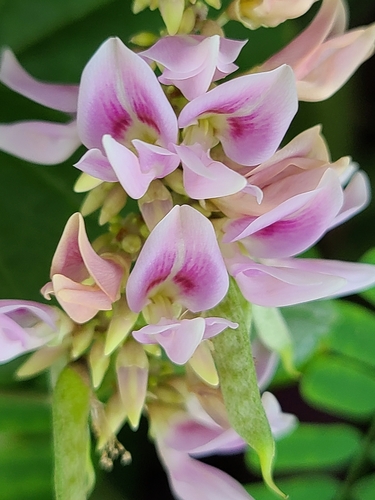
Vigna subterranea
(L.) Verdc.
Bambara groundnut

Wikimedia Commons - Joseph Pohl

Wikimedia Commons - Paul Taubert
What to Eat
Edible parts: Seeds, Leaves, Pods, Vegetable, Nuts, Seeds - coffee
The seeds are used for food, beverages because of their high protein content and for digestive system applications. In West Africa, the nuts are eaten as a snack, roasted and salted, processed into cake, or as a meal, boiled similarly to other beans. The Bambara groundnut needs to be cooked for a relatively long time, which means that more fuel is needed than for cooking other legumes. The cooking time for fresh beans is 45–60 minutes, and dry beans may even take 3–4 hours. This presents an obstacle to a more widespread use of this crop. Moreover, if the bean is not cooked enough, it can cause bloating of the stomach, constipation and flatulence. In South Eastern Nigeria, particularly in Enugu, the dried Bambara beans are ground into a fine powder, then mixed with palm oil, water and, more rarely, vegetables (e.g., utazi), then poured into banana leaf wraps or one-liter cellophane bags before being boiled into a pudding to make okpa, a common breakfast food. During the rainy season in many parts of central Nigeria, the fresh Bambara beans are cooked with their shells still on them, then eaten as a snack.
Where to Find It
It is a tropical plant. It can grow in hot climates. It can also grown on poor soils. It does best with moderate rainfall and sunshine. It can tolerate drought. Long day-lengths can reduce or prevent pod development in some kinds. It suits semi-arid regions. In Kenya it grows from sea level to 1,550 m altitude. It can grow in arid places.
Africa, Angola, Asia, Australia, Benin, Botswana, Brazil, Burkina Faso, Cameroon, Central Africa, Central African Republic, CAR, Central America, Chad, Comoros, Congo DR, Côte d'Ivoire, Dominican Republic, East Africa, Egypt, Eswatini, Ethiopia, French Guiana, Gambia, Ghana, Guianas, Guinea, Guinée, Guinea-Bissau, Haiti, India, Indochina, Indonesia, Ivory Coast, Kenya, Madagascar, Malawi, Malaysia, Mali, Mauritania, Mauritius, Mozambique, Namibia, New Caledonia, Niger, Nigeria, North Africa, Pacific, Papua New Guinea, PNG, Philippines, SE Asia, Senegal, Sierra Leone, South Africa, Southern Africa, South America, Sri Lanka, Sudan Suriname, Swaziland, Tanzania, Thailand, Togo, Uganda, USA, West Africa, West Indies, Zambia, Zimbabwe,
How to Identify
An annual plant. It can either form a bunchy bush or be a trailing plant. Often the creeping stems are near ground level. It often appears as if bunched leaves arise from branched stems near ground level. It has a well developed taproot. The leaves have 3 leaflets. The leaf stalk is erect and thickened near the base. The end leaflet is slightly larger than the side leaflets. Leaflets are about 6 cm long by 3 cm across. The flowers are yellowish-white. They occur in pairs. The fruit are pods which are round and with one seed. Some kinds have 3 seeds. This pod develops under the ground on a long stalk. The flower/fruit stalk elongates after being fertilised and pushes into the soil. The seeds are hard and are of many colours. Pods can be 3.7 cm long.
Nutrition Score: 64/100
| Part | Moisture | kJ | kcal | Protein | Vit A | Vit C | Iron | Zinc |
|---|---|---|---|---|---|---|---|---|
| Seeds | 7.3 | 1572 | 376 | 18.4 | — | — | 4.6 | 2.2 |
| dried Seeds | 10 | 1541 | 369 | 18.8 | 10 | — | 12.2 | — |
| fresh Seeds | 57 | 638 | 152 | 7.8 | — | — | — | — |
| Seeds boiled | 66.4 | 578 | 137 | 7.7 | — | — | 1.4 | 1.1 |
How to Grow
Plants are grown from seed. Plants are often put in rows 50 cm apart and with 15 cm spacing between plants. Ridges are formed to enable the pods to penetrate the soil. It is mostly grown intercropped with other plants. Soil should be light and friable and the seed bed loose and fine. Normally the whole plant is pulled up for harvesting. Any pods which become detached are harvested by hand. Pods are dried in the air before threshing.
Propagation: Seed - pre-soak for 12 hours in warm water and sow in situ. Seed germinates best at a temperature of 30 - 35°c, it does not germinate properly below 15°c or above 40°c. The seed sprouts within 5 - 21 days.
Medicinal Uses
Leaf preparations are applied as a poultice to abscesses and infected wounds. The leaf sap is applied to the eyes to treat epilepsy. The roots are sometimes taken as an aphrodisiac. Pounded seeds, mixed with water, are used to treat cataracts. The plant (part not specified) is used to treat venereal diseases.
Wikipedia
Source ↗Vigna subterranea (common names: Bambara groundnut, Bambara nut, Bambara bean, manicongo, Congo goober, earth pea, ground-bean, or hog-peanut) is a member of the family Fabaceae. Its name is derived from the Bambara ethnic group. It reproduces via geocarpy, ripening its pods underground, much like the peanut (also called a groundnut). The plant originated in West Africa. As a food and source of income, the Bambara groundnut is considered to be the third most important leguminous crop in those African countries where it is grown, after peanut and cowpea. The crop is mainly cultivated, sold and processed by women, and is, thus, particularly valuable for female subsistence farmers. Bambara groundnut represents the third most important grain legume in semi-arid Africa. It is resistant to high temperatures and is suitable for marginal soils where other leguminous crops cannot be grown. It is a low-impact crop. The entire plant is known for soil improvement because of nitrogen fixation. The pods can be eaten fresh or boiled after drying, and can be ground either fresh or dry to make puddings.
Production
Pods reach their maximum size 30 days after being fertilised and seeds develop over the next 10 days. Pods mature in 4 months from planting. Yields of 500-1,000 kg of dried nuts per hectare are produced. Higher yields are possible.
Other Information
It is a commercially cultivated vegetable.
Notes
On average, the seeds were found to contain 63% carbohydrate, 19% protein and 6.5% oil.
Names & Synonyms
Adokolet, Adywl-adyel, Akwen, Akyi, Akyin, Angola-Erbse, Azi kpodoe, Azingokwin, Azi todoe, Bambarra, Banbara mame, Congo goober, Densi bonte, Ditlao, Dokolo, Earth nut, Ebede, Ekpa boro, Epa roro, Epede, Eto, Fool, Gige-lokoto, Ground bean, Ground pea, Guisante de tierra, Indluba, Isugu, Jinguba-de-cabambe, Jugo bean, Kacang bogor, Kali, Kgiolodi, Khalage, Kwaruru, Lituu, Madagascar groundnut, Mampode, Mancara-de-bijago, Mani africano, Nduhu, Niumu, Njama, Njumu, Nyimo, Nzama, Okboli ede, Paruru, Pisello di terra, Pois bambara, Su, Sugama, Tessurum-o, Thua rang, Tira, Tura, Voandzou, Yakammwa, Zyama
References (67)
- Abbiw, D.K., 1990, Useful Plants of Ghana. West African uses of wild and cultivated plants. Intermediate Technology Publications and the Royal Botanic Gardens, Kew. p 31
- Akinola, R., et al, 2020, A Review of Indigenous Food Crops in Africa and the Implications for more Sustainable and Healthy Food Systems. Sustainability 2020, 12, 3493;
- Ambasta, S.P. (Ed.), 2000, The Useful Plants of India. CSIR India. p 685 (As Voandzeia subterranea)
- Asfaw, Z. and Tadesse, M., 2001, Prospects for Sustainable Use and Development of Wild Food Plants in Ethiopia. Economic Botany, Vol. 55, No. 1, pp. 47-62
- Baa-Poku, F. & Asante, I. K., 2020, Use of Neglected and Underutilized Crop Species (NUCS) in some farming communities in the Upper Afram and Upper Dayi River Basins in Ghana. International Journal of Technology and Management Research 5 (2): 48-63
- Baidu-Forson, J.J., et al ,2014,. Assessment of agrobiodiversity resources in the Borotse flood plain, Zambia. CGIAR Research Program on Aquatic Agricultural Systems. Penang, Malaysia. Working Paper: AAS-2014-12.
- Brink, M., Ramolemana, G.M. & Sibuga, K.P., 2006. Vigna subterranea (L.) Verdc. [Internet] Record from Protabase. Brink, M. & Belay, G. (Editors). PROTA (Plant Resources of Tropical Africa), Wageningen, Netherlands. < http://database.prota.org/search.htm>. Accessed 23 October 2009
- Burkill, H. M., 1985, The useful plants of west tropical Africa, Vol. 3. Kew. Burkill, I.H., 1966, A Dictionary of the Economic Products of the Malay Peninsula. Ministry of Agriculture and Cooperatives, Kuala Lumpur, Malaysia. Vol 2 (I-Z) p 2291 (As Voandzeia subterranea)
- Cobley, L.S. (rev. Steele, W.M.) 2nd Ed., 1976, An Introduction to the Botany of Tropical Crops. Longmans. p 101 (As Voandzeia subterranea)
- Dakora, F. D., 2013, Biogeographic Distribution, Nodulation and Nutritional Attributes of Underutilized Indigenous Agrican Legumes. Acta Horticulturae Number 979 Vol. 1. p 53
- Dalziel, J. M., 1937, The Useful plants of west tropical Africa. Crown Agents for the Colonies London.
- Dansi, A., et al, 2012, Diversity of the Neglected and Underutilized Crop Species of Importance in Benin. The Scientific World Journal. Volume 2012, Article ID 932947, 19 pages
- Facciola, S., 1998, Cornucopia 2: a Source Book of Edible Plants. Kampong Publications, p 114 (As Voandzeia subterranea)
- FAO, 1988, Traditional Food Plants, FAO Food and Nutrition Paper 42. FAO Rome p 507
- Fowler, D. G., 2007, Zambian Plants: Their Vernacular Names and Uses. Kew. p 41
- Fox, F. W. & Young, M. E. N., 1982, Food from the Veld. Delta Books. p 223 (As Voandzeia subterranea)
- Grivetti, L. E., 1980, Agricultural development: present and potential role of edible wild plants. Part 2: Sub-Saharan Africa, Report to the Department of State Agency for International Development. p 32
- Hedrick, U.P., 1919, (Ed.), Sturtevant's edible plants of the world. p 688 (As Voandzeia subterranea)
- Heller, J., F. Begemann and J. Mushonga, editors. 1997. Bambara groundnut (Vigna subterranea (L.) Verdc.). Promoting the conservation and use of underutilized and neglected crops. 9. Proceedings of the workshop on Conservation and Improvement of Bambara Groundnut (Vigna subterranea (L.) Verdc.), 14–16 November 1995, Harare, Zimbabwe. Institute of Plant Genetics and Crop Plant Research, Gatersleben/Department of Research & Specialist Services, Harare/International Plant Genetic Resources Institute, Rome, Italy.
- ILDIS Legumes of the World http:www:ildis.org/Legume/Web
- Jacquat, C., 1990, Plants from the Markets of Thailand. D.K. Book House p (As Voandzeia subterranea)
- Jardin, C., 1970, List of Foods Used In Africa, FAO Nutrition Information Document Series No 2.p 110 (As Voandzeia subterranea)
- Kays, S. J., and Dias, J. C. S., 1995, Common Names of Commercially Cultivated Vegetables of the World in 15 languages. Economic Botany, Vol. 49, No. 2, pp. 115-152
- Kermath, B. M., et al, 2014, Food Plants in the Americas: A survey of the domesticated, cultivated and wild plants used for Human food in North, Central and South America and the Caribbean. On line draft. p 911
- Kew Bull. 35:474. 1981
- Kiple, K.F. & Ornelas, K.C., (eds), 2000, The Cambridge World History of Food. CUP p 1726 (As Voandzeia subterranea)
- Latham, P., 2004, Useful Plants of Bas-Congo province. Salvation Army & DFID p 289
- Long, C., 2005, Swaziland's Flora - siSwati names and Uses http://www.sntc.org.sz/flora/ (As Voandzeia subterranea)
- Macmillan, H.F. (Revised Barlow, H.S., et al), 1991, Tropical Planting and Gardening. Sixth edition. Malayan Nature Society. Kuala Lumpur. p 350
- Malaisse, F., 1997, Se nourrir en floret claire africaine. Approche ecologique et nutritionnelle. CTA., p 69
- Martin, F.W. & Ruberte, R.M., 1979, Edible Leaves of the Tropics. Antillian College Press, Mayaguez, Puerto Rico. p 201 (As Voandzeia subterranea)
- Masters, T., 2021, Traditional food plants of the upper Aswa River catchment of northern Uganda—a cultural crossroads. Journal of Ethnobiology and Ethnomedicine (2021) 17:24
- Maundu, P. et al, 1999, Traditional Food Plants of Kenya. National Museum of Kenya. 288p
- Menninger, E.A., 1977, Edible Nuts of the World. Horticultural Books. Florida p 88 (As Voandzeia subterranea)
- Mertz, O., Lykke, A. M., and Reenberg, A., 2001, Importance and Seasonality of Vegetable Consumption and Marketing in Burkina Faso. Economic Botany, 55(2):276-289
- Mutie, F. M., et al, 2023, Important Medicinal and Food Taxa (Orders and Families) in Kenya, Based on Three Quantitative Approaches. Plants 2023, 12, 1145
- Nyadanu, D., et al, 2015, Agro-biodiversity and challenges of on-farm conservation: the case of plant genetic resources of neglected and underutilized crop species in Ghana. Genet. Resourc. Crop Evol. 62(7):
- Ochse, J.J. et al, 1931, Vegetables of the Dutch East Indies. Asher reprint. p 439 (As Voandzeia subterranea)
- Okigbo, B.N., Vegetables in Tropical Africa, in Opena, R.T. & Kyomo, M.L., 1990, Vegetable Research and development in SADCC countries. Asian Vegetable Research and development Centre. Taiwan. p 42 (As Voandzeia subterranea)
- Owen, S., 1993, Indonesian Food and Cookery, INDIRA reprints. p 62 (As Voandzeia subterranea)
- Peters, C. R., O'Brien, E. M., and Drummond, R.B., 1992, Edible Wild plants of Sub-saharan Africa. Kew. p 140
- Purseglove, J.W., 1968, Tropical Crops Dicotyledons, Longmans. p 329 (As Voandzeia subterranea)
- Royal Botanic Gardens, Kew (1999). Survey of Economic Plants for Arid and Semi-Arid Lands (SEPASAL) database. Published on the Internet; http://www.rbgkew.org.uk/ceb/sepasal/internet [Accessed 1st May 2011]
- Ruiters-Welcome, A. K., 2019, Food plants of southern Africa. Ph.D. thesis. Univ. of Johannesburg p 63
- Segnon, A. C. & Achigan-Dako, E. G., 2014, Comparative analysis of diversity and utilization of edible plants in arid and semi-arid areas in Benin. Journal of Ethnobiology and Ethnomedicine 2014, 10:80
- Shava, S., et al, 2009, Traditional food crops as a source of community resilience in Zimbabwe. International Journal of the African Renaissance 4(1) (As Voandzeia subterrana)
- Smith, P.M., 1979, Bambara groundnut, in Simmonds, N.W., (ed), Crop Plant Evolution. Longmans. London. p 314 (As Voandzeia subterranea)
- Sprent, J. I., et al, 2009, African legumes: a vital but under-utilized resource. Journal of Experimental Botany.
- Terra, G.J.A., 1973, Tropical Vegetables. Communication 54e Royal Tropical Institute, Amsterdam, p 80 (As Voandzeia subterranea)
- Tindall, H.D., & Williams, J.T., 1977, Tropical Vegetables and their Genetic Resources, International Board for Plant Genetic Resources, Rome, p 77 (As Voandzeia subterranea)
- Tindall, H.D., 1983, Vegetables in the Tropics, Macmillan p 299 (As Voandzeia subterranea)
- Tredgold, M.H., 1986, Food Plants of Zimbabwe. Mambo Press. p 16
- Ulian, T., et al, 2020, Unlocking plant resources to support food security and promote sustainable agriculture. Plants, People, Planet. 2020;2:421–445.
- USDA, ARS, National Genetic Resources Program. Germplasm Resources Information Network - (GRIN). [Online Database] National Germplasm Resources Laboratory, Beltsville, Maryland. Available: www.ars-grin.gov/cgi-bin/npgs/html/econ.pl (10 April 2000)
- van Wyk, B., 2005, Food Plants of the World. An illustrated guide. Timber press. p 382
- van Wyk, Be, & Gericke, N., 2007, People's plants. A Guide to Useful Plants of Southern Africa. Briza. p 26
- van Wyk, B-E., 2011, The potential of South African plants in the development of new food and beverage products. South African Journal of Botany 77 (2011) 857–868
- van Wyk, Ben-Erik, 2019, The diversity and multiple uses of southern African legumes. Australian Systematic Botany, 2019, 32, 519–546
- Wickens, G.E., 1995, Edible Nuts. FAO Non-wood forest products. FAO, Rome. p 143
- Vickery, M.L. and Vickery, B., 1979, Plant Products of Tropical Africa, Macmillan. p 24 (As Voandzeia subterranea)
- Weinberger, K., Msuya J., 2004, Indigenous Vegetables in Tanzania. Significance and Prospects. Technical Bulletin No. 31 AVRDC, Taiwan/FAO p 4
- Welcome, A. K. & Van Wyk, B.-E., 2019, An inventory and analysis of the food plants of southern Africa. South African Journal of Botany 122 (2019) 136–179
- Wiersema, J. H. & Leon, B., 2013, World Economic Plants. A Standard Reference CRC Press. 2nd Ed. p 721
- Williams, C.N., Chew, W.Y., and Rajaratnam, J.A., 1989, Tree and Field Crops of the Wetter Regions of the Tropics. Longman, p 183 (As Voandzeia subterranea)
- Williamson, J., 2005, Useful Plants of Malawi. 3rd. Edition. Mdadzi Book Trust. p 265 (As Voandzeia subterranea)
- Wilson, J.M. & Witcombe, J.R., Crops for Arid lands, in Wickens, G.E., Goodin, J.R., and Field, D.V.,(Eds.) 1985, Plants for Arid Lands. Unwin Hyman, London, p 43
- World Checklist of Useful Plant Species 2020. Royal Botanic Gardens, Kew