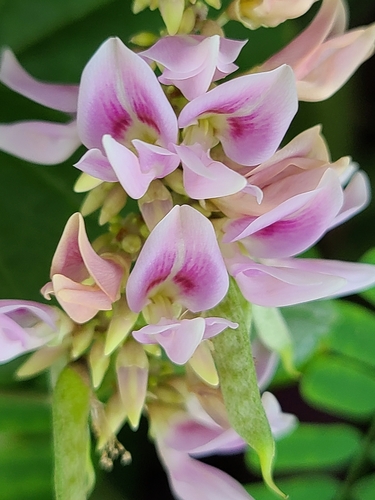
Wisteria sinensis
(Sims) DC.
Chinese Wisteria, Wistaria, Purple vine
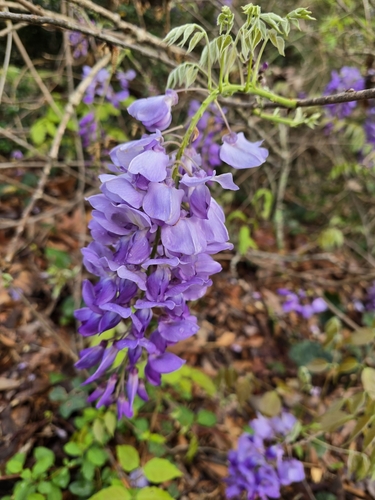
(c) Collin Willson, some rights reserved (CC BY-NC), uploaded by Collin Willson
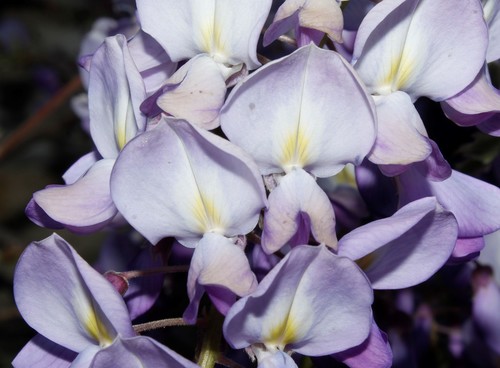
(c) Σάββας Ζαφειρίου (Savvas Zafeiriou), some rights reserved (CC BY-NC), uploaded by Σάββας Ζαφειρίου (Savvas Zafeiriou)

(c) hopeanne, some rights reserved (CC BY-NC)
What to Eat
Edible parts: Flowers, Seeds
The seeds can be cooked, though some caution is advised — see the notes on toxicity. The flowers are thoroughly washed and then boiled or made into fritters; they are also cured in sugar, mixed with flour, and made into a traditional delicacy called 'Teng Lo'. The leaves contain allantoic acid and are used as a tea substitute. Young leaves have also been eaten.
Where to Find It
It is a temperate plant. It will grow in most soils. It is resistant to frost and drought. It suits hardiness zones 5-10. Arboretum Tasmania. Melbourne Botanical Gardens. In Yunnan.
Asia, Australia, Britain, Central Asia, China*, Europe, France, Hawaii, India, Japan, Mediterranean, Myanmar, North America, Pakistan, SE Asia, Slovenia, Tajikistan, Tasmania, USA,
How to Identify
A vigorous climber. It grows 12-18 m long. The trunks are twisted and gnarled. The twining stems turn woody. The leaves have leaflets along the stalk. There are about 11 alternate leaflets that are oval and untoothed. The leaves are mid to dark green. The flowers are mauve and hang in 30 cm long racemes. These are on small spur like growths. The flowers are pea shaped and droop. The pods are oblong and velvety.
How to Grow
Many plants are grown from seed. Fresh seed germinate easily. They can also be grown from cuttings.
Propagation: Seed has no dormancy requirements and can be sown as soon as it is ripe in a cold frame, germinating in spring. Stored seed should be pre-soaked for 24 hours in warm water before sowing in a greenhouse in early spring. Seed can also be sown in an outdoor seedbed in late spring; germination usually occurs in the first spring but may be delayed a further 12 months. Prick seedlings into individual pots when large enough to handle and grow on in a cold frame for the first winter, then plant out in late spring or early summer. Plants grown from seed are very slow and can take up to 20 years to flower. Basal cuttings of side-shoots can be taken in early to mid summer once new growth has hardened sufficiently, each with 2–3 leaves. Removing a shallow slice of bark from the bottom 15mm of the cutting exposes extra cambium and encourages better callusing and rooting. In a mist frame with bottom heat of 27–30°C, cuttings will root within 4 weeks and produce well-established plants by autumn. Layering in spring is also effective: lay a long shoot along the ground, cover with a shallow layer of soil, and it will produce roots at intervals along the stem. Once roots are well formed, the shoot can be divided into several plants, potted up, and kept in a lightly shaded greenhouse until established before planting out. Named varieties should be grown on their own roots before dividing suckers in winter, to ensure the divisions are true to type.
Medicinal Uses
The seed is diuretic and is used in the treatment of heart ailments. One report notes that the stems and flowers are also used in Chinese medicine, but provides no further detail.
Other Uses
A fibre from the stems can be used to make paper; the fibre measures approximately 1.3–3.7mm in length. Stems are harvested in summer, the leaves removed, and the stems steamed until the fibre can be stripped. The fibres are then cooked for 2 hours with lye and put in a ball mill for 3 hours, producing a buff-coloured paper. The plant is also a nitrogen fixer.
Wikipedia
Source ↗Wisteria sinensis, commonly known as the Chinese wisteria, is a species of flowering plant in the pea family, native to China, in the provinces of Guangxi, Guizhou, Hebei, Henan, Hubei, Shaanxi, and Yunnan. Growing 20–30 m (66–98 ft) tall, it is a deciduous vine. It is widely cultivated in temperate regions for its twisting stems and masses of scented flowers in hanging racemes, in spring.
Production
It is fast growing.
Notes
There are 10 Wisteria species. The seeds and flowers are used in medicine. It can be invasive.
Names & Synonyms
Dišeča glicinija, Tengluo, Ziteng
References (19)
- Ambasta, S.P. (Ed.), 2000, The Useful Plants of India. CSIR India. p 689
- Blamey, M and Grey-Wilson, C., 2005, Wild flowers of the Mediterranean. A & C Black London. p 110
- Bodkin, F., 1991, Encyclopedia Botanica. Cornstalk publishing, p 1028
- Brickell, C. (Ed.), 1999, The Royal Horticultural Society A-Z Encyclopedia of Garden Plants. Convent Garden Books. p 1063
- Cundall, P., (ed.), 2004, Gardening Australia: flora: the gardener's bible. ABC Books. p 1487
- Facciola, S., 1998, Cornucopia 2: a Source Book of Edible Plants. Kampong Publications, p 114
- Hibbert, M., 2002, The Aussie Plant Finder 2002, Florilegium. p 310
- http://www.botanic-gardens-ljubljana.com/en/plants
- Hu, Shiu-ying, 2005, Food Plants of China. The Chinese University Press. p 489
- Joyce, D., 1998, The Garden Plant Selector. Ryland, Peters and Small. p 188
- Kremer, B.P., 1995, Shrubs in the Wild and in Gardens. Barrons. p 186 (Listed as poisonous)
- Liu, Yi-tao, & Long, Chun-Lin, 2002, Studies on Edible Flowers Consumed by Ethnic Groups in Yunnan. Acta Botanica Yunnanica. 24(1):41-56
- Lord, E.E., & Willis, J.H., 1999, Shrubs and Trees for Australian gardens. Lothian. p 339
- Marinelli, J. (Ed), 2004, Plant. DK. p 471
- Plants for a Future database, The Field, Penpol, Lostwithiel, Cornwall, PL22 0NG, UK. http://www.scs.leeds.ac.uk/pfaf/
- Prodr. 2:390. 1825 "chinensis" (R. Sweet, Hort. brit. ed. 1:121. 1826)
- READ,
- Ryan, S., 2008, Dicksonia. Rare Plants Manual. Hyland House. p 81
- Valder, P., 1999, The Garden Plants of China. Florilegium. p 200