Yucca baccata
Torr.
Blue yucca, Banana yucca, Spanish bayonet
(c) Walter Fertig, some rights reserved (CC BY-NC), uploaded by Walter Fertig

(c) Jim Boone, some rights reserved (CC BY-NC), uploaded by Jim Boone

(c) Jim Boone, some rights reserved (CC BY-NC), uploaded by Jim Boone
What to Eat
Edible parts: Flowers, Fruit, Leaves, Seeds, Stem
Fully ripe fruit can be eaten raw, cooked, or dried for winter use. The fruits are large, fleshy, sweet, and palatable — the ovoid fruit is about 17 cm long and 7 cm wide — and were considered a staple and a luxury by several native North American Indian tribes. They were often baked in ovens, and the cooked fruit could be formed into cakes and dried for later use. Large quantities have caused diarrhoea in people unaccustomed to eating them. Dried fruit can be dissolved in water to make a drink. Flower buds are cooked; they have a soapy taste, with older flowers being richest in sugar. Flowers harvested before the summer rains — which turn them bitter — have been used as a vegetable. Flowering stems are harvested before the flowers open and then roasted. Seed can be roasted and ground into a powder then boiled. The tender crowns of the plant have been roasted and eaten in times of food shortage. Young leaves have been cooked as a flavouring in soups.
Known Hazards
Where to Find It
It is a temperate plant. It grows well on mountain slopes and in rocky areas. It suits sandy type soils. It can grow in semi-desert locations. It suits hardiness zones 9-11. Melbourne Botanical gardens.
Australia, Britain, Central America, Europe, Mexico, North America, Slovenia, Tasmania, USA,
How to Identify
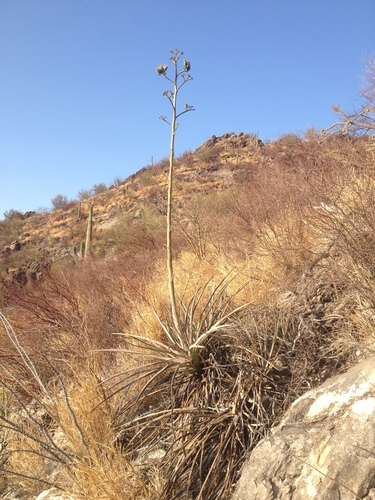
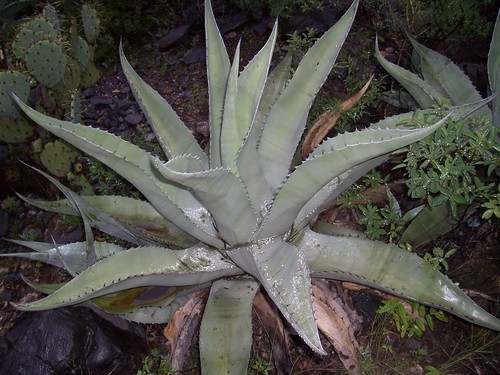
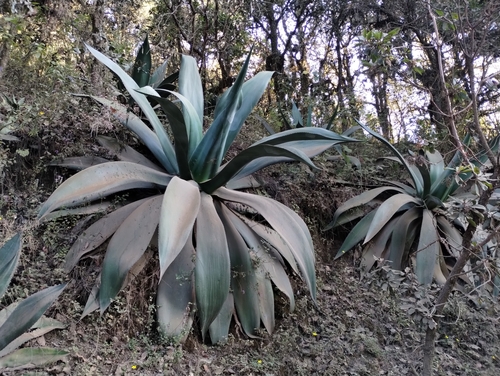
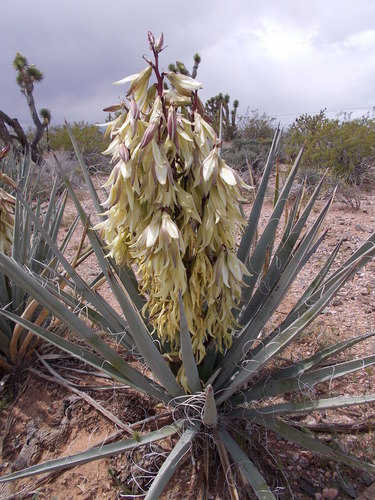
A shrub. It grows 1.5 m high and spreads 1.2 m wide. It can have a single stem or the trunk can be branched. The old leaves remain on the stem. The leaves are green with yellow or blue tinges. There are fine hairs on the edges of the leaves. The flowers are bell shaped. They occur in panicles. They are cream and tinged with purple. The fruit is the size of a large fig.
How to Grow
Thrives in any soil but prefers a sandy loam and full exposure to the south. Plants are hardier when grown on poor sandy soils. Prefers a hot dry position, disliking heavy rain. Established plants are very drought resistant. Only hardy in the milder areas of Britain. Another report says that plants are hardy to at least -30°c. A plant at Kew (1992) has survived the last 3 winters outdoors. This plant is still thriving in 1999, though it has not grown much and has not flowered. Another plant is thriving in an open sunny position at Cambridge Botanical Gardens and must have experienced temperatures of at least -10°c, probably somewhat lower. In the plants native environment, its flowers can only be pollinated by a certain species of moth. This moth cannot live in Britain and, if fruit and seed is required, hand pollination is necessary. This can be quite easily and successfully done using something like a small paint brush. Individual crowns are monocarpic, dying after flowering. However, the crown will usually produce a number of sideshoots before it dies and these will grow on to flower in later years. Plants in this genus are notably resistant to honey fungus. Members of this genus seem to be immune to the predations of rabbits. An evergreen. The edible flower stalks and roots are typically harvested in late summer to early autumn. Yucca baccata usually flowers in late spring to early summer, typically from May to July (Northern Hemisphere). Spanish yucca is a slow-growing plant, often taking several years to reach maturity.
Propagation: Sow seed in spring in a greenhouse, pre-soaking for 24 hours in warm water may reduce germination time. Germination typically occurs within 1–12 months at 20°C. Prick out seedlings into individual pots when large enough to handle and grow on in a greenhouse or cold frame for at least their first two winters. Plant out in early summer, with some winter protection recommended for at least the first winter outdoors. Seed is not produced in Britain unless the flowers are hand pollinated. Root cuttings can be taken in late winter or early spring: lift in April or May, remove small buds from the base of the stem and rhizomes, dip in dry wood ash to stop bleeding, and plant in sandy soil in pots in a greenhouse until established. Divide suckers in late spring — larger divisions can go directly into permanent positions, while smaller divisions are best potted up and grown on in light shade in a greenhouse or cold frame until growing well, then planted out the following spring.
Medicinal Uses
An infusion of pulverised leaves has been used as an antiemetic to prevent vomiting. The fruits have been eaten raw as a laxative.
Other Uses
Fibre from the leaves is used to make ropes, baskets, mats, and cloth. The fibre can be braided into good-quality rope. To extract fibre, the terminal spine and a section of the leaf back are removed and the leaf pounded to free the fibre from the flesh. Alternatively, leaves are folded into sections about 10 cm long, boiled with a small quantity of cedar ash, cooled, then the epidermis peeled away and the leaf chewed from one end to the other to separate the fibres, which are then straightened and hung to dry. Before weaving, the fibres are soaked in water to soften them. Whole leaves can be split and tied with square knots into rope, used as paint brushes, made into small pottery-decoration brushes, or woven into mats and used in basket making. Small roots have been used in basket making to produce red patterns. Terminal leaf spines have been used as needles. Dried leaves boiled with gum, hardened, ground to powder, and mixed with water have been used to waterproof baskets. The roots are rich in saponins and, when crushed and soaked in water, produce suds suitable for washing hair, the body, and clothing. Soap can also be obtained from the leaves and stems.
Wikipedia
Source ↗Yucca baccata (datil yucca or banana yucca, also known as Spanish bayonet and broadleaf yucca) is a common species of yucca native to the deserts of the Southwestern United States and three states in Northern Mexico. The species gets its common name "banana yucca" from its banana-shaped fruit. The specific epithet baccata means 'with berries'. Banana yucca is closely related to the Yucca schidigera, the Mojave yucca, with which it is interspersed where their ranges overlap; hybrids between them occur.
Notes
There are about 40 Yucca species. Also put in the family Agavaceae.
Names & Synonyms
Banana yucca, Datil, Palmilla ancha, Spanish bayonet
References (20)
- Anderson, B. A., (Rev.) 1996, Desert Plants of Utah. Utah State University Extension p 28
- Castetter, E. F., 1935, "Uncultivated native plants used as sources of food." University of New Mexico biological series, v. 4, no. 1, University of New Mexico bulletin, whole no. 266, Ethnobiological studies in the American Southwest, 1 4, 1
- Cundall, P., (ed.), 2004, Gardening Australia: flora: the gardener's bible. ABC Books. p 1491
- W. H. Emory, Rep. U.S. Mex. bound. 2(1):221. 1858 ("1859")
- Esperanca, M. J., 1988. Surviving in the wild. A glance at the wild plants and their uses. Vol. 2. p 368
- Etkin, N.L. (Ed.), 1994, Eating on the Wild Side, Univ. of Arizona. p 70
- Facciola, S., 1998, Cornucopia 2: a Source Book of Edible Plants. Kampong Publications. p 3
- Hedrick, U.P., 1919, (Ed.), Sturtevant's edible plants of the world. p 690
- http://www.botanic-gardens-ljubljana.com/en/plants
- https://www.fireflyforest.com/flowers/category/edible-plants/ Edible Plants – Southeastern Arizona Wildflowers and Plants
- Jackes, D. A., 2007, Edible Forest Gardens
- Kermath, B. M., et al, 2014, Food Plants in the Americas: A survey of the domesticated, cultivated and wild plants used for Human food in North, Central and South America and the Caribbean. On line draft. p 932
- Lyle, S., 2006, Discovering fruit and nuts. Land Links. p 465 (As Yucca baccata var. vespertina)
- Medsger, O. P., 1939, Edible Wild Plants. Macmillan Company. p 2
- Moerman, D. F., 2010, Native American Ethnobotany. Timber Press. p 604
- Plants for a Future database, The Field, Penpol, Lostwithiel, Cornwall, PL22 0NG, UK. http://www.scs.leeds.ac.uk/pfaf/
- Robbins, W. W., 1916, Tewa Ethnobotany. An annotated List of Plants
- Saunders, C.F., 1948, Edible and Useful Wild Plants. Dover. New York. p 104
- Self, M., 2014, Phoenix Seeds catalogue. p 17
- www.desert-tropicals.com