Yucca brevifolia
Engelm.
Joshua tree
no rights reserved, uploaded by Rod

(c) Larry Page, some rights reserved (CC BY)

(c) nonnagnagem, some rights reserved (CC BY-NC)
What to Eat
Edible parts: Flowers, Fruit, Root, Seeds, Seeds pod
Flower buds, before opening, can be parboiled in salt water to remove bitterness, drained, then cooked again and served like cauliflower. Opened flowers are rich in sugar and can be roasted and eaten as candy. The fruit is cooked — roasted and formed into cakes, then dried for later use. The root can be eaten raw, boiled, or roasted. Seed was gathered and eaten by local Indians; no further details are given, but it was likely ground into a powder and mixed with cornmeal or other flours to make bread or cakes. The immature seedpod is also edible, though no further details are given.
Known Hazards
Where to Find It
It is a warm temperate plant. It suits hardiness zones 7-10.
Australia, Mexico, North America, USA,
How to Identify
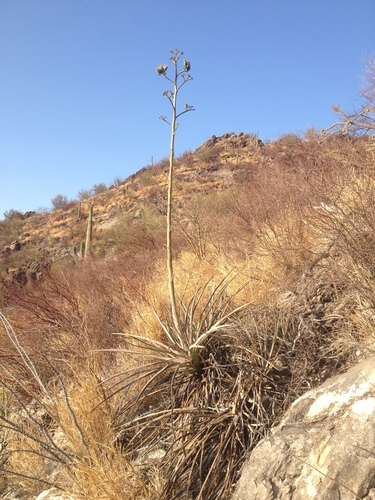
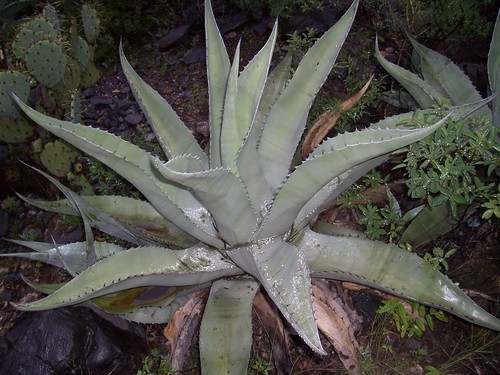
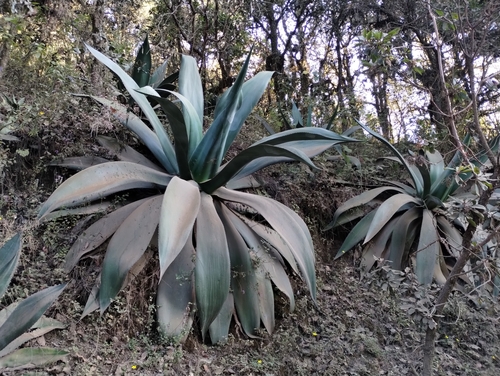
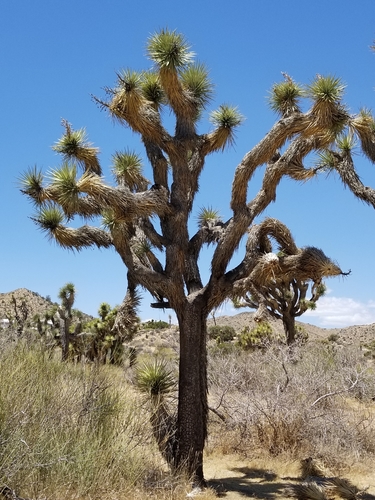
A shrub or small tree. It grows 9-12 m high and spreads 1.5 m wide. The stem branches. The bark is grey or orange-brown. It forms in plates. The leaves are straight and narrow. They have fine teeth along the edge. The flower spikes have greenish flowers. They have an unpleasant smell.
How to Grow
Thrives in any soil but prefers a sandy loam and full exposure to the south. Plants are hardier when they are grown on poor sandy soils. Prefers a hot dry position, disliking heavy rain. Established plants are very drought resistant. The flowers of this species are malodorous. In the plants native environment, its flowers can only be pollinated by a certain species of moth. This moth cannot live in Britain and, if fruit and seed is required, hand pollination is necessary. This can be quite easily and successfully done using something like a small paint brush. Individual crowns are monocarpic, dying after flowering. However, the crown will usually produce a number of sideshoots before it dies and these will grow on to flower in later years. Plants in this genus are notably resistant to honey fungus. Members of this genus seem to be immune to the predations of rabbits.
Propagation: Sow seed in spring in a greenhouse, pre-soaking for 24 hours in warm water may reduce germination time. Germination typically occurs within 1–12 months at 20°C. Prick out seedlings into individual pots when large enough to handle and grow on in a greenhouse or cold frame for at least their first two winters. Plant out in early summer, with some winter protection recommended for at least the first winter outdoors. Seed is not produced in Britain unless the flowers are hand pollinated. Root cuttings can be taken in late winter or early spring: lift in April or May, remove small buds from the base of the stem and rhizomes, dip in dry wood ash to stop bleeding, and plant in sandy soil in pots in a greenhouse until established. Divide suckers in late spring — larger divisions can go directly into permanent positions, while smaller divisions are best potted up and grown on in light shade in a greenhouse or cold frame until growing well, then planted out the following spring.
Medicinal Uses
None known.
Other Uses
Fibre from the leaves is used to make ropes, baskets, sandals, clothing, and mats. Whole leaves can be woven into mats or used as a paint brush. The dark red core of the roots has been used as pattern material in coiled baskets — split into strands, soaked, and worked into the coiling so the colour remains on the outside. Red and black dyes have also been obtained from the roots. The roots are rich in saponins and serve as a soap substitute, particularly suitable for washing hair. The wood is light, soft, and spongy and is difficult to work; it is sometimes cut into thin layers for use as wrapping material or made into boxes and small articles.
Wikipedia
Source ↗Yucca brevifolia (also known as the Joshua tree, yucca palm, tree yucca, and palm tree yucca) is a plant species belonging to the genus Yucca. It is tree-like in appearance, which is reflected in its common names. This monocotyledonous tree is native to the arid Southwestern United States (specifically California, Arizona, Utah, and Nevada), and northwestern Mexico. It is confined mostly to the Mojave Desert between 400 and 1,800 m (1,300 and 5,900 ft) elevation. It thrives in the open grasslands of Queen Valley and Lost Horse Valley in Joshua Tree National Park. Other regions with a large population of the trees can be found northeast of Kingman, Arizona, in Mohave County; and along U.S. 93 just south of the community of Meadview, Arizona, a route which has been designated the Joshua Tree Parkway of Arizona. The trees are also abundant in Saddleback Butte State Park 135 kilometres (85 miles) north of Downtown Los Angeles in Los Angeles County's Antelope Valley. The common name, Joshua tree, is derived from Christian iconography.
Notes
There are about 40 Yucca species. Also put in the family Agavaceae.
Names & Synonyms
Hoskawn
References (12)
- Beckstrom-Sternberg, Stephen M., and James A. Duke. "The Foodplant Database." http://probe.nalusda.gov:8300/cgi-bin/browse/foodplantdb.(ACEDB version 4.0 - data version July 1994) (As Clistoyucca brevifolia)
- Cundall, P., (ed.), 2004, Gardening Australia: flora: the gardener's bible. ABC Books. p 1492
- Facciola, S., 1998, Cornucopia 2: a Source Book of Edible Plants. Kampong Publications. p 3
- Kermath, B. M., et al, 2014, Food Plants in the Americas: A survey of the domesticated, cultivated and wild plants used for Human food in North, Central and South America and the Caribbean. On line draft. p 932
- Lim, T. K., 2015, Edible Medicinal and Non Medicinal Plants. Volume 9, Modified Stems, Roots, Bulbs. Springer p 86
- Marinelli, J. (Ed), 2004, Plant. DK. p 355
- Moerman, D. F., 2010, Native American Ethnobotany. Timber Press. p 606
- Plants for a Future database, The Field, Penpol, Lostwithiel, Cornwall, PL22 0NG, UK. http://www.scs.leeds.ac.uk/pfaf/
- Saunders, C.F., 1948, Edible and Useful Wild Plants. Dover. New York. p 106
- S. Watson et al., Botany [fortieth parallel] 496. 1871 (in C. King, U.S. geol. explor. 40th Parallel vol. 5)
- World Checklist of Useful Plant Species 2020. Royal Botanic Gardens, Kew
- www.desert-tropicals.com