Zaleya pentandra
(L.) Jeffrey
African purslane, Horse purslane

(c) Tony Benn, some rights reserved (CC BY-NC), uploaded by Tony Benn

(c) Tony Benn, some rights reserved (CC BY-NC)
What to Eat
Edible parts: Leaves, Caution, Vegetable
The leaves are eaten as a vegetable in some places, though they may require careful cooking. It is used as a famine food.
Known Hazards
Where to Find It
A tropical plant. It is rare in Swaziland. It is a desert plant. It grows quickly after rains. In Pakistan it grows up to 1,600 m altitude. It can grow in arid places. It does best on gravelly soil.
Africa, Algeria, Arabia, Asia, Botswana, Burkina Faso, Central Africa, Chad, Congo DR, East Africa, Egypt, Eswatini, Ethiopia, Gambia, Ghana, India, Iran, Israel, Kenya, Madagascar, Malawi, Mali, Mauritania, Mediterranean, Middle East, Mozambique, Niger, Nigeria, North Africa, Pakistan, Palestine, Saudi Arabia, Senegal, Somalia, Southern Africa, Sudan, Swaziland, Tanzania, Uganda, West Africa, Zambia, Zimbabwe,
How to Identify
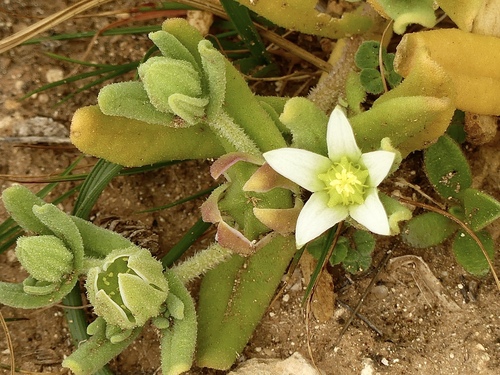
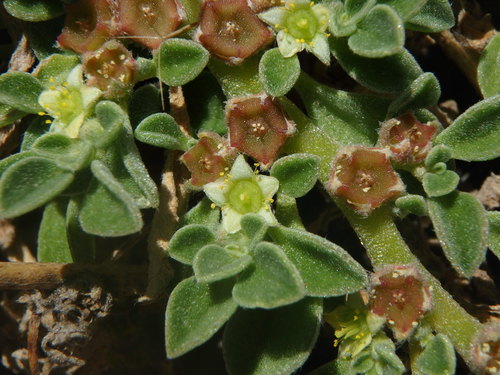
A herb that keeps growing from year to year. It lies along the ground. The leaves are 2-4 cm long and 1-2 cm wide. The flowers are in the axils of leaves. They can occur singly or in groups of 2-5. They do not have flower stalks. The fruit is a capsule with a lid. It is 2-5 mm long. There are 4 seeds. The seeds are black and 1.5 mm long.
Medicinal Uses
The above-ground parts of the plant are used as a stomachic and treatment for gonorrhoea. For this latter purpose, the plant is dried and powdered and taken with millet beer. This sets up acute inflammation of the urino-genitary tract resulting in haematuria, vomiting and bloody stools, and thus a 'purging' of the infection. This treatment may have homeopathic connotations. The plant contains saponins.
Other Uses
The plant has been burnt to extract potash, which can be used for making soap. The plant forms a close cover over waste ground and so could have potential as a ground cover plant. One drawback is that the plant is supposed to harbour snakes.
Wikipedia
Source ↗Zaleya pentandra is a prostrate perennial herb of the Aizoaceae family. It is widespread in semi-arid and arid climes and also in woodlands and can adapt to different ecological zones.
Other Information
It is a famine food. It is highly palatability.
Notes
It can be a problem weed.
Names & Synonyms
Al-Rabah, Arig alarab, Bilee komme, Bishkapra, Charanai, Gadbani, Gadon maciji, Gaija soppu, Galijaeru, Isindura, Itsit, Khari-buti, Ki thua kia mbiti, Laniyh, Lunak, Muisvygie, Narwan, Rabah, Raphuudhimaa, Slathi, Thellagalijaeru, Unchava, Wahoo, Wasanh, Xicalandemba
References (21)
- Ajain, M., Ali, T., & Siddiqui, M.F., 2015, A Survey of Ethnobotanically Important Herbaceous Plants of Tehsil Jatoi,District Muzaffar Garh, Punjab, Pakistan. Int. J. Biol. Res., 3(2): 87-92, 2015.
- Anum, W., et al, 2018, African purslane (Zaleya pentandra), a Blessing in Arid Ecosystems: A Review. Plant Protection, 02 (03) 2018. 137-143
- Burkill, H. M., 1985, The useful plants of west tropical Africa, Vol. 1. Kew.
- Busson, 1965,
- DARLINGTON & AMMAL, (As Trianthema pentandra)
- Flora of Pakistan.
- Goode, P., 1989, Edible Plants of Uganda. FAO p 30
- Grivetti, L. E., 1980, Agricultural development: present and potential role of edible wild plants. Part 2: Sub-Saharan Africa, Report to the Department of State Agency for International Development. p 49 (As Trianthema pentandra)
- Grubben, G. J. H. and Denton, O. A. (eds), 2004, Plant Resources of Tropical Africa 2. Vegetables. PROTA, Wageningen, Netherlands. p 566
- GUPTA & KANODIA (As Zaleya govindia)
- Herb., E. A., 1981,
- Jardin, C., 1970, List of Foods Used In Africa, FAO Nutrition Information Document Series No 2.p 111
- Martin, F.W. & Ruberte, R.M., 1979, Edible Leaves of the Tropics. Antillian College Press, Mayaguez, Puerto Rico. p 172 (As Trianthema pentandra)
- MORTIMORE (As Trianthema pentandra)
- Peters, C. R., O'Brien, E. M., and Drummond, R.B., 1992, Edible Wild plants of Sub-saharan Africa. Kew. p 46
- RILEY & BROKENSHA
- Royal Botanic Gardens, Kew (1999). Survey of Economic Plants for Arid and Semi-Arid Lands (SEPASAL) database. Published on the Internet; http://www.rbgkew.org.uk/ceb/sepasal/internet [Accessed 24th March 2011]
- Swaziland's Flora Database http://www.sntc.org.sz/flora
- Terra, G.J.A., 1973, Tropical Vegetables. Communication 54e Royal Tropical Institute, Amsterdam, p 79 (As Trianthema pentandra)
- WATT (As Trianthema pentandra)
- World Checklist of Useful Plant Species 2020. Royal Botanic Gardens, Kew