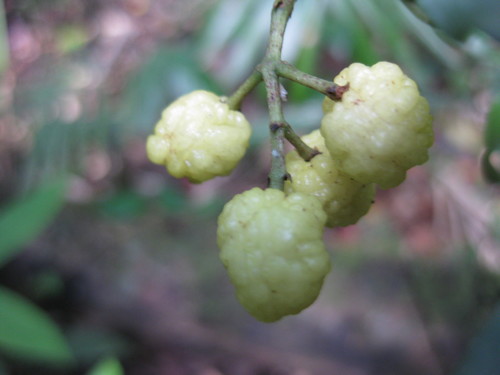
Zanthoxylum ailanthoides
Siebold & Zuccarini
Vietnam pepper, Japanese prickly ash
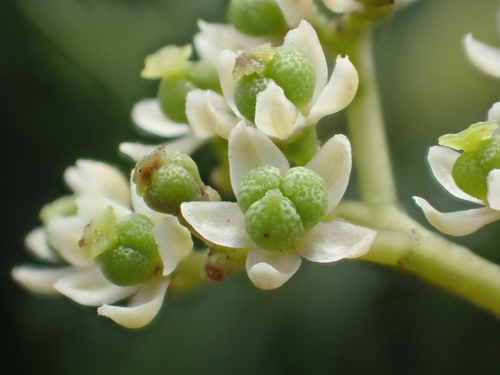
no rights reserved, uploaded by 葉子
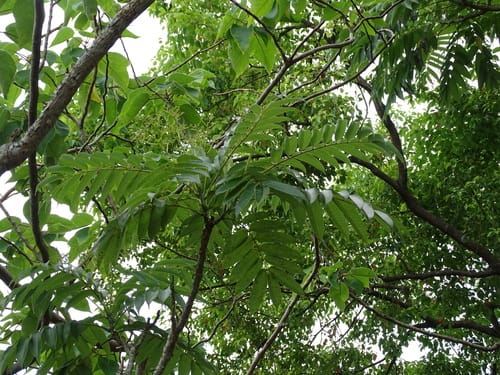
(c) maplerice, some rights reserved (CC BY-NC)
What to Eat
Edible parts: Leaves, Fruit - spice
The seed is cooked and used as a pungent condiment, functioning as a red pepper substitute. While the individual fruits are small, they are produced in clusters that make harvesting straightforward; each fruit contains a single seed. Young leaves are also edible, though no further preparation details are recorded.
Where to Find It
It is a subtropical plant. It is native to E. Asia. It grows in woodland. In southern China it grows between 300-1,500 m above sea level.
Asia, China, Indochina, Japan, Korea, Philippines, SE Asia, Taiwan, Vietnam,
How to Identify
A deciduous tree. It grows 15 m high. It is a broad spreading shape. The bark is grey and green striped. It has spiny processes on it. The leaves have leaflets along the stalk. The leaves are 30 cm long. There are 15 pairs of leaflets. These are pointed. They are 15 cm long by 5 cm wide. They are light green above and blue-green underneath. The male and female flowers occur on separate plants. They are yellow-green and in broad heads at the ends of shoots. The fruit are small and green with black seeds.
How to Grow
It can be grown from seeds. The seeds need 2-3 months of cold treatment. Then they should be soaked before planting. It can also be grown from stem cuttings. 20 cm long sections are used.
Propagation: Seed is best sown in a greenhouse as soon as it is ripe in autumn. Stored seed may need up to 3 months of cold stratification, though scarification may also help. Sow stored seed in a cold frame as early in the year as possible; germination should occur in late spring, though it may take a further 12 months. Prick seedlings into individual pots when large enough and grow on in a cold frame through their first winter, then plant out in early summer. Half-ripe cuttings can be taken in July/August in a frame. Root cuttings 3cm long, planted horizontally in pots in a greenhouse, give a good success rate. Suckers can be removed in late winter and planted directly into permanent positions.
Medicinal Uses
The resin found in the bark — particularly the root bark — is antitussive, carminative and powerfully stimulant.
Other Uses
None known.
Wikipedia
Source ↗Zanthoxylum ailanthoides, also called ailanthus-like prickly ash, (Chinese: 椿叶花椒; pinyin: chun ye hua jiao, lit. "Ailanthus-leaved pepper", Chinese: 越椒; pinyin: yue-jiao; Wade–Giles: yüeh-chiao, lit. "Yue pepper", 食茱萸 shi zhu yu, lit. "edible shān zhū yú"; Japanese: カラスザンショウ, からすのさんしょう karasu-zanshō, karasu-no-sanshō, lit. "crow prickly ash") is an Asiatic plant of the prickly-ash genus Zanthoxylum, natively occurring in forest-covered parts of southeastern China, Taiwan, Southeast Asia, and Japan from Honshu southward. The piquant fruit serves as a local substitute for the ordinary red-pepper in China before the Columbian exchange. In Taiwan, the young leaves are used in cuisines. Though some refer to the species as "Japanese prickly-ash", that name is confusing since it is sometimes applied to the sanshō which is Z. piperitum. Z. ailanthoides is not normally exploited for human consumption in Japan, except by the prehistoric people from the Jōmon period. It is foraged in the wild by the Japanese macaque. A regional nickname is tara, and in fact, its young shoots are often mistaken for the true tara (Aralia elata) by gatherers of wild plants. The Latin name ailanthoides of the species comes from its leaves resembling those of the Ailanthus. Like other genera of plants in the rue family, it serves as the host food plant for the larvae of several Continental Asian swallowtail butterfly species, such as Papilio bianor, Papilio helenus, Papilio protenor, and Papilio xuthus.
Notes
There are about 200 Zanthoxylum species.
Names & Synonyms
Ailanthus prickly ash, Karasu-zansho, La Tzu, Shih Chu Yu, Tang Tzu, Yueh Chiao, Yue-jiao
References (7)
- Abh. Math.-Phys. Cl. Koenigl. Bayer. Akad. Wiss. 4(2):138. 1846 "Zanthoxylon"
- AVRDC files
- Coombes, A.J., 2000, Trees. Dorling Kindersley Handbooks. p 285
- Hu, Shiu-ying, 2005, Food Plants of China. The Chinese University Press. p 503
- Martin, F. W., et al, 1987, Perennial Edible Fruits of the Tropics. USDA Handbook 642 p 77
- Plants for a Future database, The Field, Penpol, Lostwithiel, Cornwall, PL22 0NG, UK. http://www.scs.leeds.ac.uk/pfaf
- Yang, R., et al, 2008, Content and distribution of flavonoids among 91 edible plant species. Asia Pac. J. Clin. Nutru. 17(S1): 275-279