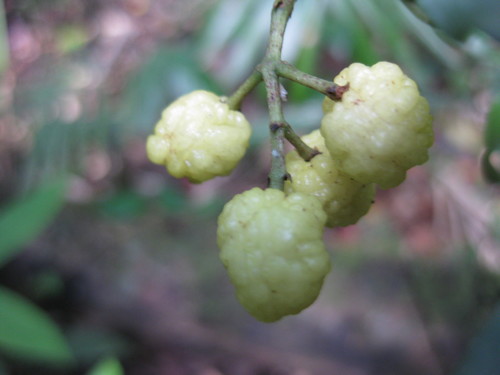
Zanthoxylum armatum
DC.
Nepal pepper, Prickly ash bark

(c) zcguoxia, some rights reserved (CC BY-NC)

(c) 红梅, some rights reserved (CC BY-NC)

(c) 红梅, some rights reserved (CC BY-NC)
What to Eat
Edible parts: Fruit, Leaves, Twigs, Spice
Fresh fruit are pickled and used as a spice, while the dried fruit shells are used for seasoning. The seeds are used in seasoning for pickles and chutneys. Young twigs are sold in markets and used as a spice, and young leaves are used as a condiment in dishes like beef curry.
Known Hazards
Where to Find It
It is a subtropical plant. It grows in rainforest and often at higher elevations. In SE Asia it grows up to 1750 m altitude. In Nepal plants grow between 110-2900 m altitude. In Argentina it grows above 700 m above sea level. In Yunnan.
Argentina, Asia, Bangladesh, Bhutan, China, Himalayas, India, Indochina, Indonesia, Japan, Korea, Laos, Malaysia, Myanmar, Nepal, Northeastern India, NW India, Pacific, Pakistan, Philippines, SE Asia, South America, Taiwan, Thailand, Vietnam,
How to Identify
A spiny shrub. It grows about 3-6 m high. It can lose its leaves during the year. The bark is corky. The branches have strong prickles. The leaves have stalks. They are alternate. They are slightly winged. There are spines at the base. The leaves are 5-23 cm long. There are an odd number of leaflets. There are 3-9 leaflets. They are 2-10 cm long by 1.5-2.5 cm wide. They do not have a leaf stalk. They are sword shaped and dotted with glands. The flowers are small and white. They occur in loose clusters. These can be at the ends of branches or in the axils of leaves. Male and female flowers are separate. The fruit are round and red. They split into two valves. There is a single seed in each section which is shiny and black.
Nutrition Score: 57/100
| Part | Moisture | kJ | kcal | Protein | Vit A | Vit C | Iron | Zinc |
|---|---|---|---|---|---|---|---|---|
| Fruit | 54.2 | — | 374 | 18.4 | — | — | 0.2 | 0.3 |
How to Grow
Plants are grown from seed or branch cuttings.
Propagation: Seed - best sown as soon as it is ripe. Stored seed may requires up to 3 months cold stratification, though scarification may also help. Germination should take place within 6 months, though it might take another 12 months. Prick out the seedlings into individual pots when they are large enough to handle and grow them until large enough to plant out. Cuttings of half-ripe wood. Root cuttings, 3cm long, planted horizontally in pots. Good percentage. Suckers, removed when the plant is dormant, and planted direct into their permanent positions.
Medicinal Uses
The fruit and seeds of the plant are used as a spice, timut pepper, related to Sichuan pepper, but less pungent, while the bark, fruit and seeds are used in indigenous medicines in India, Nepal and Thailand. The plant is also a source of an essential oil, Wartara Oil, and the shrub is also grown as an ornamental garden plant. In the Salyan district of Nepal, the parts used in medicine are harvested primarily of export to India. The plants grow in state-controlled, community-controlled and private lands, resulting in a variety of access regimes, harvesting regimes and management practices, leading to a conclusion that in general the effects of supply and demand on Non-timber forest products (NTFP) cannot be generalised, but are specific to each product and place. Extracts have been shown to inhibit the growth of Porphyromonas gingivalis – the main bacteria involved in Periodontal disease and suspected cause of Alzheimer's disease.
Other Uses
The fruit contains 1.5% essential oil. The fruit is used to purify water. The bark is pungent. Toothbrushes are made from the branches. They are used especially to relieve the pain of toothaches. The bark has been used as an insect repellent. The yellow wood is heavy, hard, close grained. Used for walking sticks. The wood is used for fuel. The plant is occasionally cultivated as a hedge. The plant is traditionally grown in living fences in the northwestern Himalayas, where it helps to exclude livestock and other animals; mark out land boundaries; whilst also providing a range of medicinal and other uses.
Wikipedia
Source ↗Zanthoxylum armatum, also called winged prickly ash or rattan pepper in English, is a species of plant in the family Rutaceae. It is an aromatic, deciduous, spiny shrub growing to 3.5 metres (11 ft) in height, endemic from Pakistan across to Southeast Asia and up to Korea and Japan. It is one of the sources of the spice Sichuan pepper, and also used in folk medicine, essential oil production and as an ornamental garden plant.
Other Information
The twigs are sold in markets. It is cultivated.
Notes
There are about 200 Zanthoxylum species.
Names & Synonyms
Ah hihlou, Akhiklou, Baletimur, Bhale timur, Bu ga, Changkao, Chi-it, D(aws)ng cay s(er)n gai, Dambara, Darmar, Dhiva, Gaira, Gandhalu, Ganya, Gawra-kha-nan-nan, G.yer-ma, Hling-hiar, Jajur, Khagi, Lingnamsia, Lu ga jian, Ma:d, Mak kak, Mejen, Mike-cup, Nech chi, Nepali dhaniya, Nepali thaniya, Ombae, Onier, Parpare timur, Prumo, Sibit-paklauit, Singzor, Sunguru-kung, Tambul, Tejphal, Taza-bo, Temro, Tezbal, Tezmal, Timal, Timbar, Timbat, Timbru, Timber, Timbur, Timru, Timur, Tirmir, Tsogok, Tumburu, Tumru, Tundopoda, Wild Chinese pepper, Winged prickly ash, Yer, Za la
References (66)
- Abbasi, A. M., Khan, M & Zafar, M., 2013, Ethno-medicinal assessment of some selected wild edible fruits and vegetables of Lesser-Himalayas, Pakistan. Pak. J. Bot. 45 (SI):215-222
- Agarwal, R. & Chandra, V., 2019, Diversity of wild edible plants in the Mandal-Chopta forest, Uttarakhand. Journal of Medicinal Plants Studies 2019; 7(1): 89-92
- Ambasta, S.P. (Ed.), 2000, The Useful Plants of India. CSIR India. p 697
- Angami, A., et al, 2006, Status and potential of wild edible plants of Arunachal Pradesh. Indian Journal of Traditional Knowledge 5(4) October 2006, pp 541-550
- Aryal, K. P. et al, 2009, Uncultivated Plants and Livehood Support - A case study from the Chepang people of Nepal. Ethnobotany Research and Applications. 7:409-422
- Aryal, K. P., et al, 2018, Diversity and use of wild and non-cultivated edible plants in the Western Himalaya. Journal of Ethnobiology and Ethnomedicine (2018) 14:10
- Awan, M. R., et al, 2011, Studies on traditional knowledge of economically important plants of Kaghan Valley, Mansehra District, Pakistan. Journal of Medicinal Plants Research Vol. 5(16), pp. 3958-3967
- Barkatullah, et al, 2009, Ethnobotanical studies of plants of Charkotli Hills, Batkhela District, Malakand, Pakistan. Front. Biol. China 2009, 4(4): 539–548
- Barua, U., et al, 2007, Wild edible plants of Majuli island and Darrang districts of Assam. Indian Journal of Traditional Knowledge 6(1) pp 191-194
- Bhatia, H., et al, 2018, Traditionally used wild edible plants of district Udhampur, J&K, India. Journal of Ethnobiology and Ethnomedicine (2018) 14:73
- Bhattarai, S and Chaudary, R. P., 2009, Wild Edible Plants Used by the People of Manang District, Central Nepal. Ecology of Food and Nutrition, 48:1-20
- Burkill, I.H., 1966, A Dictionary of the Economic Products of the Malay Peninsula. Ministry of Agriculture and Cooperatives, Kuala Lumpur, Malaysia. Vol 2 (I-Z) p 2326 (As Zanthoxylum alatum)
- Cao, Y., et al, 2020, Ethnobotanical study on wild edible plants used by three trans-boundary ethnic groups in Jiangcheng County, Pu’er, Southwest China. Journal of Ethnobiology and Ethnomedicine (2020) 16:66
- Chase, P. & Singh, O. P., 2016, Bioresources of Nagaland: A Case of Wild 4 Edible Fruits in Khonoma Village Forest. in J. Purkayastha (ed.), Bioprospecting of Indigenous Bioresources of North-East India. p 51
- Dangol, D. R. et al, 2017, Wild Edible Plants in Nepal. Proceedings of 2nd National Workshop on CUAOGR, 2017.
- Ethnobotanical Study of Tehsil Kabal, Swat District, KPK, Pakistan, Table 1
- Ethnobotany of Karbis. Chapter 4 in p 102
- Facciola, S., 1998, Cornucopia 2: a Source Book of Edible Plants. Kampong Publications, p 221
- Flora of Pakistan. www.eFloras.org
- Gangte, H. E., et al, 2013, Wild Edible Plants used by the Zou Tribe in Manipur, India. International Journal of Scientific and Research Publications, Volume 3, Issue 5
- Gangwar, A. K. & Ramakrishnan, P. S., 1990, Ethnobotanical Notes on Some Tribes of Arunachal Pradesh, Northeastern India. Economic Botany, Vol. 44, No. 1 pp. 94-105
- Gautam, R. S., et al, 2020, Wild Edible Fruits of Nepal. Int. J. Appl. Sci. Biotechnol. Vol 8(3): 289-304
- Geng, Y., et al, 2016, Traditional knowledge and its transmission of wild edibles used by the Naxi in Baidi Village, northwest Yunnan province. Journal of Ethnobiology and Ethnomedicine. 12:10
- Ghimire, S. K., et al, 2008, Non-Timber Forest Products of Nepal Himalaya. WWF Nepal p 133
- Guite, C., 2016, Study of wild edible plants associated with the Paite Tribe of Manipur, India. International Journal of Current Research. Vol. 8, Issue 11, pp. 40927-40932
- Haj, F., et al, 2012, Species Diversity and Ethno Botanical Classes of the Flora of Allai Valley District Battagram Pakistan. International Journal of Plant Research 2012, 2(4): 111-123
- Hamayun, M., Ethnobotanical Studies of some Useful Shrubs and Trees of District Buner, NWFP, Pakistan
- Hedrick, U.P., 1919, (Ed.), Sturtevant's edible plants of the world. p 692 (Zanthoxylum alatum)
- Hu, Shiu-ying, 2005, Food Plants of China. The Chinese University Press. p 503
- Kar, A., et al, 2013, Wild Edible Plant Resources used by the Mizos of Mizoram, India. Kathmandu University Journal of Science, Engineering and Technology. Vol. 9, No. 1, July, 2013, 106-126
- Khakurel, D., et al, 2021, Foods from the wild: Local knowledge, use pattern and distribution in Western Nepal. PLOS ONE.
- Khan, A. H., et al, 2023, Traditional foraging for ecological transition? Wild food ethnobotany among three ethnic groups in the highlands of the eastern Hindukush, North Pakistan. Journal of Ethnobiology and Ethnomedicine 19:9
- Khan, M. & Hussain, S., 2014, Diversity of wild edible plants and flowering phenology of district Poonch (J & K) in the northwest Himalaya. Indian Journal of Sci, Res. 9(1): 032-038 (As Zanthoxylum alatum)
- Lungphi, P., Wangpan, T. & Tangjang, S., 2018, Wild edible plants and their additional uses by the Tangsa community living in the Changlang district of Arunachal Pradesh, India. Pleione 12(2): 151 - 164. 2018.
- Manandhar, N.P., 2002, Plants and People of Nepal. Timber Press. Portland, Oregon. p 484
- Martin, F. W., et al, 1987, Perennial Edible Fruits of the Tropics. USDA Handbook 642 p 78
- Medhi, P. & Borthakur, S. K., 2012, Phytoresources from North Cachur Hills of Assam -3: Edible plants sold at Hflong market. Indian Journal of Natural Products and Resources. 3(1) pp 84-109
- Medhi, P. & Borthakur, S. K., 2013, Wild edible plants sold by the Zeme Nagas at the makeshift market of Mahur, Dima Hasao district of Assam. Pleione 7(1): 84 - 93. 2013
- Medhi, P., Sarma, A and Borthakur, S. K., 2014, Wild edible plants from the Dima Hasao district of Assam, India. Pleione 8(1): 133-148
- Meitei, L. R., et al, 2022, An ethnobotanical study on the wild edible plants used by forest dwellers in Yangoupokpi Lokchao Wildlife Sanctuary, Manipur, India. Ethnobotany Research and Application 23:15
- Miya, M. S. & Gautum, D., 2021, Checklist of floral species at the Institute of Forestry, Pokhara Campus, Pokhara, Nepal. Journal of Institute of Forestry, Nepal 18 (2021) 133-177
- Murtem, G. & Chaudhrey, P., 2016, An ethnobotanical note on wild edible plants of Upper Eastern Himalaya, India. Brazilian Journal of Biological Sciences, 2016, v. 3, no. 5, p. 63-81.
- Peter, K. V. (Ed.), 2004, Handbook of Herbs and Spices Vol. 2 Woodhead Publishing and CRC Press. (As Zanthoxylum alatum)
- Pfoze, N. L., et al, 2012, Survey and assessment of floral diversity on wild edible plants from Senapati district of Manipur, Northeast India. Journal of Biodiversity and Environmental Sciences. 1(6):50-52
- Polunin, O., & Stainton, A., 2006, Flowers of the Himalaya, Oxford India Paperbacks. p 73
- Prodr. 1:727. 1824
- PROSEA handbook Volume 13 Spices. p 266
- Rashid, A., Anand, V.K. & Serwar, J., 2008, Less Known Wild Plants Used by the Gujjar Tribe of District Rajouri, Jammu and Kashmir State. International Journal of Botany 4(2):219-244
- Seal, T., et al, 2014, Nutritional potential of wild edible fruits traditionally used by the local people of Meghalaya state in India. Indian Journal of Natural Products and Resources. Vol. 5(4) December 2014 pp. 359-364
- Sharma, P., et al, 2013, Wild edibles of Murari Devi and surrounding areas in Mandi district of Himachal Pradesh, India. International Journal of Biodiversity and Conservation. Vol. 5(9), pp. 580-592, September 2013
- Sher, Z., Hussain, F., & Ibrar, M., 2014, Traditional knowledge on plant resources of Ashezai and Salarzai Valleys, District Buner, Pakistan. African Journal of Plant Science. Vol. 8(1), pp. 42-53, January 2014
- Shin, T., et al, 2018, Traditional knowledge of wild edible plants with special emphasis on medicinal uses in Southern Shan State, Myanmar. Journal of Ethnobiology and Ethnomedicine (2018) 14:48
- Singh, S.R. and Singh, N.I., 1985, A Preliminary Ethnobotanical studies on wild edible plants in the markets of Manipur - 1. J. Econ. Tax. Bot. Vol. 6 No. 3 pp 699-703 (As Zanthoxylum alatum)
- Srivastava, R. C., et al, 2010, Indigenous biodiversity of Apatani plateau: Learning on biolcultural knowledge of Apani tribe of Qrunachal Pradesh for sustainable livelihoods. Indian Journal of Traditional Knowledge 9(3): 432-442
- Taram, M., et al, 2018, Wild Food Plant Resources of Komkar Adi Tribe of Upper Siang District in Arunachal Pradesh, India. Bulletin of Arunachal Forest Research, Vol. 33(2), 27-35
- Teron, R. & Borthakur, S. K., 2016, Edible Medicines: An Exploration of Medicinal Plants in Dietary Practices of Karbi Tribal Population of Assam, Northeast India. In Mondal, N. & Sen, J.(Ed.) Nutrition and Health among tribal populations of India. p 155
- Thakur, D., et al, 2017, Why they eat, what they eat: patterns of wild edible plants consumption in a tribal area of Western Himalaya. Journal of Ethnobiology and Ethnomedicine (2017) 13:70
- Thapa, L. B., et al, 2014, Wild Edible Plants used by endangered and Indigenous Raji Tribe in Western Nepal. International Journal of Applied Sciences and Biotechnology. Vol 2(3):243-252
- Toppo, P. et al, 2016, Wild edible plants of Dhamtari district of Chhattisgarh, India. Van Sangyan Vol. 3, No. 4 (As Zanthoxylum alatum)
- Tsering, J., et al, 2017, Ethnobotanical appraisal on wild edible plants used by the Monpa community of Arunchal Pradesh. Indian Journal of Traditional Knowledge. Vol 16(4), October 2017, pp 626-637
- Upreti, K., et al, 2010, Diversity and Distribution of Wild Edible Fruit Plants of Uttarakhand. Bioversity Potentials of the Himalaya. p 194
- Weckerle, C. S., et al, 2006, Plant Knowledge of the Shuhi in the Hengduan Mountains, Southwest China. Economic Botany 60(1):2-23
- Wiersema, J. H. & Leon, B., 2013, World Economic Plants. A Standard Reference CRC Press. 2nd Ed. p 733
- World Checklist of Useful Plant Species 2020. Royal Botanic Gardens, Kew
- Xu, You-Kai, et al, 2004, Wild Vegetable Resources and Market Survey in Xishuangbanna, Southwest China. Economic Botany. 58(4): 647-667.
- Yeshi, K. et al, 2017, Taxonomical Identification of Himalayan Edible Medicinal Plants in Bhutan and the Phenolic Contents and Antioxidant Activity of Selected Plants. TBAP 7 (2) 2017 pp 89 - 106