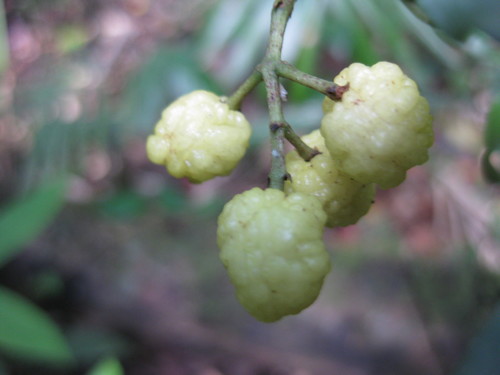
Zanthoxylum khasianum
Hook.f.
Sumer-chheng, Soh-umiuw

(c) Aibor Sanglyne, some rights reserved (CC BY-NC), uploaded by Aibor Sanglyne

photo by Michael Saalfeld (via Wikimedia Commons)
What to Eat
Edible parts: Leaves, Seed
The leaves are cooked as a vegetable. The leaves and seeds are edible portions.
Where to Find It
It is a subtropical plant. It grows on hillsides and open forests between 1,500-2,500 m above sea level. In Yunnan.
Asia, China, India, Northeastern India,
How to Identify
A shrub or climber. It grows 3 m tall. The small branches are grey and have prickles. The leaves have 5-13 leaflets. The leaflets are alternate and oval. They are unequal on their sides and are 4-9 cm long by 2-4 cm wide. The base is wedge shaped and the edges are wavy. The fruit are 7-10 mm across.
Wikipedia
Source ↗Zanthoxylum khasianum is woody plant in the family Rutaceae native to Attam and South Central China.
Production
In China plants flower in May and fruit July to August.
Notes
There are about 200 Zanthoxylum species.
Names & Synonyms
Soh-mrit
References (2)
- Maikhuri, R, K, and Gangwar, A. K., 1993, Ethnobiological Notes on the Khasi and Garo Tribes of Meghalaya, Northeast India, Economic Botany, Vol. 47, No. 4, pp. 345-357
- Sawian, J. T., et al, 2007, Wild edible plants of Meghalaya, North-east India. Natural Product Radiance Vol. 6(5): p 423