Zanthoxylum piperitum
(L.) DC.
Japanese Pepper leaf, Sichuan pepper

(c) 空猫 T. N, some rights reserved (CC BY-NC), uploaded by 空猫 T. N

(c) onidiras-iNaturalist, some rights reserved (CC BY-NC), uploaded by onidiras-iNaturalist

(c) onidiras-iNaturalist, some rights reserved (CC BY-NC), uploaded by onidiras-iNaturalist
What to Eat
Edible parts: Seeds, Berry, Leaves, Bark, Fruit - spice
The seed is cooked and ground into a powder for use as a condiment and pepper substitute. The fruit can be used in the same way and is often heated to develop its full flavour; it can also be mixed with salt as a table condiment. Ground, dry-roasted fruit is one of the ingredients in Chinese five spice powder. The bark and leaves are also used as a spice. Young leaves can be eaten raw or cooked — used in soups or as a flavouring in salads.
Where to Find It
It is a temperate plant. It grows naturally in Szechwan province in SW China. It suits hardiness zones 7-10. Hobart Botanical Gardens.
Asia, Australia, Britain, China*, Europe, India, Indochina, Indonesia, Japan*, Korea*, SE Asia, Taiwan, Tasmania, Thailand,
How to Identify
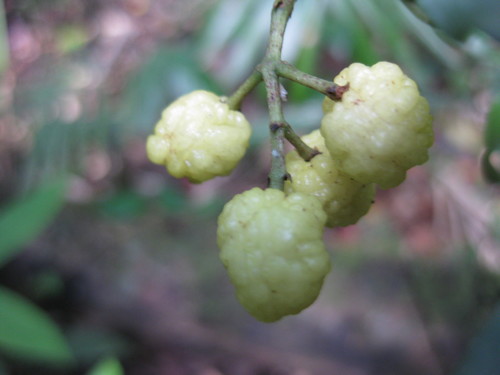
A shrubby tree. It grows 3-6 m high. It spreads 3 m wide. It has prickles on both the stem and the branches. It loses its leaves during the year. The leaves are clusters 30 cm long divided into 5-11 oval leaflets. The flowers are greenish-yellow. They appear before the leaves. The fruit are small reddish-brown berries. These are 5 mm across. The fruit split when drying to reveal a tiny black seed.
How to Grow
Plants can be grown by seed. They can also be grown by root cuttings.
Propagation: Seed is best sown in a greenhouse as soon as it ripens in autumn. Stored seed may need up to 3 months of cold stratification, though scarification can also help. Sow stored seed in a cold frame as early in the year as possible; germination should occur in late spring, though it may take a further 12 months. Prick seedlings into individual pots when large enough to handle, grow on in a cold frame through their first winter, then plant out in early summer. Cuttings of half-ripe wood can be taken in July or August and rooted in a frame. Root cuttings 3cm long, planted horizontally in pots in a greenhouse, give a good success rate. Suckers can be removed in late winter and planted directly into their permanent positions.
Medicinal Uses
The fruit has antiperiodic, antitussive, carminative, diuretic, parasiticide, and stimulant properties. It contains an essential oil, flavonoids, and isoquinoline alkaloids, and is anthelmintic, antibacterial, antifungal, and stomachic. It inhibits the synthesis of prostaglandin and, in larger doses, is toxic to the central nervous system. In Korea it is used in the treatment of tuberculosis, dyspepsia, and internal parasites. The resin in the bark — especially that of the roots — is powerfully stimulant and tonic.
Other Uses
In Japan, the dense wood of this tree is traditionally shaped into the gnarled, rough-hewn wooden pestle used with a suribachi. The plant also has parasiticide properties.
Wikipedia
Source ↗Zanthoxylum piperitum, also known as Japanese pepper or Japanese prickly-ash, is a deciduous aromatic spiny shrub or small tree of the citrus and rue family Rutaceae, native to Japan and Korea. It is called sanshō (山椒) in Japan and chopi (초피) in Korea. Both the leaves and fruits (peppercorns) are used as aromatics and flavorings in these countries. It is closely related to the Chinese Sichuan pepper, which comes from plants of the same genus.
Production
The leaves are dried away from sunlight in a warm dry environment. The berries are dried and then sieved and winnowed. The seeds are removed.
Other Information
It is a cultivated food plant.
Notes
There are about 200 Zanthoxylum species. The leaves contain essential oil and saponin.
Names & Synonyms
Anise pepper, Anise-pepper, Chin chiao, Chinese pepper, Chopinamu, Chop'inamu, Faah jiu, Fagara, Hu chiao, Hua chiao, Hua jiao, Japanese Prickly Ash, Japanischer Pfeffer, Jepinamu, Pepper Ash, Poivre du Sechuan, Sansho, Szechwan pepper
References (35)
- Arora, R. K., 2014, Diversity in Underutilized Plant Species - An Asia-Pacific Perspective. Bioversity International. p 110
- Bremness, L., 1994, Herbs. Collins Eyewitness Handbooks. Harper Collins. p 91
- Brickell, C. (Ed.), 1999, The Royal Horticultural Society A-Z Encyclopedia of Garden Plants. Convent Garden Books. p 1068
- Chen, B. & Qiu, Z., Consumer's Attitudes towards Edible Wild Plants, Ishikawa Prefecture, Japan. p 26 www.hindawi.com/journals/ijfr/aip/872413.pdf
- Chon, S. et al., 2009, Total Phenolics Level, Antioxidants Activity and Cytotoxicity of Young Sprouts of Some Traditional Korean Salad Plants. Plant Foods for Human Nutrition. 64:25-31
- Cundall, P., (ed.), 2004, Gardening Australia: flora: the gardener's bible. ABC Books. p 1495
- Facciola, S., 1998, Cornucopia 2: a Source Book of Edible Plants. Kampong Publications, p 221
- Fujime, Y., 2012, Introduction to Some Indigenous Vegetables in Japan. HortScience Vol. 47(7) July 2012. p 831
- Hedrick, U.P., 1919, (Ed.), Sturtevant's edible plants of the world. p 692
- Hemphill, I, 2002, Spice Notes. Macmillan. p 296
- Hibbert, M., 2002, The Aussie Plant Finder 2002, Florilegium. p 310
- Hutton, W., 1997, Tropical Herbs and Spices of Indonesia. Periplus. p 52
- Hwang, H., et al, 2013, A Study on the Flora of 15 Islands in the Western Sea of Jeollanamdo Province, Korea. Journal of Asia-Pacific Biodiversity Vol. 6, No. 2 281-310
- Hwang, HS, et al, 2014, Distribution characteristics of plant in the Ungseokbong Mountain, Gyeongsangnam-do, Korea. Journal of Asia-Pacific Biodiversity. 7(2014) e164-e178
- Jackes, D. A., 2007, Edible Forest Gardens
- Kim, H. & Song, M., 2013, Ethnobotanical analysis for traditional knowledge of wild edible plants in North Jeolla Province (Korea). Genetic. Resour. Crop Evol. (2013) 60:1571-1585
- Kiple, K.F. & Ornelas, K.C., (eds), 2000, The Cambridge World History of Food. CUP p 432
- Larkcom, J., 1991, Oriental Vegetables, John Murray, London, p 128
- Macmillan, H.F. (Revised Barlow, H.S., et al), 1991, Tropical Planting and Gardening. Sixth edition. Malayan Nature Society. Kuala Lumpur. p 384
- Martin, F. W., et al, 1987, Perennial Edible Fruits of the Tropics. USDA Handbook 642 p 78
- Ong, H. G., et al, 2015, Ethnobotany of the wild edible plants gathered in Ulleung Island, South Korea. Genet Resourc Crop Evol. Springer
- Pemberton, R. W. & Lee, N. S., 1996, Wild Food Plants in South Korea: Market Presence, New Crops, and Exports to the United States. Economic Botany, Vol. 50, No. 1, pp. 57-70
- Peter, K. V. (Ed.), 2004, Handbook of Herbs and Spices Vol. 2 Woodhead Publishing and CRC Press.
- Plants for a Future database, The Field, Penpol, Lostwithiel, Cornwall, PL22 0NG, UK. http://www.scs.leeds.ac.uk/pfaf/
- Prodr. 1:725. 1824
- READ,
- Ryan, S., 2008, Dicksonia. Rare Plants Manual. Hyland House. p 62
- Solomon, C., 2001, Encyclopedia of Asian Food. New Holland. p 329, 371
- Song, M., et al, 2013, Traditional knowledge of wild edible plants in Jeju Island, Korea. Indian Journal of Traditional Knowledge. 12(2) pp 177-194
- UPHOF,
- van Wyk, B., 2005, Food Plants of the World. An illustrated guide. Timber press. p 387
- Wiersema, J. H. & Leon, B., 2013, World Economic Plants. A Standard Reference CRC Press. 2nd Ed. p 733
- Woo, Y., et al, 2017, Antioxidant Potential of Selected Korean Edible Plant Extracts. Hindawi BioMed Research International Volume 2017, Article ID 7695606
- World Checklist of Useful Plant Species 2020. Royal Botanic Gardens, Kew
- Zeven, A. C. & de West, J. M. J., 1982, Dictionary of cultivated plants and their regions of diversity. Wageningen. p 45