Zanthoxylum simulans
Hance
Szechwan pepper, Sichuan peppercorn
(c) mecarr, some rights reserved (CC BY)

(c) mecarr, some rights reserved (CC BY)

(c) mecarr, some rights reserved (CC BY)
What to Eat
Edible parts: Fruit - spice
The dried fruit is used as a condiment with a pepper flavour that is stronger and more pungent than black pepper. It can be used whole or ground into a powder as a table seasoning, and light roasting brings out more of its flavour. It is one of the ingredients in the famous Chinese five spice mixture.
Where to Find It
It is a temperate plant. It is native to China. It grows in mountain woods and thickets. It suits hardiness zones 5-8.
Asia, Australia, China, Japan, Korea, Slovenia, Taiwan,
How to Identify
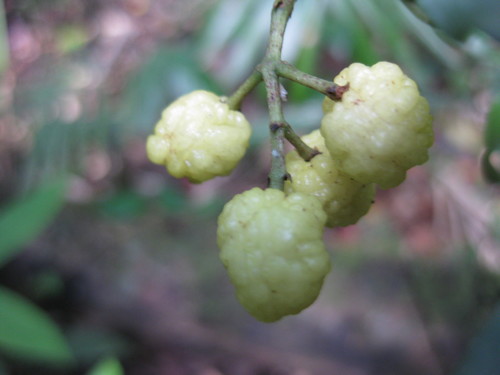
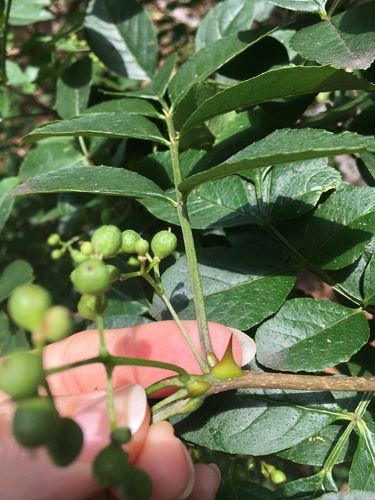
A deciduous tree. It grows 6 m high. It is a broad spreading shape. The bark is grey with cone shaped processes over it. The leaves have leaflets along the stalk. The leaves are 20 cm long and there are about 11 leaflets. They are oval and glossy green. There can be some prickles on the upper surface. The stalk has prickles. The flowers are small and green. They occur in clusters 5 cm across. The fruit are small and round. They are warty and have a strong aroma. They are 5 mm across. They are green and ripen to red. On drying they split open to reveal shiny black seeds. Probably now Zanthoxylum bungeanum.
How to Grow
Easily grown in loamy soils in most positions, but prefers a good deep well-drained moisture retentive soil in full sun or semi-shade. A plant has been growing well for many years in deep woodland shade at Cambridge Botanical gardens, it was fruiting heavily in autumn 1996. Cultivated for its seed, which is used as a condiment in China. Flowers are formed on the old wood. The bruised leaves are strongly aromatic. Dioecious. Male and female plants must be grown if seed is required.
Propagation: Seed is best sown in a greenhouse as soon as it ripens in autumn. Stored seed may need up to 3 months of cold stratification, though scarification can also help. Sow stored seed in a cold frame as early in the year as possible; germination should occur in late spring, though it may take a further 12 months. Prick seedlings into individual pots when large enough to handle, grow on in a cold frame through their first winter, then plant out in early summer. Cuttings of half-ripe wood can be taken in July or August and rooted in a frame. Root cuttings 3cm long, planted horizontally in pots in a greenhouse, give a good success rate. Suckers can be removed in late winter and planted directly into their permanent positions.
Medicinal Uses
The fruit is astringent, diaphoretic, and emmenagogue. The pericarp is anaesthetic, diuretic, parasiticide, and vasodilator, and is used to treat gastralgia and dyspepsia caused by cold, as well as vomiting, diarrhoea, abdominal pain, ascariasis, and dermal diseases. It has a local anaesthetic action and is parasiticide against the pork tapeworm (Taenia solium). The pericarp contains geraniol, which in small doses acts as a mild diuretic, while large doses inhibit urinary excretion. Peristalsis increases persistently at low concentrations but is inhibited at high concentrations. The leaves are carminative, stimulant, and sudorific. The fruit is carminative, diuretic, stimulant, stomachic, and tonic. The seed is antiphlogistic and diuretic. A decoction of the root is digestive and is also used in the treatment of snakebites. The resin in the bark — especially that of the roots — is powerfully stimulant and tonic.
Other Uses
None known.
Wikipedia
Source ↗Zanthoxylum simulans, the Chinese-pepper, Chinese prickly-ash or flatspine prickly-ash, is a flowering plant in the family Rutaceae, native to southern and central China, Taiwan, and South Korea. It is one of several species of Zanthoxylum from which Sichuan pepper is produced. It is a spreading shrub or small tree growing to 7 m tall. The leaves are 7–12.5 cm long, pinnate, with 7–11 leaflets, the leaflets 3–5 cm long and 1.5–2 cm broad. There are numerous short (3–6 mm) spines on both the stems and the leaf petioles, and large (several cm) knobs on the branches. The flowers are produced in slender cymes, each flower about 4–5 mm diameter. The 3–4 mm berry has a rough reddish brown shell that splits open to release the black seeds from inside.
Other Information
It is a cultivated food plant.
Notes
There are about 200 Zanthoxylum species.
Names & Synonyms
Chinese pepper, Flat-spine prickly ash, Hua-chiao, Prickly ash, Sichuan pepper, Ye hua jiao
References (15)
- Ann. Sci. Nat. Bot. ser. 5, 5:208. 1866
- Arora, R. K., 2014, Diversity in Underutilized Plant Species - An Asia-Pacific Perspective. Bioversity International. p 110
- Brickell, C. (Ed.), 1999, The Royal Horticultural Society A-Z Encyclopedia of Garden Plants. Convent Garden Books. p 1068
- Coombes, A.J., 2000, Trees. Dorling Kindersley Handbooks. p 285
- Cundall, P., (ed.), 2004, Gardening Australia: flora: the gardener's bible. ABC Books. p 1495
- Facciola, S., 1998, Cornucopia 2: a Source Book of Edible Plants. Kampong Publications, p 221
- http://www.botanic-gardens-ljubljana.com/en/plants
- Hu, Shiu-ying, 2005, Food Plants of China. The Chinese University Press. p 504
- Luo, B., et al, 2019, Wild edible plants collected by Hani from terraced rice paddy agroecosystem in Honghe Prefecture, Yunnan, China. Journal of Ethnobiology and Ethnomedicine 15:56
- Martin, F. W., et al, 1987, Perennial Edible Fruits of the Tropics. USDA Handbook 642 p 78
- Peter, K. V. (Ed.), 2004, Handbook of Herbs and Spices Vol. 2 Woodhead Publishing and CRC Press.
- Reis, S. V. and Lipp, F. L., 1982, New Plant Sources for Drugs and Foods from the New York Botanical Garden herbarium. Harvard. p 146
- Solomon, C., 2001, Encyclopedia of Asian Food. New Holland. p 371
- Wiersema, J. H. & Leon, B., 2013, World Economic Plants. A Standard Reference CRC Press. 2nd Ed. p 733
- Zeven, A. C. & de West, J. M. J., 1982, Dictionary of cultivated plants and their regions of diversity. Wageningen. p 45