Zea mays
L.
Corn, Maize

(c) Ken, some rights reserved (CC BY-NC), uploaded by Ken

(c) Douglas Goldman, some rights reserved (CC BY-SA), uploaded by Douglas Goldman
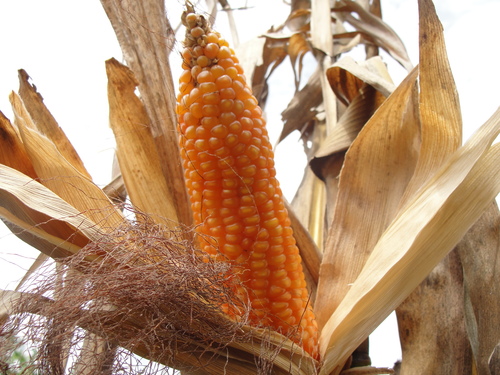
(c) Diogo Luiz, some rights reserved (CC BY), uploaded by Diogo Luiz
What to Eat
Edible parts: Seeds, Leaves, Cereal, Flowers, Vegetable
Corn is one of the most widely grown food plants in the world. The seed can be eaten raw or cooked before fully ripe; sweet corn varieties have been developed specifically for this purpose and have particularly sweet, flavoursome seeds. Mature seed can be dried and used whole or ground into flour — it has a mild flavour and is especially valued as a thickening agent in foods such as custards. Starch extracted from the grain is used in confectionery and noodles. Certain varieties can be oven-heated to make popcorn. The seed can also be sprouted for use in uncooked breads and cereals. The fresh succulent silks — the flowering parts of the cob — are edible. An edible all-purpose culinary oil is obtained from the seed and used in salads and for cooking. Pollen, which is rich in protein, is used as a soup ingredient; it is harvested by tapping the flowering heads over a bowl, and collecting the pollen also helps improve seed fertilisation. The roasted seed serves as a coffee substitute. The pith of the stem can be chewed like sugar cane and is sometimes made into a syrup. Nutritional composition per 100g of fresh seed: 361 calories; water 10.6%; protein 9.4g; fat 4.3g; carbohydrate 74.4g; fibre 1.8g; ash 1.3g; calcium 9mg; phosphorus 290mg; iron 2.5mg; vitamin A 140mg; thiamine (B1) 0.43mg; riboflavin (B2) 0.1mg; niacin 1.9mg.
Where to Find It
A warm temperate plant. Seeds need a soil temperature more than 10°C to germinate. The best temperature is 21-26°C. It grows best at less than 1800 m altitude in the equatorial tropics. It is grown in most areas of Asia. Plants have been grown from sea level to 3,300 m in the Americas. It tends to be in areas too dry for rice but wetter than for millets. Maize must have over 120 days frost free. In Nepal it grows up to 3000 m altitude. It suits hardiness zones 8-10. In Yunnan.
Africa, Albania, Algeria, Andes, Andorra, Angola, Antigua and Barbuda, Arabia, Argentina, Armenia, Asia, Australia, Austria, Azerbaijan, Bahamas, Balkans, Bangladesh, Belize, Benin, Bhutan, Bolivia, Bosnia and Herzegovina, Botswana, Bougainville, Brazil, Britain, Burkina Faso, Burundi, Cambodia, Cameroon, Canada, Cape Verde, Caucasus, Central Africa, Central African Republic, CAR, Central America, Central Asia, Chad, Chile, China, Colombia, Comoros, Congo DR, Congo R, Cook Islands, Costa Rica, Côte d'Ivoire, Croatia, Cuba, Dominican Republic, East Africa, East Timor, Ecuador, Egypt, El Salvador, Equatorial Guinea, Eritrea, Eswatini, Ethiopia, Europe, Fiji, Finland, France, French Guiana, Gabon, Gambia, Georgia, Germany, Ghana, Greece, Grenada, Guam, Guatemala, Guiana, Guianas, Guinea, Guinée, Guinea-Bissau, Guyana, Haiti, Hawaii, Himalayas, Honduras, Hungary, India, Indochina, Indonesia, Iran, Italy, Ivory Coast, Jamaica, Kazakhstan, Kenya, Kiribati, Korea, Kyrgyzstan, Laos, Liberia, Macedonia, Madagascar, Malawi, Malaysia, Maldives, Mali, Mauritania, Mauritius, Mediterranean, Mexico*, Middle East, Moldova, Morocco, Mozambique, Myanmar, Namibia, Nepal, New Caledonia, New Zealand, Nicaragua, Niger, Nigeria, Niue, North Africa, North America, Northeastern India, Pacific, Pakistan, Panama, Papua New Guinea, PNG, Paraguay, Peru, Philippines, Portugal, Puerto Rico, Rotuma, Rwanda, Russia, Samoa, Sao Tome and Principe, Saudi Arabia, Scandinavia, SE Asia, Senegal, Serbia, Seychelles, Sierra Leone, Sikkim, Slovenia, Somalia, Solomon Islands, Somalia, South Africa, Southern Africa, South America, South Sudan, Spain, Sri Lanka, St. Kitts and Nevis, St Lucia, St. Vincent and Grenadines, Sudan, Suriname, Swaziland, Switzerland, Syria, Tajikistan, Tanzania, Tasmania, Thailand, Timor-Leste, Togo, Turkey, Türkiye, Turks & Caicos, Tuvalu, Uganda, Ukraine, USA, Uzbekistan, Vanuatu, Venezuela, Vietnam, Wallis & Futuna, West Africa, West Indies, West Timor, Zambia, Zimbabwe,
How to Identify
A grass. It is an annual plant 2-3 m high. It has a single stem. The stem is solid. It can be 2-3 cm across. Usually there are 14 internodes but this can vary from 8-21. It is a large grass family plant with prop roots near the base. Some forms produce tillers near the base. Seed roots feed the plant initially then casual side roots develop from the lowest node on the plant and continue supplying the plants nutrients. Roots can go sideways for 1 m or downwards for 2-3 m. It is a very variable plant and due to cross pollination variation continues and all forms hybridize. Leaves are produce one after another along opposite sides of the stem and there are between 8 and 21 leaves. The leaf sheath wraps around the stem but opens towards the top of the sheath. The leaf blade is 30-150 cm long and 5-15 cm wide. The leaf blade has a pronounced midrib and is often wavy along the edge. The male flower or tassel is at the top. The female flower is called the ear. It is on a short stalk in the axils of one of the largest leaves about half way down the stem. In the axils of the leaves it produces a large cob wrapped in leaves. The kernels develop in an even number of rows carrying 4-30 grains along the length of the cob. Cobs commonly have 300-1,000 grains. Normally only one or two cobs develop per plant. The seed endosperm is soft in dent types, hard in flint and popcorn types and have more sugar in sweet types.
Nutrition Score: 68/100
| Part | Moisture | kJ | kcal | Protein | Vit A | Vit C | Iron | Zinc |
|---|---|---|---|---|---|---|---|---|
| Seeds (mature) | 10.4 | 1528 | 366 | 10 | 100 | 4 | 4.9 | — |
How to Grow
Requires a warm position a well drained soil and ample moisture in the growing season. Prefers a pH in the range 5.5 to 6.8. Requires a rich soil if it is to do well. Corn is widely cultivated for its edible seed, especially in tropical and warm temperate zones of the world, there are many named varieties. Unfortunately, the plant is not frost tolerant and so needs to be started off under glass in Britain if a reasonable crop is to be grown. There are five main types:- Sweetcorn is of fairly recent development. It has very sweet, soft-skinned grains that can be eaten raw or cooked before they are fully ripe. Cultivars have been developed that can produce a worthwhile crop even in the more northerly latitudes of Britain if a suitable warm sunny sheltered site is chosen[238, K. Popcorn is a primitive form with hard-skinned grains. When roasted, these grains 'explode' to form the popular snack 'popcorn'. Waxy corn is used mainly in the Far East. It has a tapioca-like starch. Flint corn, which shrinks on drying, can have white, yellow, purple, red or blue-black grains. It is not so sweet and also takes longer to mature so is a problematic crop in Britain. There are many other uses for this plant as detailed below. Dent corn has mostly white to yellow grains. This and Flint corn are widely grown for oils, cornflour, cereals and silage crops. Corn grows well with early potatoes, legumes, dill, cucurbits and sunflowers, it dislikes growing with tomatoes. In garden design, as well as the above-ground architecture of a plant, root structure considerations help in choosing plants that work together for their optimal soil requirements including nutrients and water.
Propagation: Sow seed in April in individual pots in a greenhouse, grow on quickly, and plant out after the last expected frosts. A direct outdoor sowing — particularly of less sweet varieties — can be attempted in May.
Medicinal Uses
A decoction of the leaves and roots is used in the treatment of strangury, dysuria, and gravel. The corn silks are cholagogue, demulcent, diuretic, lithontripic, mildly stimulant, and vasodilator. They also lower blood sugar levels and are used in treating diabetes mellitus, as well as cystitis, gonorrhoea, and gout. The silks are best harvested before pollination and used fresh, as they tend to lose their diuretic effect when stored and can become purgative. A decoction of the cob is used in the treatment of nosebleeds and menorrhagia. The seed is diuretic and mildly stimulant, and makes a good emollient poultice for ulcers, swellings, and rheumatic pains. It is widely used in the treatment of cancer, tumours, and warts, and contains allantoin — a cell-proliferant and wound-healing substance also found in comfrey (Symphytum officinale) — which speeds the healing process. The plant is said to have anticancer properties and is experimentally hypoglycaemic and hypotensive.
Other Uses
A glue is made from the starch in the seed; this starch is also used in cosmetics and the manufacture of glucose. A semi-drying oil obtained from the seed has industrial uses in the manufacture of linoleum, paints, varnishes, and soaps. The corn spathes are used to produce paper, straw hats, and small woven articles such as baskets. Fibre from the stems and seed husks is also used for papermaking: harvested in late summer after the seed, cut into usable pieces, soaked in clear water for 24 hours, cooked for 2 hours in soda ash, then beaten in a ball mill for 1½ hours. The resulting fibres produce a light greenish-cream paper. Care should be taken not to overcook the fibre, as this produces a sticky pulp that is very difficult to form into paper. Dried cobs are used as fuel. The pith of the stems is used as a packing material.
Wikipedia
Source ↗Annual reaching 2 m tall, growing at fast rate. Hardy to UK zone 3 but frost tender. Flowers July to October with seeds ripening September to October. Monoecious with wind pollination. Tolerates light sandy, medium loamy, and heavy clay soils with good drainage. Grows in mildly acidic to neutral soils. Requires full sun and prefers moist soil.
Production
In warm moist soil seeds geminate in 2-3 days after planting. Cobs are harvested when the grains are full and the tassel is just starting to turn brown. This is normally about 50 days after fertilisation. It is sweetest eaten soon after harvesting. Drought and unfavourable weather can result in the silks of the female flowers emerging after the pollen has been shed. This results in poorly pollinated cobs.
Other Information
It is a commercially cultivated vegetable. Common in most areas of Papua New Guinea but never as a staple food. It is a major staple food of Central and East Africa.
Notes
There are 4 Zea species. They are annual grasses from Central America.
Names & Synonyms
Abado, Abich, Able, Abro, Aburow, Agbado, Awasi, Awi, Bada inguru, Bada iringu, Bara-jowar, Bhutta, Blefo, Bli, Buta, Cholam, Chujak, Dimariyo, Doldal, Dzhugoru, Goinjol, Gomdhan, Igbado, Iringu, Jagung, Janar, Jonar, Junri, Kaaba, Keto, Kolkoti, Kon, Kono, Kukri, Kwaliyl, Maka, Makai, Makka jonnalu, Makka-cholam, Makka, Makkai, Makkari, Makoi, Manzoo, Masara agwado, Massara, Mekkejola, Milho, Misir, Mokka-janna, Musukojola, Naham, Nyo, Oka, Oksusu, Pembea, Pyaung-bu, Saangu, Samik, Shaa, Sil ni vavalagi, Simindi, Ta-mank, Thengthe, Top, Vaimiim, Yu shu shu
References (110)
- Abbiw, D.K., 1990, Useful Plants of Ghana. West African uses of wild and cultivated plants. Intermediate Technology Publications and the Royal Botanic Gardens, Kew. p
- Ambasta, S.P. (Ed.), 2000, The Useful Plants of India. CSIR India. p 699
- Anderson, E. F., 1993, Plants and people of the Golden Triangle. Dioscorides Press. p 224
- Baa-Poku, F. & Asante, I. K., 2020, Use of Neglected and Underutilized Crop Species (NUCS) in some farming communities in the Upper Afram and Upper Dayi River Basins in Ghana. International Journal of Technology and Management Research 5 (2): 48-63
- Balkrishna, A., et al, 2022, Indigenous Uses of Plants among Forest-dependent Communities of Seijosa, Arunachal Pradesh. International Journal of Economic Plants 2022, 9(1):064-080
- Barfod, A. S. & Kvist, L. P., 1996, Comparative Ethnobotanical Studies of the Amerindian Groups in Coastal Ecuador. Biologiske Skrifter 46. Copenhagen. p 76
- Beckstrom-Sternberg, Stephen M., and James A. Duke. "The Foodplant Database." http://probe.nalusda.gov:8300/cgi-bin/browse/foodplantdb.(ACEDB version 4.0 - data version July 1994)
- Bernholt, H. et al, 2009, Plant species richness and diversity in urban and peri-urban gardens of Niamey, Niger. Agroforestry Systems 77:159-179
- Bianchini, F., Corbetta, F., and Pistoia, M., 1975, Fruits of the Earth. Cassell. p 22
- Bodkin, F., 1991, Encyclopedia Botanica. Cornstalk publishing, p 1033
- Bodner, C. C. and Gereau, R. E., 1988, A Contribution to Bontoc Ethnobotany. Economic Botany, 43(2): 307-369
- Bremness, L., 1994, Herbs. Collins Eyewitness Handbooks. Harper Collins. p 275
- Brickell, C. (Ed.), 1999, The Royal Horticultural Society A-Z Encyclopedia of Garden Plants. Convent Garden Books. p 1069
- Burkill, H. M., 1985, The useful plants of west tropical Africa, Vol. 2. Kew.
- Burkill, I.H., 1966, A Dictionary of the Economic Products of the Malay Peninsula. Ministry of Agriculture and Cooperatives, Kuala Lumpur, Malaysia. Vol 2 (I-Z) p 2327
- Bussman, R. W., et al, 2016, A comparative ethnobotany of Khevsureti, Samtskhe-Javakheti, Tusheti, Svaneti, and Racha-Lechkhumi, Republic of Georgia (Sakartvelo), Caucasus. Journal of Ethnobiology and Ethnomedicine.
- Bussman, R. W. et al, 2017, Ethnobotany of Samtskhe-Javakheti, Sakartvelo (Republic of Georgia), Caucasus. Indian Journal of Traditional Knowledge Vol. 16(1) pp 7-24
- Bussman, R. W., et al, 2021, Unity in diversity—food plants and fungi of Sakartvelo (Republic of Georgia), Caucasus. Journal of Ethnobiology and Ethnomedicine (2021) 17:72 p 13
- Cheifetz, A., (ed), 1999, 500 popular vegetables, herbs, fruits and nuts for Australian Gardeners. Random House p 107
- Chin, H. F., 1999, Malaysian Vegetables in Colour. Tropical Press. p 105
- Cobley, L.S. (rev. Steele, W.M.) 2nd Ed., 1976, An Introduction to the Botany of Tropical Crops. Longmans. p 33
- Coe, F. G., and Anderson, G. J., 1996, Ethnobotany of the Garifuna of Eastern Nicaragua. Economic Botany 50(1) pp 71-107
- Coe, F. G. and Anderson, G. J., 1999, Ethnobotany of the Sumu (Ulwa) of Southeastern Nicaragua and Comparisons with Miskitu Plant Lore. Economic Botany Vol. 53. No. 4. pp. 363-386
- Cundall, P., (ed.), 2004, Gardening Australia: flora: the gardener's bible. ABC Books. p 1495
- D'Ambrosio, U., & Puri, R. K., 2016, Foodways in transition: food plants, diet and local perceptions of change in a Costa Rican Ngäbe community. Journal of Ethnobiology and Ethnomedicine (2016) 12:3 p 27
- Duarte, M. C., et al, 2022, Diversity of Useful Plants in Cabo Verde Islands: A Biogeographic and Conservation Perspective. Plants 2022, 11, 1313 p 15
- Facciola, S., 1998, Cornucopia 2: a Source Book of Edible Plants. Kampong Publications, p 183
- Foo, J.T.S.(ed), 1996, A Guide to Common Vegetables. Singapore Science Foundation. p 74
- Fowler, D. G., 2007, Zambian Plants: Their Vernacular Names and Uses. Kew. p 74
- Fox, F. W. & Young, M. E. N., 1982, Food from the Veld. Delta Books. p 298
- French, B.R., 1986, Food Plants of Papua New Guinea, A Compendium. Asia Pacific Science Foundation p 98
- French, B.R., 2010, Food Plants of Solomon Islands. A Compendium. Food Plants International Inc. p 128
- Furusawa, T., et al, 2014, Interaction between forest biodiversity and people's used of forest resources in Roviana, Solomon Islands: implications for biocultural conservation under socioeconomic changes. Journal of Ethnobiology and Ethnomedicine, 10:10
- Gangte, H. E., et al, 2013, Wild Edible Plants used by the Zou Tribe in Manipur, India. International Journal of Scientific and Research Publications, Volume 3, Issue 5
- Goodman, M.M., 1979, Maize, in Simmonds N.W.,(ed), Crop Plant Evolution. Longmans. London. p 128
- Grubben, G. J. H. and Denton, O. A. (eds), 2004, Plant Resources of Tropical Africa 2. Vegetables. PROTA, Wageningen, Netherlands. p 566
- Guite, C., 2016, Study of wild edible plants associated with the Paite Tribe of Manipur, India. International Journal of Current Research. Vol. 8, Issue 11, pp. 40927-40932
- Hedrick, U.P., 1919, (Ed.), Sturtevant's edible plants of the world. p 692
- Hermandez Bermejo, J.E., and Leon, J. (Eds.), 1994, Neglected Crops. 1492 from a different perspective. FAO Plant Production and Protection Series No 26. FAO, Rome. p 12
- Heywood, V.H., Brummitt, R.K., Culham, A., and Seberg, O., 2007, Flowering Plant Families of the World. Royal Botanical Gardens, Kew. p 394
- Hide, R., et al, 1979, A checklist of some plants in the territory of the Sinasina Nimai (Simbai Province, Papua New Guinea), with notes on their uses. Department Anthropology, University of Aukland
- http://www.botanic-gardens-ljubljana.com/en/plants
- Hu, Shiu-ying, 2005, Food Plants of China. The Chinese University Press. p 298
- Jardin, C., 1970, List of Foods Used In Africa, FAO Nutrition Information Document Series No 2.p 10, 111
- Kays, S. J., and Dias, J. C. S., 1995, Common Names of Commercially Cultivated Vegetables of the World in 15 languages. Economic Botany, Vol. 49, No. 2, pp. 115-152
- Kiple, K.F. & Ornelas, K.C., (eds), 2000, The Cambridge World History of Food. CUP p 1805
- Kizilarslan, C. & Ozhatay, N., 2012, An ethnobotanical study of the useful and edible plants of İzmit. Marmara Pharmaceutical Journal 16: 134-140, 2012.
- Lamp, C.A., Forbes, S.J. and Cade, J.W., 1990, Grasses of Temperate Australia. Inkata Press. p 292
- Latham, P., 2004, Useful Plants of Bas-Congo province. Salvation Army & DFID p 297
- Lazarides, M. & Hince, B., 1993, Handbook of Economic Plants of Australia, CSIRO. p 251
- Liu, Yi-tao, & Long, Chun-Lin, 2002, Studies on Edible Flowers Consumed by Ethnic Groups in Yunnan. Acta Botanica Yunnanica. 24(1):41-56
- Macmillan, H.F. (Revised Barlow, H.S., et al), 1991, Tropical Planting and Gardening. Sixth edition. Malayan Nature Society. Kuala Lumpur. p 350
- Malaisse, F., 1997, Se nourrir en floret claire africaine. Approche ecologique et nutritionnelle. CTA., p 69
- Mapes, C. & Basurto, F., 2016, Biodiversity and Edible Plants of Mexico. Chapter 5 in R. Lira, et al. (eds.), Ethnobotany of Mexico, Ethnobiology, Springer. p 87
- Martin, F.W. & Ruberte, R.M., 1979, Edible Leaves of the Tropics. Antillian College Press, Mayaguez, Puerto Rico. p 43, 194
- Menninger, E.A., 1977, Edible Nuts of the World. Horticultural Books. Florida p 152
- Miguel, E., et al, 1989, A checklist of the cultivated plants of Cuba. Kulturpflanze 37. 1989, 211-357
- Milliken, W., 2000, Ethnobotany of the Yali of West Papua. Royal Botanic Garden, Edinburgh (near Baliem)
- Moerman, D. F., 2010, Native American Ethnobotany. Timber Press. p 610
- Molla, A., Ethiopian Plant Names. http://www.ethiopic.com/aplants.htm
- Mukemre, M., et al, 2016, Survey of wild food plants for human consumption in villages of Catak, (Van-Turkey), Indian Journal of Traditional Knowledge. Vol. 15(2) pp. 183-191
- Murtem, G. & Chaudhrey, P., 2016, An ethnobotanical note on wild edible plants of Upper Eastern Himalaya, India. Brazilian Journal of Biological Sciences, 2016, v. 3, no. 5, p. 63-81
- Norrington, L., & Campbell, C., 2001, Tropical Food Gardens. Bloomings Books. p 28
- Ochse, J.J. et al, 1931, Vegetables of the Dutch East Indies. Asher reprint. p 342
- Omawale, 1973, Guyana's edible plants. Guyana University, Georgetown p 93
- Pascual-Mendoza, S. et al, 2021, Traditional knowledge of edible plants in an indigenous community in the Sierra Norte of Oaxaca, Mexico. Plant Biosystems - An International Journal Dealing with all Aspects of Plant Biology
- Peekel, P.G., 1984, (Translation E.E.Henty), Flora of the Bismarck Archipelago for Naturalists, Division of Botany, Lae, PNG. p 44, 45
- Penafield Anchundia, D. D., 2017, Traditional food consumption and its nutritional contribution in Guasaganda, Central Ecuador. PhD Ghent University p 72
- Phon, P., 2000, Plants used in Cambodia. © Pauline Dy Phon, Phnom Penh, Cambodia. p 643
- Piedra-Malagón, E. M., et al, 2022, Edible native plants of the Gulf of Mexico Province. Biodiversity Data Journal 10: e80565 p 27
- Pieroni, A. & Soukand, R., 2017, The disappearing wild food and medicinal plant knowledge in a few mountain villages of North-Eastern Albania. Journal of Applied Botany and Food Quality 90, 58 - 67
- Plants for a Future database, The Field, Penpol, Lostwithiel, Cornwall, PL22 0NG, UK. http://www.scs.leeds.ac.uk/pfaf/
- Plants of Haiti Smithsonian Institute http://botany.si.edu/antilles/West Indies
- Purseglove, J.W., 1972, Tropical Crops. Monocotyledons. Longmans p 300
- Rajapaksha, U., 1998, Traditional Food Plants in Sri Lanka. HARTI, Sri Lanka. p 408
- Rosero-Toro, et al, 2018, Cultural significance of the flora of a tropical dry forest in the Doche vereda (Villavieja, Huila, Colombia). Journal of Ethnobiology and Ethnomedicine (2018) 14:22 p 12
- Ruiters-Welcome, A. K., 2019, Food plants of southern Africa. Ph.D. thesis. Univ. of Johannesburg p 90
- Salako, V. K. et al, 2013, Home gardens: an assessment of their biodiversity and potential contribution to conservation of threatened species and crop wild relatives in Benin. Genet Resour Crop Evol
- Segnon, A. C. & Achigan-Dako, E. G., 2014, Comparative analysis of diversity and utilization of edible plants in arid and semi-arid areas in Benin. Journal of Ethnobiology and Ethnomedicine 2014, 10:80
- Sillitoe, P. 1995, An Ethnobotanical Account of the Plant Resources of the Wola Region, Southern Highlands Province, Papua New Guinea. J. Ethnobiol. 15(2): 201-235
- Small, E., 2009, Top 100 Food Plants. The world's most important culinary crops. NRC Research Press. p 224
- Song, M., et al, 2013, Traditional knowledge of wild edible plants in Jeju Island, Korea. Indian Journal of Traditional Knowledge. 12(2) pp 177-194
- Sp. pl. 2:971. 1753
- Staples, G.W. and Herbst, D.R., 2005, A tropical Garden Flora. Bishop Museum Press, Honolulu, Hawaii. p 749
- Stone, B. C., 1970, The Flora of Guam. A Manual for the Identification of the Vascular Plants of the Island. Micronesica. Journal of the University of Guam. p 184
- Sukenti, K., et al, 2016, Ethnobotanical study on local cuisine of the Sasak tribe in Lombok Island, Indonesia. Journal of Ethnic Foods. 3 (2016) 189-200 p 198
- Tapia, M. E., The role of under-utilised plant species with regard to increased food security and improved health of poor poeople, in mountain regions. IIAP-PNUD/Peru
- Termote, C., et al, 2014, Assessing the potential of wild foods to reduce the cost of a nutritionally adequate diet: An example from eastern Baringo District, Kenya. Food and Nutrition Bulletin, vol. 35, no. 4
- Teron, R. & Borthakur, S. K., 2016, Edible Medicines: An Exploration of Medicinal Plants in Dietary Practices of Karbi Tribal Population of Assam, Northeast India. In Mondal, N. & Sen, J.(Ed.) Nutrition and Health among tribal populations of India. p 154
- Terra, G.J.A., 1973, Tropical Vegetables. Communication 54e Royal Tropical Institute, Amsterdam, p 82
- Thaman, R. R, 2016, The flora of Tuvalu. Atoll Research Bulletin No. 611. Smithsonian Institute p 57
- Tindall, H.D., 1983, Vegetables in the Tropics, Macmillan p 232 (as var. saccharata)
- Toupal, R. S. & Hollenback, K., 2009, An Ethnobotany of Indiana Dunes National Lakeshore: Plant Uses of the Ojibwa People. Bureau of Applied Research in Anthropology. University of Arizona
- Torre, de la, L., et al, 2008, Enciclopedia de las Plantas Útiles del Ecuador. Herbario QCA. Pontificia Universidad Católica del Ecuador. p 522
- Tredgold, M.H., 1986, Food Plants of Zimbabwe. Mambo Press. p 29
- USDA, ARS, National Genetic Resources Program. Germplasm Resources Information Network - (GRIN). [Online Database] National Germplasm Resources Laboratory, Beltsville, Maryland. Available: www.ars-grin.gov/cgi-bin/npgs/html/econ.pl (10 April 2000)
- van Wyk, B., 2005, Food Plants of the World. An illustrated guide. Timber press. p 388
- van Wyk, Be, & Gericke, N., 2007, People's plants. A Guide to Useful Plants of Southern Africa. Briza. p 16
- Vaughan, J. C. & Geissler, C. A., 2009, The new Oxford Book of Food Plants. Oxford University Press. p 8
- Vickery, M.L. and Vickery, B., 1979, Plant Products of Tropical Africa, Macmillan. p 8
- Vlkova, M., et al, 2015, Edible Plants Sold on Marginal Rural Markets in Fergana Valley, Southern Kyrgyzstan. Bulgarian Journal of Agricultural Science, 21 (No 2) 2015, 243–250
- Walter, A. & Lebot, V., 2007, Gardens of Oceania. ACIAR Monograph No. 122. p 293
- Welcome, A. K. & Van Wyk, B.-E., 2019, An inventory and analysis of the food plants of southern Africa. South African Journal of Botany 122 (2019) 136–179
- Wiersema, J. H. & Leon, B., 2013, World Economic Plants. A Standard Reference CRC Press. 2nd Ed. p 734
- Williams, C.N., Chew, W.Y., and Rajaratnam, J.A., 1989, Tree and Field Crops of the Wetter Regions of the Tropics. Longman, p 142
- Wijayakusuma, H.M.H., et al, 1996, Tanaman Berkhasiat Obat Di Indonesia. Pustaka Kartini. p 56
- World Checklist of Useful Plant Species 2020. Royal Botanic Gardens, Kew
- Zaldivar, M. E., et al, 2002, Species Diversity of Edible Plants Grown in Homegardens of Chibehan Amerindians from Costa Rica. Human Ecology, Vol. 30, No. 3, pp. 301-316
- Zeven, A. C. & de West, J. M. J., 1982, Dictionary of cultivated plants and their regions of diversity. Wageningen. p 39, 56, 75
- Zhang, L., et al, 2016, Ethnobotanical study of traditional edible plants used by the Naxi people during droughts. Journal of Ethnobiology and Ethnomedicine. 12:39


