Sarcomphalus mistol
(Griseb.) Hauenschild
Mistol
(c) Cecilia Trujillo, some rights reserved (CC BY-NC), uploaded by Cecilia Trujillo

(c) Guillermo Menéndez, some rights reserved (CC BY-NC)

(c) Guillermo Menéndez, some rights reserved (CC BY-NC)
What to Eat
Edible parts: Fruit
The ripe fruit are eaten fresh, or can be dried and stored. The fruit are pounded and used as a drink, and also used to prepare an alcoholic drink in the Andes.
Known Hazards
Where to Find It
A tropical plant. It grows naturally in dry, thorny scrubland in Brazil.
Andes, Argentina, Bolivia, Brazil*, Paraguay, Peru, South America,
How to Identify
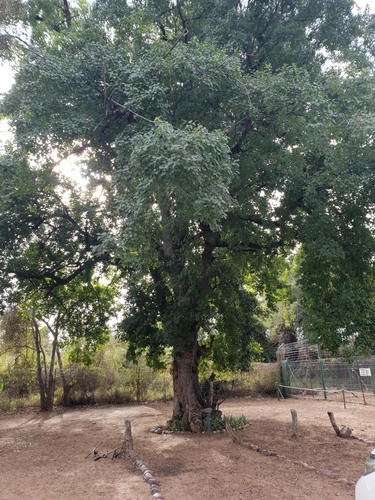
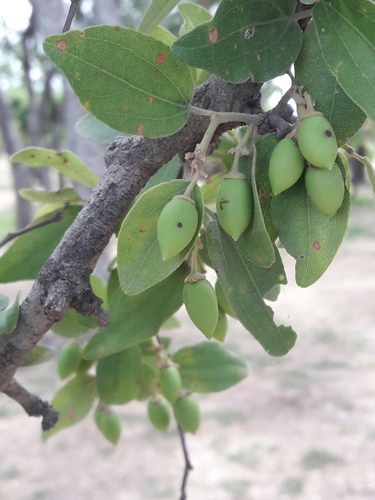
A small tree. It grows 4-8 m high. The trunk is 20-40 cm across. The branches zigzag. The leaves are alternate. They are entire and oblong. They are 4-5 cm long by 2.5-3 cm wide. There are 3 parallel veins running from the base to the tip. The fruit stalks are hairy and 3-4 mm long. The fruit is fleshy with a hard stone inside. It is round and 1.5 cm across. They are green and turn purple. The seed is oval and 1 cm long.
How to Grow
Plants are grown from seed.
Propagation: Seed - best sown as soon as it is ripe in a sunny position in individual containers. A low germination rate can usually be expected, with the seed sprouting within 35 - 50 days.
Other Uses
he heartwood and sapwood are clearly demarcated. The wood is medium to fine-textured, cross-grained, very heavy, hard, flexible, with good mechanical properties and moderately durable, even when exposed. It is used locally for tool handles, cart wheels, lathe work etc. The wood is used for fuel and to make charcoal.
Wikipedia
Source ↗Sarcomphalus mistol or mistol is a species of spiniferous shrub or tree of the family Rhamnaceae. It is native to Peru, Bolivia, Paraguay, and northern Argentina in South America, and very abundant in parts of the Gran Chaco of northern Argentina and Paraguay. The word "mistol" derives from colonial era Spanish, from the word "mixture" (mezcla) since it was believed that mistol was a hybrid between species of genus Schinopsis because of the likely color of its wood to Spaniard colonists' perception.
Other Information
The fruit are enjoyed.
Names & Synonyms
Ahayuc, Ahayuk, Ahayaj, Ayiitak, Chicha, Fruto-de-cabra, Juasy'y, Maala, Mbokaja'i, Naalaic, Nausa, Nosa, Olho-de-boi, Quassii, Veludinho, Yiwa'iwasu, Yiwa'imi, Yu'ayore
References (24)
- Abh. Koenigl. Ges. Wiss. Goettingen 19:99; Pl. lorentz. 51. 1874 (As Ziziphus mistol)
- Arenas, P. and Scarpa, G. F., 2006, Edible wild plants of the Chorote Indians, Gran Chaco, Argentina. Botanical Journal of the Linnean Society. Vol. 153 (1): pp 73-85 (As Ziziphus mistol)
- Bortolotto, I. M., et al, 2015, Knowledge and use of wild edible plants in rural communities along Paraguay River, Pantanal, Brazil. Journal or Ethnobiology and Ethnomedicine. 11:46 (As Ziziphus mistol)
- Bortolotto, I. M., et al, 2018, Lista preliminar das plantas alimenticias nativas de Mato Grosso do Sul, Brasil. Iheringia, Serie Botanica, Porto Alegre, 73 (supl.):101-116 (As Ziziphus oblongifolius)
- INFOODSUpdatedFGU-list.xls (As Ziziphus mistol)
- Kermath, B. M., et al, 2014, Food Plants in the Americas: A survey of the domesticated, cultivated and wild plants used for Human food in North, Central and South America and the Caribbean. On line draft. p 942 (As Ziziphus mistol)
- Lorenzi, H., Bacher, L., Lacerda, M. & Sartori, S., 2006, Brazilian Fruits & Cultivated Exotics. Sao Paulo, Instituto Plantarum de Estuados da Flora Ltda. p 279 (As Ziziphus mistol)
- Malezas Comestibles del Cono Sur, INTA, 2009, Buernos Aires (As Ziziphus mistol)
- Montani, M. C. & Scarpa, G. F., 2016, Recursos vegetales y prácticas alimentarias entre indígenas tapiete del noreste de la provincia de Salta, Argentina. Darwiniana, nueva serie vol.4 no.1 San Isidro jul. 2016 (As Ziziphus mistol)
- NYBG herbarium "edible" (As Ziziphus mistol)
- Palmieri, V. S., et al, 2018, Aproximaciones etnobotánicas de las especies y prácticas de frutos nativos comestibles de la Actualidad. Aportes para la interpretación del pasado prehispánico de cerro colorado (Córdoba, Argentina). Bol. Soc. Argent. Bot. 53 (1): 115-133
- Palmeiri, V. S., & Geisa, M. G., 2019, Las plantas comestibles empleadas por las comunidades comechingonas de San Marcos Sierras (Córdoba, Argentina). Primeras aproximaciones. Bol. Soc. Argent. Bot. 54: 295-309.
- Palmieri, V. S., et al, 2022, Wild edible plants of the Central Mountains in Argentina. Comparing subregions to understand the complexity of local botanical knowledge. Rodriguésia 73: e01092021. 2022
- Polini, G., et al, Useful and edible plants of Paraguay Region of Chaco. p 110 (As Ziziphus mistol)
- Scarpa, G. F., 2009, Wild food plants used by the indigenous peoples of South American Gran Chaco: A general synopsis and intercultural comparison. Journal of Applied Botany and Food Quality 83:90-101 (As Ziziphus mistol)
- Schmedia-Hirschmann, G., 1994, Plants resources Used by the Ayoreo of the Paraguayan Chaco. Economic Botany Vol. 48. No. 3. pp. 252-258 (As Ziziphus mistol)
- Smith, N., Mori, S.A., et al, 2004, Flowering Plants of the Neotropics. Princeton. p 324 (As Ziziphus mistol)
- Toledo, B. A., et al, 2007, Knowledge and Use of Edible and Medicinal Plants in two Populations from the Chaco Forest, Cordoba Province, Argentina. Journal of Ethnobiology 27(2):218-232 (As Ziziphus mistol)
- Toledo, B. A. et al, 2009, Ethnobotanical knowledge in rural communities of Cordoba (Argentina): the importance of cultural and biogeographical factors. Journal of Ethnobiology and Ethnomedicine. 9:22 (As Ziziphus mistol)
- USDA, ARS, National Genetic Resources Program. Germplasm Resources Information Network - (GRIN). [Online Database] National Germplasm Resources Laboratory, Beltsville, Maryland. Available: www.ars-grin.gov/cgi-bin/npgs/html/econ.pl (10 April 2000) (As Ziziphus mistol)
- van Wyk, B., 2005, Food Plants of the World. An illustrated guide. Timber press. p 391 (As Ziziphus mistol)
- Vasquez, Roberto Ch. & Coimbra, German S., 1996, Frutas Silvestres Comestibles de Santa Cruz. p 196 (As Ziziphus mistol)
- World Checklist of Useful Plant Species 2020. Royal Botanic Gardens, Kew (As Sarcomphalus mistol)
- www.colecionandofrutas.org (As Ziziphus oblongifolius)