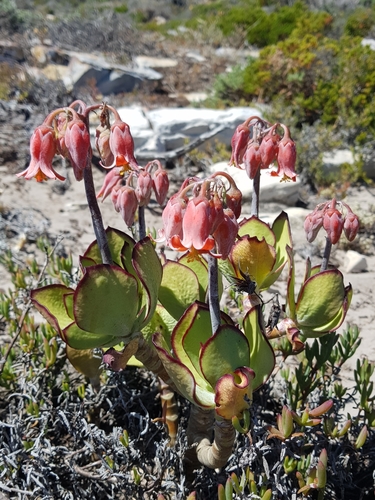
Sedum reflexum
L.
Stonecrop, Jenny stonecrop, Yellow stonecrop
(c) vercassivelaunos, some rights reserved (CC BY-NC)

(c) Kim Falck, some rights reserved (CC BY-NC)

(c) Kim Falck, some rights reserved (CC BY-NC)
What to Eat
Edible parts: Leaves, Spice
The young leaves are eaten raw or cooked in soups and salads.
Where to Find It
It is a temperate plant. It mostly grows on rick walls, stony ground and on dry stream banks. It grows in an open sunny position. It is resistant to frost and drought.
Australia, Czech Republic, Europe*, Netherlands, Tasmania,
How to Identify
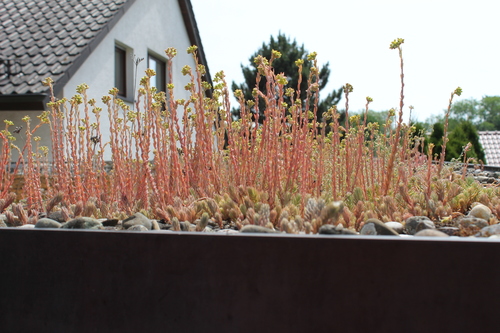
A perennial plant. It grows 30 cm high and spreads 50 cm wide. The stem is slender and lies along the ground. It has a pink tinge. It has several branches that curve upwards. The leaves are spreading and cylinder shaped. They taper towards the tip and curve backwards. The flowers are bright yellow. They are in groups at the ends of branches.
How to Grow
It can be grown by seed, by cuttings or by division of the clump.
Notes
There are about 400 Sedum species.
Names & Synonyms
References (8)
- Bremness, L., 1994, Herbs. Collins Eyewitness Handbooks. Harper Collins. p 216
- Facciola, S., 1998, Cornucopia 2: a Source Book of Edible Plants. Kampong Publications, p 83
- Hammer, K. & Spahillari, M., 1999, Crops of European origin. in Report of a networking group on minor crops. IPGRI p 46
- Kermath, B. M., et al, 2014, Food Plants in the Americas: A survey of the domesticated, cultivated and wild plants used for Human food in North, Central and South America and the Caribbean. On line draft. p 793
- Kiple, K.F. & Ornelas, K.C., (eds), 2000, The Cambridge World History of Food. CUP p 434, 1858
- Simkova, K. et al, 2014, Ethnobotanical review of wild edible plants used in the Czech Republic. Journal of Applied Botany and Food Quality 88, 49-67
- Sp. pl. ed. 2, 1:618. 1762
- Tasmanian Herbarium Vascular Plants list p 23 (Misapplied - see Baker, M. L. & de Salas, M. F., 2012, A Census of the Vascular Plants of Tasmania. (On line))