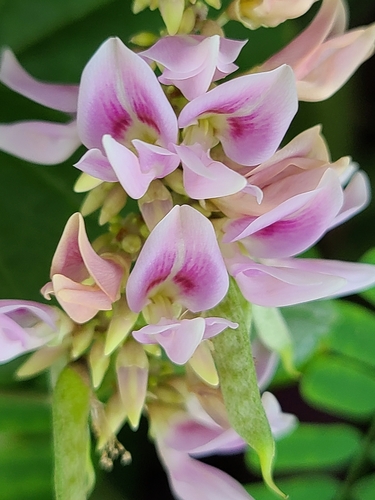
Acacia omalophylla
A. Cunn. ex Benth.
Yarran, Gidya tree
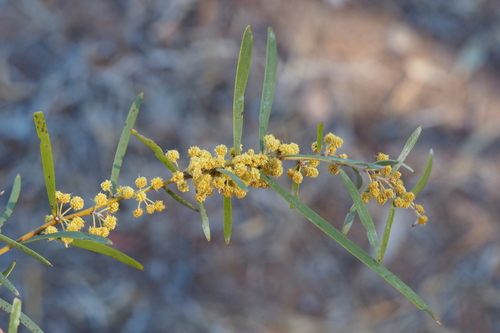
(c) Greg Spearritt, some rights reserved (CC BY-NC), uploaded by Greg Spearritt
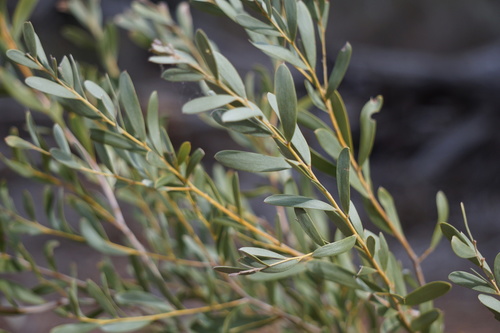
(c) Bruce McLennan, some rights reserved (CC BY-NC), uploaded by Bruce McLennan
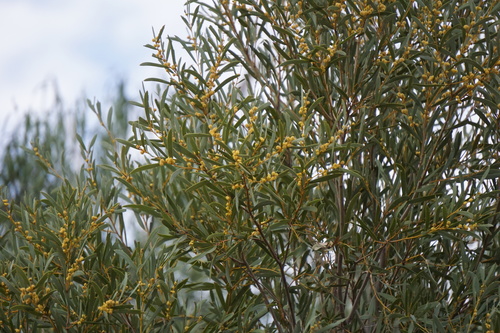
(c) Bruce McLennan, some rights reserved (CC BY-NC), uploaded by Bruce McLennan
What to Eat
Edible parts: Seeds, Gum
The seeds and gum can be eaten.
Where to Find It
It is a warm temperate plant. It occurs in inland Australia. It suits semi arid places. It can grow on a wide range of soils but requires a sunny position. It can grow in cooler places. It is drought, frost and wind resistant. It grows in areas with a rainfall between 150-650 mm. It can grow in arid places.
Africa, Asia, Australia*, India, Israel, Kenya, Mediterranean, Middle East, Pakistan,
How to Identify
A shrub or small tree. It grows 5 m tall. There are prickles along the stem. The leaves are twice divided and there are 8-18 pairs of pinnae. There are up to 50 pairs of pinnules on each pinnae. The flowers are yellow. They are in large clusters at the ends of branches. The pods are flattened.
How to Grow
It is grown from seed. The seed need treatment to break the hard seed coat. Normally this is by putting the seeds in very hot water and letting the water cool down overnight then planting the seeds immediately.
Wikipedia
Source ↗Acacia omalophylla, also known as yarrany or yarran, is a shrub or tree of the genus Acacia that is native to the eastern states of Australia from south central Queensland to northern parts of Victoria. It has also been introduced into India and Pakistan.
Notes
There are about 1,350 Acacia species. Over 1,000 occur in Australia. Also as Mimosaceae.
Names & Synonyms
Myall-wood, Violet-wood
References (10)
- Bodkin, F., 1991, Encyclopedia Botanica. Cornstalk publishing, p 27
- Bodkin, F., 1991, Encyclopedia Botanica. Cornstalk publishing, p 20 (As Acacia homalophylla)
- Cherikoff V. & Isaacs, J., The Bush Food Handbook. How to gather, grow, process and cook Australian Wild Foods. Ti Tree Press, Australia p 47
- Elliot, W.R., & Jones, D.L., 1982, Encyclopedia of Australian Plants suitable for cultivation. Vol 2. Lothian. p 91
- Hedrick, U.P., 1919, (Ed.), Sturtevant's edible plants of the world. p 19 (As Acacia homalophylla)
- Irvine (As Acacia homalophylla)
- Lazarides, M. & Hince, B., 1993, Handbook of Economic Plants of Australia, CSIRO. p 4 (As Acacia homalophylla)
- Lazarides, M. & Hince, B., 1993, Handbook of Economic Plants of Australia, CSIRO. p 5
- London J. Bot. 1:365. 1842
- Royal Botanic Gardens, Kew (1999). Survey of Economic Plants for Arid and Semi-Arid Lands (SEPASAL) database. Published on the Internet; http://www.rbgkew.org.uk/ceb/sepasal/internet [Accessed 27th April 2011]