Dipcadi marlothii
Engl.
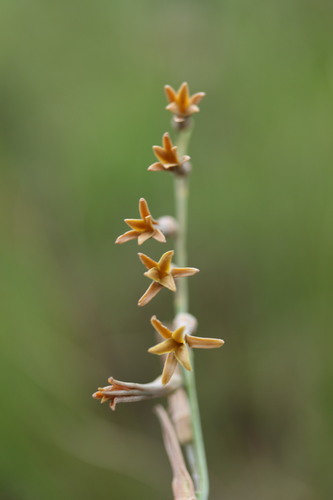
(c) Sharon Louw, some rights reserved (CC BY-NC), uploaded by Sharon Louw

(c) graham_g, some rights reserved (CC BY-NC)
What to Eat
Edible parts: Bulb
The bulbs are eaten both raw and cooked, and are traditionally consumed by Bushmen in South Africa.
Known Hazards
Where to Find It
A tropical plant. It grows in the Kalahari.
Africa, Botswana, East Africa, Eswatini, Lesotho, Namibia, South Africa, Southern Africa, Swaziland, Zimbabwe,
How to Identify
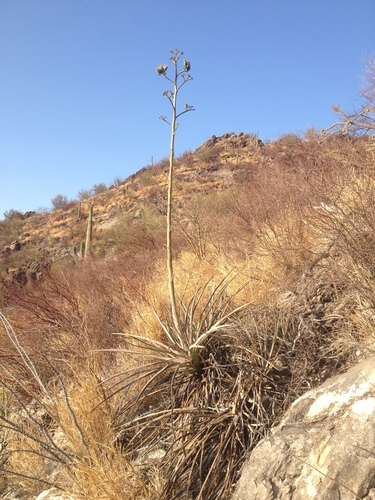
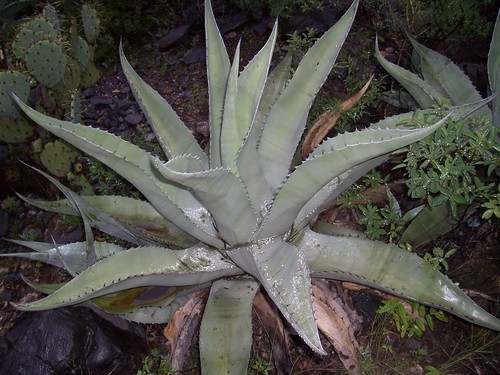
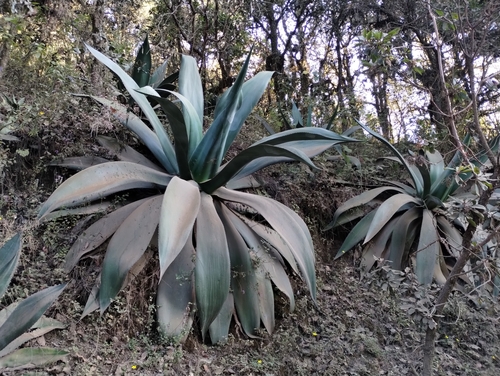
An erect herb plant with a bulb. It grows 50-100 cm high. The bulb is round but extends into a neck. It has a brown leathery skin. The leaves are thin and narrow tapering to a long point. The flowers occur as about 12 flowers around the stalk. The individual flowers are 18 mm long and green. They are shaped like a cylinder but with a tip which rolls back. The fruit are an oblong ridged capsule.
Other Information
It is eaten by Bushmen in South Africa.
Notes
They have also been put in the families Hyacinthaceae and Liliaceae.
Names & Synonyms
Dronkui, Morotoana, Ncamjolo, Phokoana, Phookoana, Umgcobane
References (10)
- FAO, 1988, Traditional Food Plants, FAO Food and Nutrition Paper 42. FAO Rome p 249
- Fox, F. W. & Young, M. E. N., 1982, Food from the Veld. Delta Books. p 250
- http://aflora.africa.kyoto-u.ac.jp
- Lee, 1979,
- Long, C., 2005, Swaziland's Flora - siSwati names and Uses http://www.sntc.org.sz/flora/
- Maguire, 1978,
- Peters, C. R., O'Brien, E. M., and Drummond, R.B., 1992, Edible Wild plants of Sub-saharan Africa. Kew. p 30
- Ruiters-Welcome, A. K., 2019, Food plants of southern Africa. Ph.D. thesis. Univ. of Johannesburg p 65
- Swaziland's Flora Database http://www.sntc.org.sz/flora
- Welcome, A. K. & Van Wyk, B.-E., 2019, An inventory and analysis of the food plants of southern Africa. South African Journal of Botany 122 (2019) 136–179