Pouteria glomerata
(Miquel) Radlkofer
Abio, Glomerate pouteria

(c) Leandro Bareiro Guiñazú, some rights reserved (CC BY-NC)

(c) Leandro Bareiro Guiñazú, some rights reserved (CC BY-NC)

(c) Leandro Bareiro Guiñazú, some rights reserved (CC BY-NC)
What to Eat
Edible parts: Seeds, Fruit, Nuts
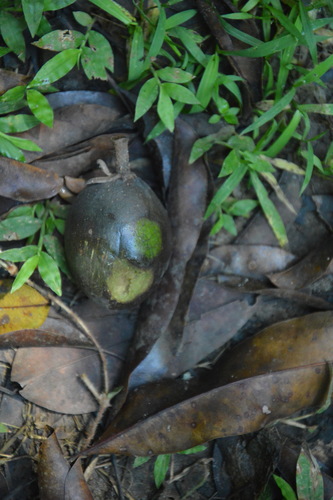
Fruit - raw. The flesh is fragrant. The oval to globose fruit is about 7cm long and 5cm wide with a very thick, hard shell and 4 fairly large seeds.
Known Hazards
Where to Find It
A tropical plant. It grows in wet forests. It is often along river banks and in flooded land. It grows from sea level to 1,300 m above sea level. It is native to Mexico and El Salvador. It can grow on limestone soils.
Amazon, Argentina, Brazil, Central America, Colombia, Costa Rica, Ecuador, El Salvador, French Guiana, Guatemala, Honduras, Mexico, North America, Panama, Paraguay, Peru, South America*, USA, Venezuela, Yucatan,
How to Identify
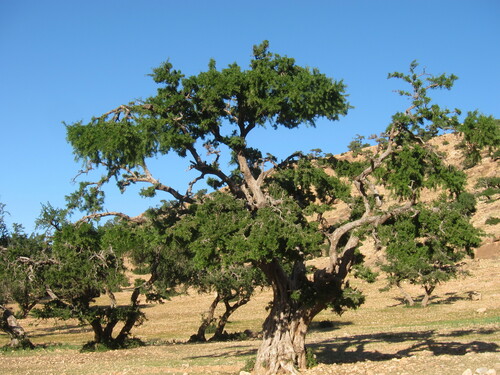
A medium sized tree. It grows 20 m tall. The trunk can be slightly fluted. The leaves are simple and alternate. The leaves are clustered at the ends of branches and arranged in spirals. They are 6-20 cm long by 3-6 cm wide. The leaves are widest above the middle. The leaves are silvery underneath. The flowers are small and in clusters on the branches below the leaves. There are 2-10 in a group. The fruit are round with a short sharp point. They are 3-9 cm long. The fruit turn yellow when ripe. There can be one or several seeds.
Nutrition Score: 15/100
| Part | Moisture | kJ | kcal | Protein | Vit A | Vit C | Iron | Zinc |
|---|---|---|---|---|---|---|---|---|
| Fruit | 85.2 | — | 50 | 0.7 | — | — | — | — |
How to Grow
Plants can tolerate occasioal temperatures as low as -2°c.
Wikipedia
Source ↗Pouteria glomerata is a species of plant in the family Sapotaceae. It is distributed from Mexico to North-East Argentina. Its greatest presence is in Brazil, where it is known as abiurana-do-igapó (wetland abiurana). Mature fruit has a smooth and yellow pericarp, with four ovary locules. The subspecies Pouteria glomerata subsp. stylosa is endemic to the Amazon Basin, where it is called abiurana-roxa (purple abiurana). The subspecies Pouteria glomerata subsp. glomerata, formerly known as Pouteria hypoglauca, is native to Central America, and an edible fruit (called cinnamon apple), grown in Florida.
Other Information
The fruit is popular.
Notes
There are about 150-320 Pouteria species. They grow in the tropics.
Names & Synonyms
Abiurana, Caimito, Chocho, Cinnamon apple, Laranjinha-de-pacu, Macondje, Mameicillo, Marmelada, Moranguinha, Nisperillo, Pan de Vida, Parada, Thokob
References (26)
- ALCORN, (As Pouteria hypoglauca)
- Bortolotto, I. M., et al, 2015, Knowledge and use of wild edible plants in rural communities along Paraguay River, Pantanal, Brazil. Journal or Ethnobiology and Ethnomedicine. 11:46
- Bortolotto, I. M., et al, 2018, Lista preliminar das plantas alimenticias nativas de Mato Grosso do Sul, Brasil. Iheringia, Serie Botanica, Porto Alegre, 73 (supl.):101-116
- Bortholotto, I. M. et al, 2021, Food Composition Data: Edible Plants of Patanal. p307 In Jacob. U.P (Eds) Local Food Plants of Brazil. Ethnobiology.
- Condit, R., et al, 2011, Trees of Panama and Costa Rica. Princeton Field Guides. p 442
- Barwick, M., 2004, Tropical and Subtropical Trees. A Worldwide Encyclopedic Guide. Thames and Hudson p 345 (As Pouteria hypoglauca)
- Candollea 9:250. 1942 (As Pouteria hypoglauca)
- Facciola, S., 1998, Cornucopia 2: a Source Book of Edible Plants. Kampong Publications, p 228 (As Pouteria hypoglauca)
- Grandtner, M. M., 2008, World Dictionary of Trees. Wood and Forest Science Department. Laval University, Quebec, Qc Canada. (Internet database http://www.wdt.qc.ca)
- Grandtner, M. M. & Chevrette, J., 2013, Dictionary of Trees, Volume 2: South America: Nomenclature, Taxonomy and Ecology. Academic Press p 526
- Hermandez Bermejo, J.E., and Leon, J. (Eds.), 1994, Neglected Crops. 1492 from a different perspective. FAO Plant Production and Protection Series No 26. FAO, Rome. p17 (As Pouteria hypoglauca)
- Kermath, B. M., et al, 2014, Food Plants in the Americas: A survey of the domesticated, cultivated and wild plants used for Human food in North, Central and South America and the Caribbean. On line draft. p 690 (Also as Pouteria hypoglauca)
- Leticia, Z., et al, 2015, Do Socioeconomic characteristics explain the knowledge and use of native food plants in semiarid environments in Northeastern Brazil? Journal of Arid Environments 115:53-61
- Lopez-Diago, D. & Garcia, N., 2021, Wild edible fruits of Colombia. Biota ColomBiana 22 (2) p 51
- Menninger, E.A., 1977, Edible Nuts of the World. Horticultural Books. Florida p 33 (As Pouteria hypoglauca)
- NYBG herbarium "edible"
- Pennington, T.D., 1990, Sapotaceae in Flora Neotropica Monograph 52. New York Botanical Gardens. p 419
- Piedra-Malagón, E. M., et al, 2022, Edible native plants of the Gulf of Mexico Province. Biodiversity Data Journal 10: e80565 p 29
- Reis, S. V. and Lipp, F. L., 1982, New Plant Sources for Drugs and Foods from the New York Botanical Garden herbarium. Harvard. p 235 (As Pouteria hypoglauca)
- Roa, J. A. G. & Boada, D. S. G., 2018, Fundación para el Fortalecimiento de la Fruticultura y Plantas Alimenticias no Convencionales en Colombia.
- Segura, S., et al, 2018, The edible fruit species in Mexico. Genet Resour Crop Evol (2018) 65:1767–1793
- Steggerda, M., Some Ethnological Data Concerning One Hundred Yucatan Plants. Smithsonian Institution Anthropological Papers, No. 29 (As Pouteria hypoglauca)
- Torre, de la, L., et al, 2008, Enciclopedia de las Plantas Útiles del Ecuador. Herbario QCA. Pontificia Universidad Católica del Ecuador. p 572
- Van den Eynden, V., et al, 2003, Wild Foods from South Ecuador. Economic Botany 57(4): 576-603
- Van Roosmalen, M.G.M., & Garcia, O. M., 2000, Fruits of the Amazonian Forest. Part 2: Sapotaceae. Acta Amazonica 30(2): 187-290
- Wickens, G.E., 1995, Edible Nuts. FAO Non-wood forest products. FAO, Rome. p152