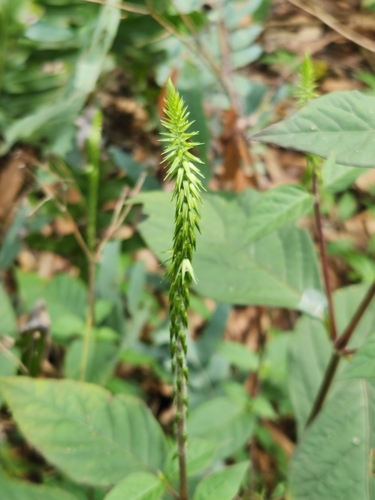
Nothosaerva brachiata
(L.) Wight
AmaranthaceaeLeaves

iNaturalist · cc-by-sa
(c) Dinesh Valke, some rights reserved (CC BY-SA)
(c) Dinesh Valke, some rights reserved (CC BY-SA)

iNaturalist · cc-by-nc
(c) Bart Wursten, some rights reserved (CC BY-NC)
(c) Bart Wursten, some rights reserved (CC BY-NC)
What to Eat
Edible parts: Leaves
The leaves are used as a pot herb.
Where to Find It
A tropical plant. It grows in sandy depressions that occasionally contain water.
Africa, Angola, Asia, Burkina Faso, Central Africa, East Africa, Ethiopia, India, Malawi, Mauritius, Mozambique, Myanmar, Nigeria, Pakistan, SE Asia, Senegal, Somalia, Southern Africa, Sri Lanka, Sudan, West Africa, Zambia, Zimbabwe,
Countries: United Arab Emirates, Afghanistan, Armenia, Angola, Azerbaijan, Bangladesh, Burkina Faso, Bahrain, Burundi, Benin, Brunei, Bhutan, Botswana, Congo (DRC), Central African Republic, Congo (Republic), Cote d'Ivoire, Cameroon, China, Cape Verde, Djibouti, Algeria, Egypt, Eritrea, Ethiopia, Gabon, Georgia, Ghana, Gambia, Guinea, Equatorial Guinea, Guinea-Bissau, Indonesia, Israel, India, Iraq, Iran, Jordan, Japan, Kenya, Kyrgyzstan, Cambodia, Comoros, North Korea, South Korea, Kuwait, Kazakhstan, Laos, Lebanon, Sri Lanka, Liberia, Lesotho, Libya, Morocco, Madagascar, Mali, Myanmar, Mongolia, Mauritania, Mauritius, Maldives, Malawi, Malaysia, Mozambique, Namibia, Niger, Nigeria, Nepal, Oman, Philippines, Pakistan, Qatar, Rwanda, Saudi Arabia, Seychelles, Sudan, Singapore, Sierra Leone, Senegal, Somalia, South Sudan, Sao Tome & Principe, Syria, Eswatini, Chad, Togo, Thailand, Tajikistan, Timor-Leste, Turkmenistan, Tunisia, Turkey, Taiwan, Tanzania, Uganda, Uzbekistan, Vietnam, Yemen, South Africa, Zambia, Zimbabwe
How to Identify
An annual herb. It grows 10-45 cm high. The leaves are narrowly oval. They are 10-40 mm long by 6-20 mm wide. They taper towards the leaf stalk. The flowers are in dense spikes. The seed are about 0.4 mm across.
Notes
There is only one Nothosaerva species.
Names & Synonyms
Akkura, Dhaula phindawri
Achyranthes brachiata L.Aerva brachiata (L.) Mart.Illecebrum brachiatum (L.) L.Pseudanthus brachiatus (L.) Wight
References (4)
- Ambasta, S.P. (Ed.), 2000, The Useful Plants of India. CSIR India. p 400
- Pullaiah, Y., Krishnamurthy, K. V. & Bahadur, B., (Eds.), 2016, Ethnobotany of India, Volume 1: Eastern Ghats and Deccan.
- Reddy, K. N. et al, 2007, Traditional knowledge on wild food plants in Andhra Pradesh. Indian Journal of Traditional Knowledge. Vol. 6(1): 223-229
- Singh, H.B., Arora R.K.,1978, Wild edible Plants of India. Indian Council of Agricultural Research, New Delhi. p 31