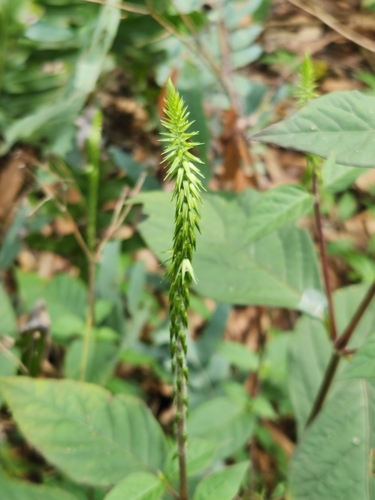
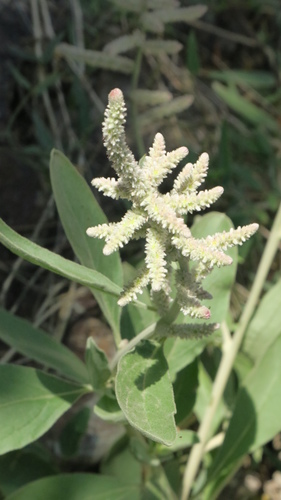
Acroglochin persicarioides
(Poiret) Moquin-Tandon
Qian zhen xian

Georg Volkens, no known copyright restrictions (public domain)

Wikimedia Commons - Georg Volkens
What to Eat
Edible parts: Leaves
The leaves are eaten with oil and salt and serve as a famine food.
Where to Find It
It is a subtropical plant. It grows on the edges of forests and along rivers.
Asia, Bhutan, China, Himalayas, India, Nepal, Pakistan, Tibet,
How to Identify
A shrub or small tree. It grows 5 m tall. There are prickles along the stem. The leaves are twice divided and there are 8-18 pairs of pinnae. There are up to 50 pairs of pinnules on each pinnae. The flowers are yellow. They are in large clusters at the ends of branches. The pods are flattened.
Wikipedia
Source ↗Acroglochin persicarioides is a species of flowering plants in the plant family Amaranthaceae. It is distributed from the Himalayas to China. The systematic position of the genus Acroglochin in subfamily Betoideae is still uncertain.
Other Information
It is a famine food.
Notes
Also put in the family Chenopodiaceae.
Names & Synonyms
Fu hui tiao, Tieniliama
References (3)
- Famine Foods.
- Kang, Y., et al, 2014, Wild food plants used by the Tibetans of Gongba Valley (Zouqu country, Gansu, China) Journal of Ethnobiology and Ethnomedicine 10:20
- READ