Pegia nitida
Colebr.
Tam
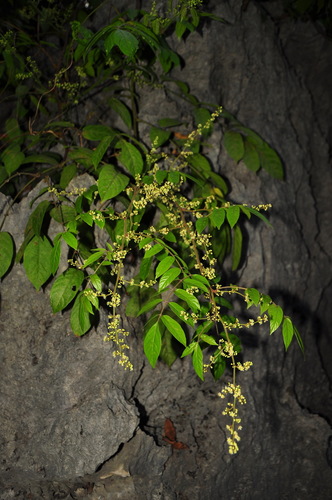
(c) mazus_jan, some rights reserved (CC BY-NC-SA), uploaded by mazus_jan

(c) Dinesh Valke, some rights reserved (CC BY-SA)
What to Eat
Edible parts: Leaves, Fruit
The young leaves are eaten as a vegetable, and the ripe fruit are eaten fresh.
Where to Find It
A subtropical plant. It grows in scrub forests in Assam up to 1,300 m above sea level. In southern China it grows in lowland hill forests between 500-1,800 m above sea level. In Yunnan.
Asia, Bangladesh, Bhutan, China, Himalayas, India, Indochina, Myanmar, Nepal, Northeastern India, SE Asia, Thailand,
How to Identify
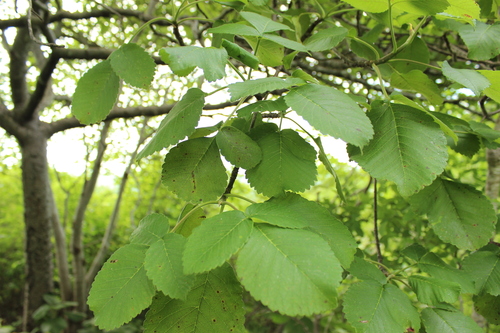
A shrub that often leans over. It can be a woody climber. It is hairy. The leaves are compound. They are 20-40 cm long with leaflets along the stalk and one at the end. The leaflets are 4-11 cm long by 2-5 cm wide. The flowers are small and white. They have a sweet scent. The fruit is fleshy and small and oblong. They are black when ripe. They are 10 mm long by 8 mm wide.
Production
In Thailand it flowers and fruits January to May.
Names & Synonyms
Bon am, Chutti lara, Da-cheng-brup, Dhindau bagurilata, Dhindou bogori, Du-cheng-brup, Hangding, Hongding, Lahari anp, Lomam, Mashul, Midi-takkir, Redin, Renchiling, Sirong-rik, Tam
References (12)
- Chayamarit, K., 1994, Preliminary Checklist of the Family Anacardiaceae in Thailand. Thai For. Bull. 22:1-25
- Dobriyal, M. J. R. & Dobriyal, R., 2014, Non Wood Forest Produce an Option for Ethnic Food and Nutritional Security in India. Int. J. of Usuf. Mngt. 15(1):17-37
- Gangwar, A. K. & Ramakrishnan, P. S., 1990, Ethnobotanical Notes on Some Tribes of Arunachal Pradesh, Northeastern India. Economic Botany, Vol. 44, No. 1 pp. 94-105 (Also as Tapirira hirsuta)
- Majumdar, K and Datta, N., 2009, Traditional wild edible fruits for the forest dwellers of Tripura, India. Pleione 3(2) 167-178
- Murtem, G. & Chaudhrey, P., 2016, An ethnobotanical note on wild edible plants of Upper Eastern Himalaya, India. Brazilian Journal of Biological Sciences, 2016, v. 3, no. 5, p. 63-81.
- Pasha, M. K. & Uddin, S. B., 2019, Minor Edible Fruits of Bangladesh. Bangladesh J. Plant Taxon. 26(2): 299–313 (As Tapirira hirsuta)
- Patiri, B. & Borah, A., 2007, Wild Edible Plants of Assam. Geethaki Publishers. p 32
- Pegu, R., et al, 2013, Ethnobotanical study of Wild Edible Plants in Poba Reserved Forest, Assam, India. Research Journal of Agriculture and Forestry Sciences 1(3):1-10 (As Tapirira hirsuta)
- Sarma, H., et al, 2010, Updated Estimates of Wild Edible and Threatened Plants of Assam: A Meta-analysis. International Journal of Botany 6(4): 414-423
- Sawian, J. T., et al, 2007, Wild edible plants of Meghalaya, North-east India. Natural Product Radiance Vol. 6(5): p 420 and p 422 (As Tapirira hirsuta)
- Singh, H.B., Arora R.K.,1978, Wild edible Plants of India. Indian Council of Agricultural Research, New Delhi. p 32, 68
- Singh, V. B., et al, (Ed.) Horticulture for Sustainable Income and Environmental Protection. Vol. 1 p 217