Alphonsea lutea
(Roxb.) Hook. f. & Thomson
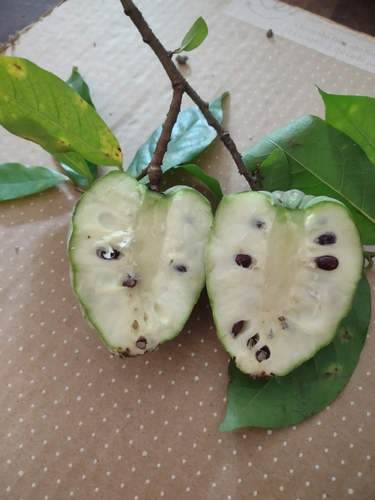
AnnonaceaeFruit

iNaturalist · cc-by
(c) Siddarth Machado, some rights reserved (CC BY), uploaded by Siddarth Machado
(c) Siddarth Machado, some rights reserved (CC BY), uploaded by Siddarth Machado

iNaturalist · cc-by
(c) Siddarth Machado, some rights reserved (CC BY), uploaded by Siddarth Machado
(c) Siddarth Machado, some rights reserved (CC BY), uploaded by Siddarth Machado
iNaturalist · cc-by
(c) Siddarth Machado, some rights reserved (CC BY), uploaded by Siddarth Machado
(c) Siddarth Machado, some rights reserved (CC BY), uploaded by Siddarth Machado
What to Eat
Edible parts: Fruit
The ripe fruit are eaten.
Where to Find It
A tropical plant. It grows in moist deciduous forests.
Asia, Bangladesh, India, Myanmar, Northeastern India, SE Asia, Sri Lanka,
Countries: United Arab Emirates, Afghanistan, Armenia, Azerbaijan, Bangladesh, Bahrain, Brunei, Bhutan, China, Georgia, Indonesia, Israel, India, Iraq, Iran, Jordan, Japan, Kyrgyzstan, Cambodia, North Korea, South Korea, Kuwait, Kazakhstan, Laos, Lebanon, Sri Lanka, Myanmar, Mongolia, Maldives, Malaysia, Nepal, Oman, Philippines, Pakistan, Qatar, Saudi Arabia, Singapore, Syria, Thailand, Tajikistan, Timor-Leste, Turkmenistan, Turkey, Taiwan, Uzbekistan, Vietnam, Yemen
How to Identify
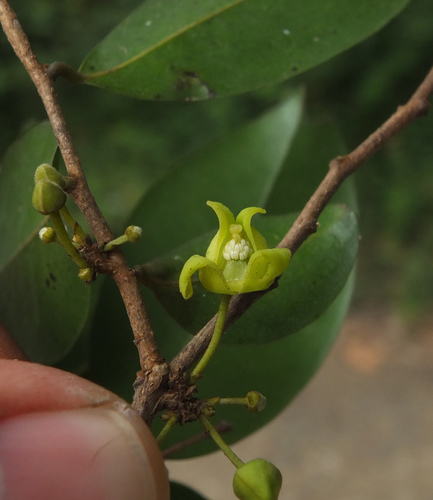
A tree. It grows 10-20 m tall. The bark is dark brown and corky. The leaves are simple and alternate. They are slightly hairy underneath. The leaves are oblong and 8-14 cm long by 3-7 cm wide. The flowers contain both sexes. They are in dense fascicles and opposite the leaves. The fruit are round or oval and 1.5 cm long. They are hairy.
Notes
The Annonaceae are a mainly tropical family.
Names & Synonyms
Fonseti, Jong-mol-kung, Noga kala, Zawngbalhla-rah-techi
Bocagea lutea Baill.Alphonsea sclerocarpa ThwaitesAlphonsea madrasapatana Bedd.Uvaria lutea Roxb.Uvaria russelii Wall.
References (8)
- Ambasta S.P. (Ed.), 2000, The Useful Plants of India. CSIR India. p 30
- Bakri, Y. M. et al, 2017, A mini Review on Alphonsea sp. (Annonaceae): Traditional uses, Biological Activities and Phytochemistry. Journal of Applied Pharmaceutical Science Vol. 7 (10), pp. 200-203
- Dobriyal, M. J. R. & Dobriyal, R., 2014, Non Wood Forest Produce an Option for Ethnic Food and Nutritional Security in India. Int. J. of Usuf. Mngt. 15(1):17-37
- Fl. ind. 1:153. 1855
- Kar, A., et al, 2013, Wild Edible Plant Resources used by the Mizos of Mizoram, India. Kathmandu University Journal of Science, Engineering and Technology. Vol. 9, No. 1, July, 2013, 106-126
- Pasha, M. K. & Uddin, S. B., 2019, Minor Edible Fruits of Bangladesh. Bangladesh J. Plant Taxon. 26(2): 299–313
- Singh, H.B., Arora R.K.,1978, Wild edible Plants of India. Indian Council of Agricultural Research, New Delhi. p 48
- Singh, V. B., et al, (Ed.) Horticulture for Sustainable Income and Environmental Protection. Vol. 1 p 214