Berberis nepalensis
Spreng.
Nepal barberry

no rights reserved

no rights reserved

(c) Sagnik Dutta Roy, some rights reserved (CC BY)
What to Eat
Edible parts: Fruit, Flowers, Shoots
The ripe fruit are eaten fresh or pickled; they are bitter and acidic. The flowers and young shoots are eaten as a vegetable and used in chutney.
Where to Find It
A subtropical plant. In Nepal they grow between 2200-2800 m altitude.
Asia, Bhutan, China, Himalayas, India, Indonesia, Malaysia, Nepal, Northeastern India, SE Asia, Sikkim,
How to Identify
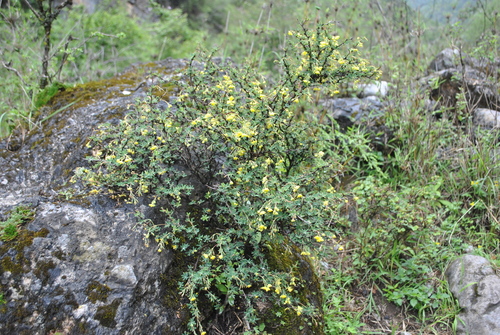
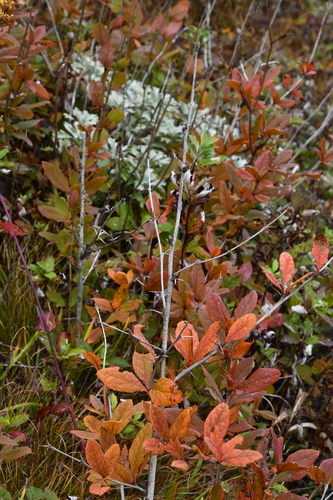
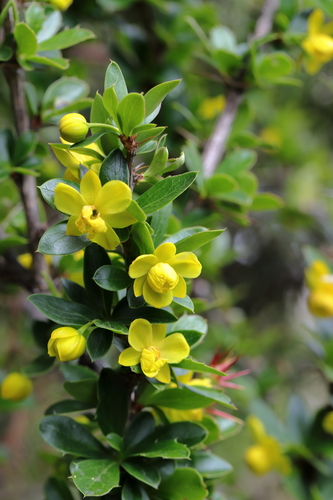
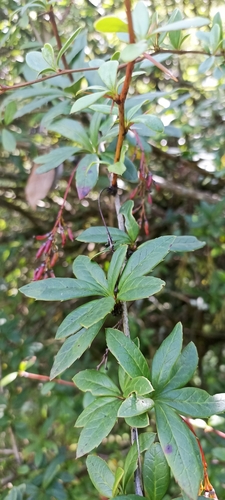
A shrub. It grows to about 3 m high. The leaves have stalks. They have an odd number of leaflets along the stalk. There are 17-21 leaflets. They are oval and taper to the tip. They have spiny teeth. They are glossy. The flowers are yellow. They occur in dense clusters along the stalk.
How to Grow
Plants are grown from seed.
Notes
There are 70-100 Mahonia species. Many Mahonia are included in Berberis.
Names & Synonyms
Barberi Nepal, Chutro, Kesari, Pual-eng, Tamen, Taming
References (11)
- Ambasta S.P. (Ed.), 2000, The Useful Plants of India. CSIR India. p 350 (As Mahonia acanthifolia)
- Dobriyal, M. J. R. & Dobriyal, R., 2014, Non Wood Forest Produce an Option for Ethnic Food and Nutritional Security in India. Int. J. of Usuf. Mngt. 15(1):17-37 (As Mahonia acanthifolia)
- Gen. hist. 1:118. 1831 (As Mahonia acanthifolia)
- Kar, A., et al, 2013, Wild Edible Plant Resources used by the Mizos of Mizoram, India. Kathmandu University Journal of Science, Engineering and Technology. Vol. 9, No. 1, July, 2013, 106-126
- Manandhar, N.P., 2002, Plants and People of Nepal. Timber Press. Portland, Oregon. p 306 (As Mahonia acanthifolia)
- Murtem, G. & Chaudhrey, P., 2016, An ethnobotanical note on wild edible plants of Upper Eastern Himalaya, India. Brazilian Journal of Biological Sciences, 2016, v. 3, no. 5, p. 63-81. (As Mahonia acanthifolia)
- Savita, et al, 2006, Studies on wild edible plants of ethnic people in east Sikkim. Asian J. of Bio Sci. (2006) Vol. 1 No. 2 : 117-125 (As Mahonia acanthifolia)
- Singh, H.B., Arora R.K.,1978, Wild edible Plants of India. Indian Council of Agricultural Research, New Delhi. p 66 (As Mahonia acanthifolia)
- Singh, V. B., et al, (Ed.) Horticulture for Sustainable Income and Environmental Protection. Vol. 1 p 217 (As Mahonia acanthifolia)
- Srivastava, R. C., et al, 2010, Indigenous biodiversity of Apatani plateau: Learning on biolcultural knowledge of Apani tribe of Qrunachal Pradesh for sustainable livelihoods. Indian Journal of Traditional Knowledge 9(3): 432-442 (As Mahonia acanthifolia)
- Sukarya, D. G., (Ed.) 2013, 3,500 Plant Species of the Botanic Gardens of Indonesia. LIPI p 591