Salacia roxburghii
Wall.
CelastraceaeFruit

gbif · cc-by-nc
Manu Guerrero
Manu Guerrero

gbif · cc-by-nc
Micky Orrey
Micky Orrey

gbif · cc-by-nc
Micky Orrey
Micky Orrey
What to Eat
Edible parts: Fruit
The fruit are edible.
Where to Find It
It is a tropical plant. It grows in open areas and up to 600 m above sea level.
Asia, India, Myanmar, SE Asia,
Countries: United Arab Emirates, Afghanistan, Armenia, Azerbaijan, Bangladesh, Bahrain, Brunei, Bhutan, China, Georgia, Indonesia, Israel, India, Iraq, Iran, Jordan, Japan, Kyrgyzstan, Cambodia, North Korea, South Korea, Kuwait, Kazakhstan, Laos, Lebanon, Sri Lanka, Myanmar, Mongolia, Maldives, Malaysia, Nepal, Oman, Philippines, Pakistan, Qatar, Saudi Arabia, Singapore, Syria, Thailand, Tajikistan, Timor-Leste, Turkmenistan, Turkey, Taiwan, Uzbekistan, Vietnam, Yemen
How to Identify
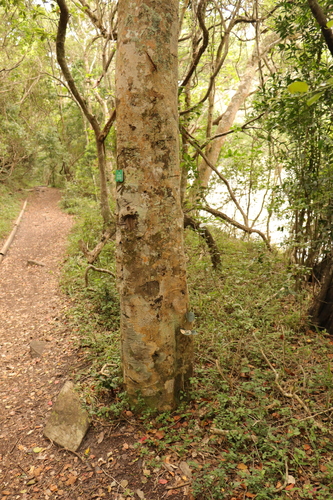
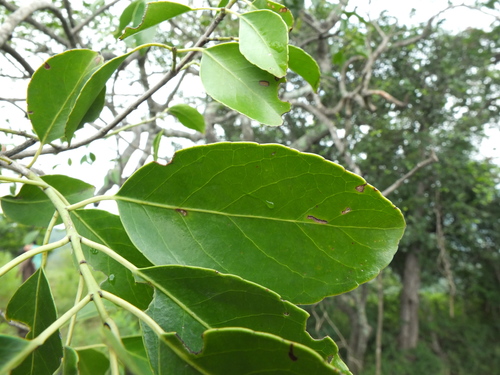
A large woody climber. The bark is thick and dark grey. The leaves are sword shaped and 10-13 cm long by 5-8 cm wide. They have a long leaf stalk. There are many flowers on long stalks. The flowers are greenish yellow. The fruit are dull red. The pulp is white. There are 2-3 cells with a large seed in each.
How to Grow
Plants can be grown from seeds.
Names & Synonyms
Ainkimbel, Maku-tung-ehung, Salasia roxburgii, Sibrai-etam
References (4)
- Ambasta, S.P. (Ed.), 2000, The Useful Plants of India. CSIR India. p 540
- Hedrick, U.P., 1919, (Ed.), Sturtevant's edible plants of the world. p 589
- Singh, H.B., Arora R.K.,1978, Wild edible Plants of India. Indian Council of Agricultural Research, New Delhi. p 71
- Sukarya, D. G., (Ed.) 2013, 3,500 Plant Species of the Botanic Gardens of Indonesia. LIPI p 967