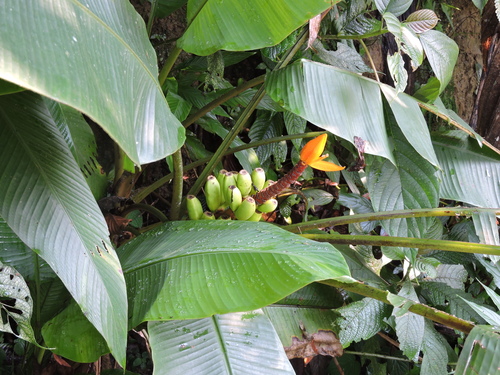
Ensete superbum
(Roxb.) Cheesman
Cliff banana

(c) Satish Nikam, some rights reserved (CC BY-NC-SA)

(c) martineno, some rights reserved (CC BY-NC-SA)
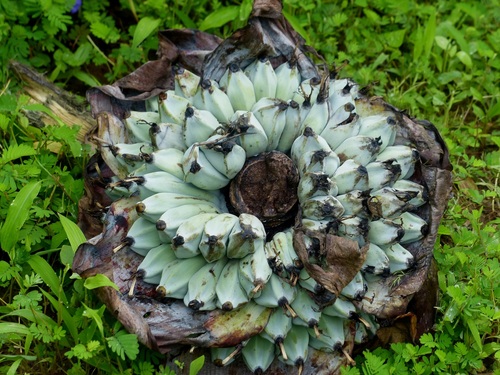
(c) Radha Veach, some rights reserved (CC BY-NC), uploaded by Radha Veach
What to Eat
Edible parts: Fruit, Flowers, Root, Rhizome, Flower stalk, Leaf-sheaths, Stem, Seed
The sprouting buds, young fruits, and flowering stalk are eaten as vegetables. The roots are dried, powdered, and made into flour for bread. The flower stalk without leaves, rolled up leaf sheaths, and seeds are also consumed. Young fruits can be pickled.
Where to Find It
A tropical plant. It grows on steep slopes of hills in the Pune district in India. It can be on limestone cliffs.
Asia, India*, Indonesia, Northeastern India, SE Asia, Singapore,
How to Identify
A banana like plant. It is a large herb. It has a false stem 4 m tall. The leaves are 3.3 m long by 1 m wide. The fruit spikes are 1.3 m long. They droop. The bracts are red and round. There are 20-30 flowers on a spike. The fruit are oblong and 3 sided berries. They are 7 cm long. The seeds are a flattened round shape.
How to Grow
Plants can be grown from seeds. They can also be grown from the rhizome.
Medicinal Uses
The roots are dried and powdered to make flour.
Wikipedia
Source ↗Ensete superbum is a species of banana from India.
Other Information
Leaves are sold in local markets.
Notes
There are 10 Ensete species.
Names & Synonyms
Bankel, Bankela, Chavan, Chaveli-keli, Chaveni, Chowani, Colon, Janglikela, Jangali keli, Kardai, Kaudar, Kawdari, Kopak, Lobong keng tong, Malai vazhai, Namninyah, Napkhoi, Pisang ensete besar, Raanmel, Rai keli, Rankel, Rankela, Rankele, Sai suo mot, Sai-su, Saisuang, Saisuong, Thaliphang yasong
References (29)
- Ambasta, S.P. (Ed.), 2000, The Useful Plants of India. CSIR India. p 196
- Angami, A., et al, 2006, Status and potential of wild edible plants of Arunachal Pradesh. Indian Journal of Traditional Knowledge 5(4) October 2006, pp 541-550
- Arinathan, V., et al, 2007, Wild edibles used by Palliyars of the western Ghats, Tamil Nadu. Indian Journal of Traditional Knowledge. 6(1) pp 163-168
- Bhogaonkar, P. Y. & Devarkar, V. D., 2018, Inventory for ethnovegetable knowledge of the tribals of Satpura hill area-Melghat, Dist. Amravati (India), Plantae Scientia, 2018; Vol. 01 Issue 01: 01-08
- GAMMIE, (As Musa superba)
- Gangte, H. E., et al, 2013, Wild Edible Plants used by the Zou Tribe in Manipur, India. International Journal of Scientific and Research Publications, Volume 3, Issue 5 (As Musa superba)
- Guite, C., 2016, A study of wild edible plants associated with the Paite tribe of Manipur, India, International Journal of Current Research. Vol. 8, Issue, 11, pp. 40927-40932 (As Musa superba)
- Jadhav, R., et al, 2015, Forest Foods of Northern Western Ghats: Mode of Consumption, Nutrition and Availability. Asian Agri-History Vol. 19, No. 4: 293-317
- Kar, A., & Borthakur, S. K., 2008, Wild vegetables of Karbi - Anglong district, Assam, Natural Product Radiance, Vol. 7(5), pp 448-460
- Kar, A., et al, 2013, Wild Edible Plant Resources used by the Mizos of Mizoram, India. Kathmandu University Journal of Science, Engineering and Technology. Vol. 9, No. 1, July, 2013, 106-126
- Kew Bull. 2:101. 1948
- Khayde, M. S., et al, 2009, Wild Edible Plants Used by the tribes of Akole Tahasil of Ahmednagar District (MS), India. Ethnobotanical Leaflets 13:1328-36
- Kiran, K. C., et al, 2019, Diversity and Seasonal Availability of Potential Wild Edible Plants from Vidarbha Region of Maharashtra State, India. Int.J.Curr.Microbiol.App.Sci (2019) 8(2): 1434-1446
- Kuvar, S. D. & Shinde, R. D., 2019, Wild Edible Plants used by Kokni Tribe of Nasik District, Maharashtra. Journal of Global Biosciences. Volume 8, Number 2, 2019, pp. 5936-5945
- Lim, T. K., 2015, Edible Medicinal and Non Medicinal Plants. Volume 9, Modified Stems, Roots, Bulbs. Springer p 41
- Mahadkar, S., Valvi, S. & Rathod, V., 2012, Nutritional assessment of some selected wild edible plants as a good source of mineral. Asian Journal of Plant Science and Research 2(4):468-472
- Medhi, P. & Borthakur, S. K., 2012, Phytoresources from North Cachur Hills of Assam -3: Edible plants sold at Hflong market. Indian Journal or Natural Products and Resources. 3(1) pp 84-109
- Nilegaonkar, S., et al, 1985, Nutritional Evaluation of some wild food plants from the Pune and Neighbouring districts, Maharashtra state: Part 1. J. Econ. Tax. Bot. Vol. 6 No. 3 pp 629-635
- Prabha, Y. P., et al, 2010, Documentation of Wild Edible Plants of Melghat Forest, Dist. Amravati, Maharashtra State, India. Ethnobotanical Leaflets 14: 751-58, 2010.
- Prachi, K., et al, 2012, Underutilized wild fruits of North Maharashtra. Journal of Research in Plant Sciences. (2012) 1:071-076
- Prashanth Kumar, G.M. and Shiddamallayya, N., 2015, Ethnobotanical Study of Less Known Wild Edible Plants of Hakki Pikki Tribes of Angadihalli, Hassan District, Karnataka. Journal or Medicinal Plants Studies 3(5):80-85
- Sethiya, N. K., et al, 2017, Antiurolithiatic activity of Ensete superbum (Roxb.) Cheesman (wild banana) pseudostem on ethylene lycol indiced urolithiasis in rats. Indian Journal of Traditional Knowledge. 16(2), pp 303-309
- Sharma, B.D., & Lakshminarasimhan, P., 1986, Ethnobotanical Studies on the Tribals of Nasik District (Maharashtra). J. Econ. Tax. Bot. Vol. 8 No. 2 pp 439-446
- Singh, H.B., Arora R.K.,1978, Wild edible Plants of India. Indian Council of Agricultural Research, New Delhi. p 76
- Sukarya, D. G., (Ed.) 2013, 3,500 Plant Species of the Botanic Gardens of Indonesia. LIPI p 1105
- Teron, R. & Borthakur, S. K., 2016, Edible Medicines: An Exploration of Medicinal Plants in Dietary Practices of Karbi Tribal Population of Assam, Northeast India. In Mondal, N. & Sen, J.(Ed.) Nutrition and Health among tribal populations of India. p 153
- Ravikrishna, S., 2011, Ethno-medico-botanical survey on Wild Edible fruits of Udupi Taluq, Udupi p 70
- WATT, (As Musa superba)
- Wild edible plants of Himachal Pradesh