Opuntia maxima
Mill.
Prickly pear

(c) Tim Johnson, some rights reserved (CC BY)

Wikimedia Commons - Luis Fernández García

Wikimedia Commons - Luis Fernández García
What to Eat
Edible parts: Fruit, Stems, Flower - nectar
O. ficus-indica is consumed widely as food. The fruits are commercialized in many parts of the world, eaten raw, and have one of the highest concentrations of vitamin C of any fruit. The young "leaves" (actually cladodes, which technically are stems) are cooked and eaten as a vegetable known as nopalitos. They are sliced into strips, skinned or unskinned, and fried with eggs and jalapeños, served as a breakfast treat. They have a texture and flavor like green beans. The fruits or leaves can be boiled, used raw, or blended with fruit juice, cooked on a frying pan, used as a side dish with chicken, or added to tacos. Jams and jellies are produced from the fruit, which resemble strawberries and figs in color and flavor. Mexicans use Opuntia fruit to make an alcoholic drink called colonche.In Sicily, a prickly pear-flavored liqueur called ficodi is produced, flavored somewhat like a medicinal aperitif. In Malta, a liqueur called bajtra (the Maltese name for prickly pear) is made from this fruit, which grows wild in almost every field. On the island of Saint Helena, the prickly pear also gives its name to locally distilled liqueur, Tungi Spirit.
Known Hazards
Where to Find It
It is a tropical plant.
Central America, Europe, Mexico, North America, Spain,
How to Identify
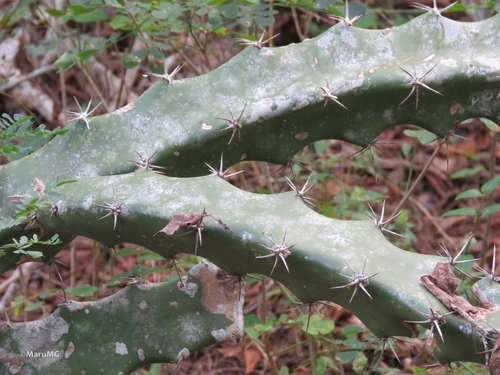
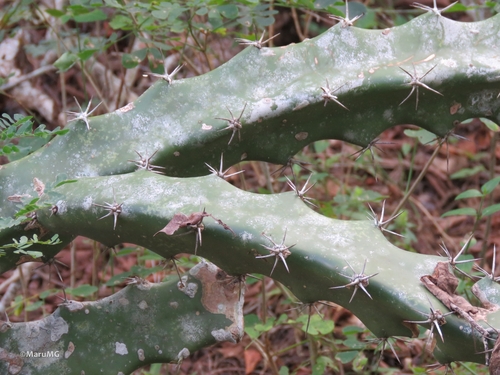
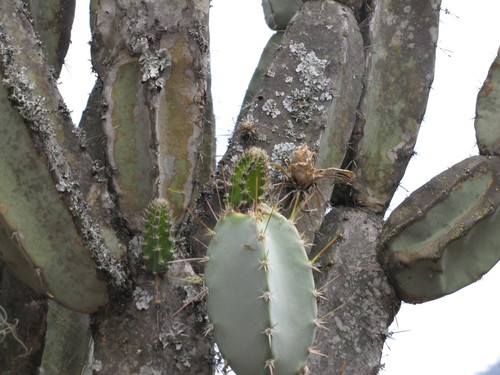
A cactus. It is a shrubby plant. The stem segments are oblong and dark green. They are 30-40 cm long. The leaves have sharp points and are red. There are 1-4 spines. They are less than 3 cm long. The flowers are yellow. The fruit are juicy. When ripe they are light greenish-yellow.
Medicinal Uses
We have no specific information on medicinal uses for this species, but the following notes are likely to apply universally to Opuntia species and other related genera. The flesh of tender young stem segments can be applied as a poultice to reduce inflammation. The mucilage and soluble fibre found in the flowers and stem segments have been shown to help control blood-sugar levels associated with adult-onset diabetes. There is clinical evidence that the soluble fibre in the stem segments helps reduce blood cholesterol levels.
Notes
There are about 180 Opuntia species. Probably all are edible. They grow in arid regions.
Names & Synonyms
Chumbera, Palas, Tuna blanca, Tuna mansa
References (8)
- Anderson, E.F., 2001, The Cactus Family, Timber Press. p 486 (As Opuntia amyclea)
- Gonzalez, J. A., et al, 2011, The consumption of wild and semi-domesticated edible plants in the Arribes del Duero (Salamanca-Zamora, Spain): an analysis of traditional knowledge. Genetic. Resour Crop Evolution 58:991-1006
- Hermandez Bermejo, J.E., and Leon, J. (Eds.), 1994, Neglected Crops. 1492 from a different perspective. FAO Plant Production and Protection Series No 26. FAO, Rome. p14 (As Opuntia amyclea)
- Kermath, B. M., et al, 2014, Food Plants in the Americas: A survey of the domesticated, cultivated and wild plants used for Human food in North, Central and South America and the Caribbean. On line draft. p 583 (As Opuntia amyclea)
- Kiple, K.F. & Ornelas, K.C., (eds), 2000, The Cambridge World History of Food. CUP p 1839 (As Opuntia amyclea)
- Rodriguez-Felix, A. & Cantwell, M., 1988, Developmental changes in composition and quality of prickly pear cactus cladodes (nopalitos). Plant Foods for Human Nutrition 38:83-93 (As Opuntia amyclea)
- Tardio, J., et al, Ethnobotanical review of wild edible plants in Spain. Botanical J. Linnean Soc. 152 (2006), 27-71
- World Checklist of Useful Plant Species 2020. Royal Botanic Gardens, Kew