Opuntia robusta
H. L. Wendl. ex Pfeiff.
Wheel cactus
(c) joshicas90, some rights reserved (CC BY-NC), uploaded by joshicas90

(c) Opuntia Cadereytensis, some rights reserved (CC BY-NC), uploaded by Opuntia Cadereytensis
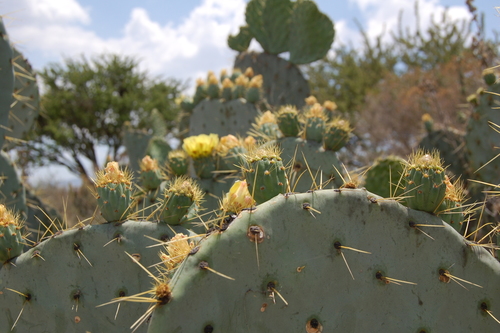
(c) Juan Carlos Scheffler Mendoza, some rights reserved (CC BY-NC), uploaded by Juan Carlos Scheffler Mendoza
What to Eat
Edible parts: Fruit, Pads
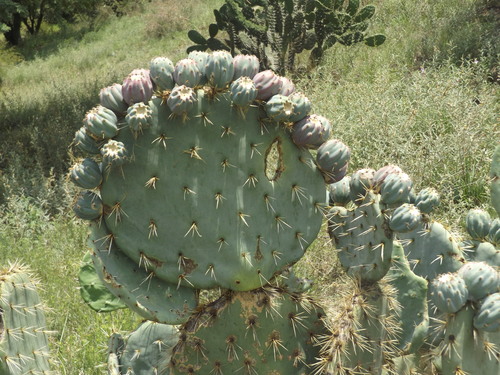
The fruit can be eaten raw or cooked, with a semi-acid to slightly sweet pulp of good quality. The peel can be consumed fried, with a texture resembling French fried potatoes. The fruits are globose to ellipsoidal, somewhat tuberculate, deep red, and 7–9cm long. The stem segments (pads) are also edible raw or cooked. These robust, glaucous blue-green segments are round to oblong, measuring 20–25cm long and 10–12cm wide. Known in Mexico as nopals, tender young pads from various Opuntia species are a common ingredient in marmalades, soups, stews, and salads. The most commonly used species are Opuntia ficus-indica and Opuntia hyptiacantha, though the pads of nearly all Opuntia species are considered edible. Fruits, known as tunas, are typically harvested from late summer to early autumn depending on species and climate.
Known Hazards
Where to Find It
It is a warm temperate plant. It needs bright sunlight. It needs a temperature above 10°C. In Argentina it grows between 300-2,100 m above sea level. Melbourne Botanical Gardens. Adelaide Botanical Gardens.
Argentina, Australia, Central America, Mexico, North America, Slovenia, South America,
How to Identify
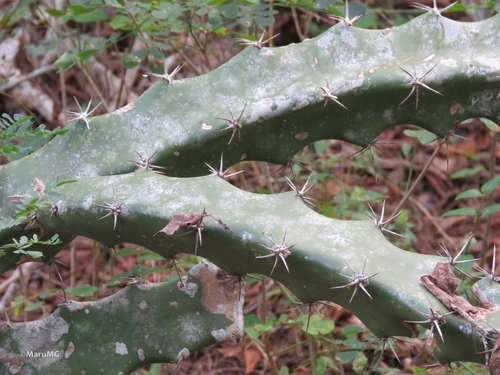
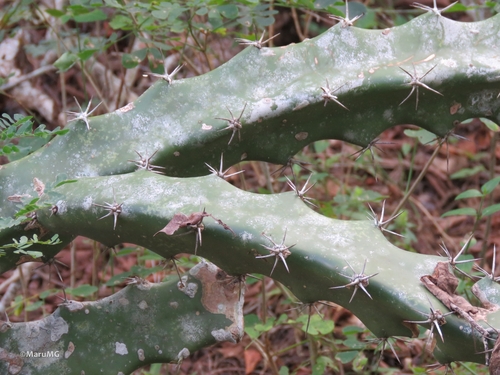
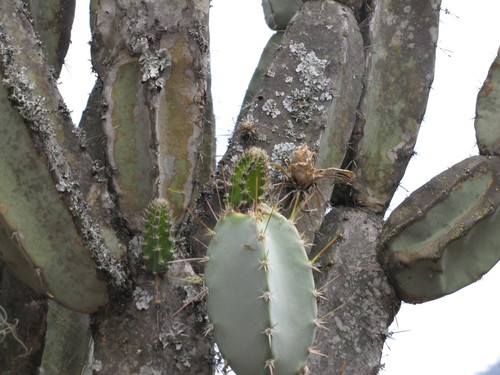
A tree like cactus. It grows to 2-5 m tall. The joints are flat and almost round. They are greyish-green and 30 cm wide. They are covered with slender spines which are 5 cm long. Several spines can occur together. The flowers are yellow. They are about 7 cm across. The fruit are deep red.
Nutrition Score: 2/100
| Part | Moisture | kJ | kcal | Protein | Vit A | Vit C | Iron | Zinc |
|---|---|---|---|---|---|---|---|---|
| Stems | — | 263 | 13.8 | — | — | — | — | — |
| Fruit | — | 317 | 4.6 | — | — | — | — | — |
How to Grow
Soil Texture: Thrives in light (sandy), medium, and gravelly or rocky soils. It is highly adaptable and can grow in poor, nutrient-deficient soils. Soil Moisture: Prefers dry to moderately moist soils. It is drought-tolerant and does not tolerate waterlogged conditions. Drainage: Requires well-drained soil to prevent root rot. Grows well in arid and semi-arid environments with minimal water. Soil pH: Tolerates a wide range of soil pH levels, from slightly acidic to alkaline. Saline Tolerance: Moderately tolerant of saline conditions, making it suitable for coastal and arid environments. Tolerance of Poor Soil: It thrives in poor soils, including rocky or degraded soils. Light Requirements: Requires full sun for optimal growth. Shade significantly reduces its vigour and flowering. Height: Grows to about 1–2 meters (3–6 feet) tall and can spread up to 3–4 meters (10–13 feet) wide. Its growth habit can form dense thickets over time. Pollination: its large yellow flowers attract bees, butterflies, and other insects.Temperature: Hardy in USDA zones 9–11. While it tolerates high heat and arid conditions, it is frost-sensitive and should be protected in colder regions. Drought Tolerance: Extremely drought-tolerant, making it ideal for xeriscaping. Flowering: Produces large, bright yellow flowers in late spring to summer, followed by large, round, edible red to purple fruits (tunas). Pests and Diseases: Generally pest-resistant but may occasionally be affected by cochineal scale (visible as white, cottony patches) or fungal issues in overly wet soils. Pruning: Minimal pruning is required unless controlling its spread. Remove dead or damaged pads to maintain plant health. Opuntia robusta is a plant of arid and semi-arid regions in the subtropical and tropical regions of Mexico. The plant is often cultivated and has become naturalised in many areas as a weed. The mature fruit is persistent on the plant; it has been observed to remain on the cladodes for 12 months or more in edible conditions. The native range of this species is Mexico. It is a succulent shrub or tree and grows primarily in the desert or dry shrubland biome. It has been introduced into Algeria, Argentina Northeast, Baleares, Canary Is., Cape Provinces, Corse, France, Free State, Greece, Italy, Kwa. Zulu-Natal, Lesotho, New South Wales, Northern Provinces, Sicilia, South Australia, Spain, Tunisia, Victoria, Western Australia. The fruits (tunas) are typically harvested in late summer to autumn, around late summer to early fall, depending on the species and climate.
Propagation: Propagates readily from pads (cuttings) or seed. Allow cut pads to dry for a few days before planting to prevent rot.
Medicinal Uses
No specific medicinal information is available for this species, but the following is likely applicable to Opuntia species generally. The flesh of tender young pads can be applied as a poultice to reduce inflammation. Mucilage and soluble fibre in the flowers and stem segments have been shown to help manage blood sugar levels associated with adult-onset diabetes. Clinical evidence also indicates that the soluble fibre in the pads helps reduce blood cholesterol levels.
Other Uses
Prickly pear can be used as a natural fence or barrier, provides wildlife habitat, and its pads serve as livestock forage. Juice extracted from the pads is used as a skin conditioner in commercial cosmetic preparations. The plant is also used as fuel. The pads are widely valued as animal fodder; this species is considered the most palatable of all for cattle and humans alike. It is often planted for erosion control, as an ornamental, or to form impenetrable hedges due to its spiny growth. The flowers are rich in nectar and pollen, attracting bees, butterflies, and other pollinators. The fruits and pads provide food for birds and mammals, and the pads offer some shelter to small animals. The spines and pads also create shelter for invertebrates, and leaf litter around the base provides habitat for beneficial insects.
Wikipedia
Source ↗Opuntia robusta, the wheel cactus, nopal tapon, or camuesa, is a species of cactus in the family Cactaceae. It is native and endemic to central and northern Mexico to within 100 miles (160 km) of the Arizona and New Mexico borders where it grow from 5,000 to 10,000 feet (1,500 to 3,000 m) on rocky slopes, open shrub lands, woodlands and mixed with other cactus and succulents.
Other Information
It is widely available in stores in Mexico. It is a cultivated food plant.
Notes
There are about 250 Opuntia species.
Names & Synonyms
Bartolona, Dinner plate, Nopal camueso, Nopal comueso, Nopal tapon, Tuna camuesa
References (19)
- Anderson, E.F., 2001, The Cactus Family, Timber Press. p 516
- Chapman, P and Martin, M., 1989, Exotic Cacti, HP Books p 41
- Chavez-Santoscoy, R. A. et al, 2009, Phenolic Composition, Antioxidant Capacity and InVitro Cancer Cell Cytotoxicity of Nine Prickly Pear (Opuntia spp.) Juices. Plant Foods fod Nutrition 64:146-152
- Crawford, M., 2012, How to grow Perennial Vegetables. Green Books. p 139
- Creasey, R., 2000, Edible Mexican Garden. Periplus p 51
- Cruz, I. M., et al, 2015, Edible fruits and seeds in the State of Mexico. Revista Mexicana de Ciencias Agricolas. Vol. 6. Num. 2 pp 331-346
- Desert Survivors Online Plant Database
- Enum. diagn. Cact. 165. 1837 (H. L. Wendland, Cat. hort. Herrnh. 1835, num. nud.?)
- Facciola, S., 1998, Cornucopia 2: a Source Book of Edible Plants. Kampong Publications, p 65
- Gallegos-Vazquez, C., et al, 2012, Morphological diversity of xoconostles (Opuntia spp.) or acidic cactus pears: A Mexican contribution to functional foods. Fruits, Vol. 67, p. 109-220
- Hermandez Bermejo, J.E., and Leon, J. (Eds.), 1994, Neglected Crops. 1492 from a different perspective. FAO Plant Production and Protection Series No 26. FAO, Rome. p15
- http://www.botanic-gardens-ljubljana.com/en/plants
- Innes, C. and Glass, C., 1997, The Illustrated Encyclopedia of Cacti. Sandstone Books. p 221
- Kermath, B. M., et al, 2014, Food Plants in the Americas: A survey of the domesticated, cultivated and wild plants used for Human food in North, Central and South America and the Caribbean. On line draft. p 589
- Lamp, C & Collet F., 1989, Field Guide to Weeds in Australia. Inkata Press. p 190
- Morley, B.D., & Toelken, H.R., (Eds), 1983, Flowering Plants in Australia. Rigby. p 74
- Segura, S. et al, 2018, The edible fruit species in Mexico. Genet Resour Crop Evol (2018) 65:1767–1793
- Wiersema, J. H. & Leon, B., 2013, World Economic Plants. A Standard Reference CRC Press. 2nd Ed. p 479
- World Checklist of Useful Plant Species 2020. Royal Botanic Gardens, Kew