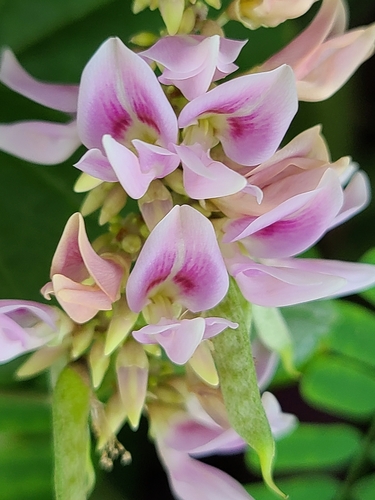
Inga macrophylla
Humb. & Bonpl. ex Willd.
Bigleaf inga

(c) Guillaume Léotard, some rights reserved (CC BY-NC), uploaded by Guillaume Léotard

(c) Guillaume Léotard, some rights reserved (CC BY-NC)
What to Eat
Edible parts: Fruit - aril, Pod pulp
The sweet aril (seed covering) and pod pulp are eaten. The plant is widely cultivated for its fruit.
Known Hazards
Where to Find It
A tropical plant. It grows in the humid lowlands and up to 1,100 m above sea level.
Amazon, Bolivia*, Brazil*, Colombia, Ecuador, French Guiana, Guyana, Peru*, South America, Suriname, Trinidad-Tobago, Venezuela,
How to Identify
A tree. It grows 4-14 m high. The crown is dense and rounded. The young branches are angular. The trunk is short and 20-35 cm across. The leaves are compound. There are 3-4 pairs of leaflets. The flowers are in crowded groups in the axils of leaves. The fruit is a flattened pod that is angular. It is 20-45 cm long by 3-5 cm wide and 1-1.5 cm thick. The pods contain 15-30 seeds.
How to Grow
Plants are grown from seeds. Seeds are collected from ripe pods. The layer around the seeds is removed before planting. Seeds should be planted fresh. They are best in light shade. Seedlings emerge in 10-20 days.
Propagation: Seed - it needs to be sown as soon as possible once it is ripe. Sow in a partially shaded position in a nursery seedbed. Germination rates are usually above 60%, with the seed sprouting within 10 - 20 days.
Medicinal Uses
None mentioned.
Other Uses
The wood is coarse-textured with an irregular to spiralled grain. It is light in weight, with low resistance to rot and difficult to cut. It is only used for low value items such as boxes and cheap toys. The wood is used for fuel and to make charcoal. A natural pioneer species within its native range, it is fast-growing and a popular food crop so should make an excellent pioneer for re-establishing woodland.
Wikipedia
Source ↗Inga macrophylla is a species of plant in the family Fabaceae. It is found in tropical South America. The common name ingá-chinelo derives from the fact that the fruit pods are large and flat like a flip flop.
Production
Plants grown rapidly. A mature tree can produce 100-150 fruit in a season.
Other Information
It is widely cultivated for its sweet fruit.
Notes
There are 350 Inga species. Also as Mimosaceae.
Names & Synonyms
Cahuabari, Goi bene, Guaba paltacha, Guacho del mico, Guama de araguato, Guamo verde, Inga-acu, Inga chata, Inga-chinelo, Inga facao, Inga pena, Inga-peua, Naranjo podrido, Pacae, Pacai amarillo, Pacay, Pairahu, Shimbillo, Vaca paleta
References (15)
- Etkin, N. L. (Ed.), 1994, Eating on the Wild Side, Univ. of Arizona. p 156
- Grandtner, M. M. & Chevrette, J., 2013, Dictionary of Trees, Volume 2: South America: Nomenclature, Taxonomy and Ecology. Academic Press p 323
- Hermandez Bermejo, J.E., and Leon, J. (Eds.), 1994, Neglected Crops. 1492 from a different perspective. FAO Plant Production and Protection Series No 26. FAO, Rome. p15
- ILDIS Legumes of the World http:www;ildis.org/Legume/Web
- Kermath, B. M., et al, 2014, Food Plants in the Americas: A survey of the domesticated, cultivated and wild plants used for Human food in North, Central and South America and the Caribbean. On line draft. p 442
- Kew Plants of the World On line
- Lopez-Diago, D. & Garcia, N., 2021, Wild edible fruits of Colombia. Biota ColomBiana 22 (2) p 38
- Lorenzi, H., 2009, Brazilian Trees. A Guide to the Identification and Cultivation of Brazilian Native Trees. Instituto Plantarum de Estuados da Flora Ltda. Vol. 3 p 159
- Martin, F. W., et al, 1987, Perennial Edible Fruits of the Tropics. USDA Handbook 642 p 99
- Paz, F. S., et al, 2021, Edible Fruit Plant Species in the Amazon Forest Rely Mostly on Bees and Beetles as Pollinators. Journal of Economic Entomology, XX(XX), 2021, 1–13
- Roa, J. A. G. & Boada, D. S. G., 2018, Fundación para el Fortalecimiento de la Fruticultura y Plantas Alimenticias no Convencionales en Colombia.
- Smith, N., et al, 2007, Amazon River Fruits. Flavors for Conservation. Missouri Botanical Gardens Press. p 126
- Sp. pl. 4(2):1015. 1806
- Torre, de la, L., et al, 2008, Enciclopedia de las Plantas Útiles del Ecuador. Herbario QCA. Pontificia Universidad Católica del Ecuador. p 345
- www.colecionandofrutas.org