Pouteria ucuqui
Pires & Schultes
Ucuqui

(c) KAIO CESAR MARINHO DA CUNHA, some rights reserved (CC BY-NC), uploaded by KAIO CESAR MARINHO DA CUNHA

Field Museum of Natural History - Botany Department | GDI 2013-2015

President and Fellows of Harvard College

President and Fellows of Harvard College
What to Eat
Edible parts: Fruit
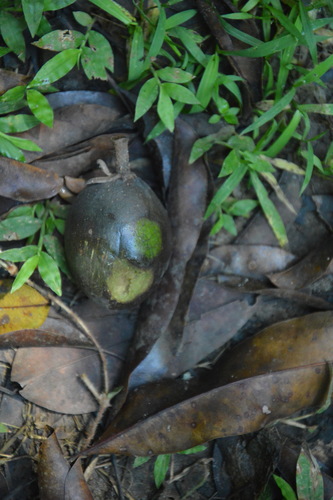
Fruit - raw. A delicious flavour when fully ripe. Eaten fresh, or mixed with cassava to produce a porridge. The unripe fruit is full of latex and is extremely sticky. The Ocoki is a large pear-shaped fruit, with a hard thick outer skin of almost woody texture, then a small quantity of very sweet pulpy matter, and within a large black oval stone. The pulp is very luscious, but is so acrid as to make the mouth and throat sore, if more than two or three are eaten. When, however, the juice is boiled it loses this property; and when made into mingau with tapioca, is exceedingly palatable and very highly esteemed in the Upper Rio Negro, where it is abundant.
Where to Find It
A tropical plant. It grows in hillside forests along river valleys. It grows on well drained soil. It occur below 250 m altitude.
Amazon, Brazil, Colombia, South America, Venezuela,
How to Identify
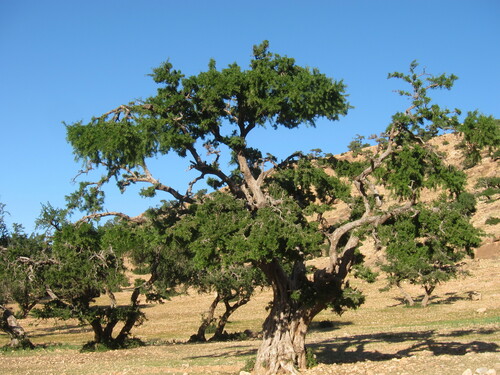
A tree. It grows 35 m high. The trunk can be 100 cm across. There can be buttresses 2 m high. The young shoots have fine rusty brown hairs. The bark is dark brown and cracked and scaly. The leaves are spaced. They are arranged in spirals. The leaves are 10-20 cm long by 5.6-9.2 cm wide. They are broadly oval. There are 9-14 pairs of veins. The leaf stalk is 2.5-5 cm long. There are many flowers in a tuft in the axils of leaves and below the leaves. The flowers are greenish-yellow. They have a strong scent. The flowers contain one sex. Both sexes may be on the same tree. The fruit is 10-11 cm long by 7.5-8 cm wide. The fruit have a hard skin and are yellow. They have soft white flesh. There are 1-2 seeds. These are 7-8 cm long.
How to Grow
The tree has a very short period of flowering, probably less than three days.
Medicinal Uses
The fruit is sometimes used as a vermifuge.
Other Uses
The seeds are used to make toy whistles. All of the interior of the seed (the cotyledons) is removed and a number of holes, over which the fingers are placed, are made.
Other Information
It is an important local seasonal food.
Notes
There are about 150-320 Pouteria species. They grow in the tropics.
Names & Synonyms
Hinirji, Kajaec, Kaja-gai, Oo-lo-da, Quidna, Tucuru, Tukuru, Ukuki, Yuco, Yucu, Yuu
References (12)
- Bot. Mus. Leafl. 14:87. 1950
- Cavalcante, P.B. 1991. Frutas comestíveis da Amazônia. Edições CEJUP.
- Etkin, N.L. (Ed.), 1994, Eating on the Wild Side, Univ. of Arizona. p 122
- Grandtner, M. M. & Chevrette, J., 2013, Dictionary of Trees, Volume 2: South America: Nomenclature, Taxonomy and Ecology. Academic Press p 530
- Hermandez Bermejo, J.E., and Leon, J. (Eds.), 1994, Neglected Crops. 1492 from a different perspective. FAO Plant Production and Protection Series No 26. FAO, Rome. p17
- Kermath, B. M., et al, 2014, Food Plants in the Americas: A survey of the domesticated, cultivated and wild plants used for Human food in North, Central and South America and the Caribbean. On line draft. p 699
- Kew Plants of the World Online
- Lopez-Diago, D. & Garcia, N., 2021, Wild edible fruits of Colombia. Biota ColomBiana 22 (2) p 51
- Paz, F. S., et al, 2021, Edible Fruit Plant Species in the Amazon Forest Rely Mostly on Bees and Beetles as Pollinators. Journal of Economic Entomology, XX(XX), 2021, 1–13
- Pennington, T.D., 1990, Sapotaceae in Flora Neotropica Monograph 52. New York Botanical Gardens. p 341
- Roa, J. A. G. & Boada, D. S. G., 2018, Fundación para el Fortalecimiento de la Fruticultura y Plantas Alimenticias no Convencionales en Colombia.
- Van Roosmalen, M.G.M., & Garcia, O. M., 2000, Fruits of the Amazonian Forest. Part 2: Sapotaceae. Acta Amazonica 30(2): 187-290