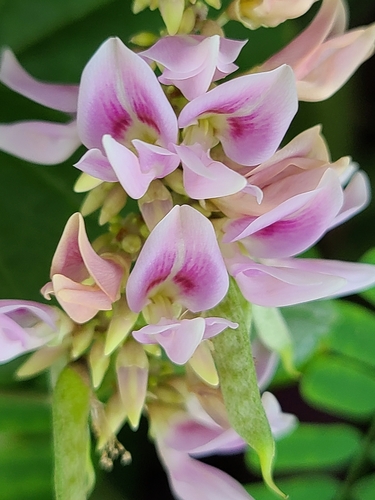
Phaseolus polyanthus
Greenman
Year bean

Field Museum of Natural History - Botany Department

Field Museum of Natural History - Botany Department

Field Museum of Natural History - Botany Department
What to Eat
Edible parts: Seeds, Leaves, Flowers
Runner beans were grown as food plants in North America and Europe from the 1600s, and also as ornamentals for their attractive flowers. However, they came to be used primarily as a garden ornamental plant in North America, including for temporary screening. The flowers attract hummingbirds, bees and other insects. In the UK and other European countries – where the vegetable is a popular choice for kitchen gardens and allotments – the flowers came to be ignored, or treated as an attractive bonus to cultivating the plant for the beans. It is a plant visited by honeybees for both pollen and nectar, from which they produce a monofloral honey that is traditionally appreciated in Poland. The seeds of the plant can be used fresh or as dried beans. The pods are eaten whole while young and not yet fibrous, though they tend to have a rougher surface than the common bean. The starchy roots of this perennial are eaten in Mesoamerica. The beans are used in many cuisines. It is a popular side vegetable in British cuisine. A variety named 'Judión de la Granja' producing large, white, edible beans is cultivated in San Ildefonso, Spain. It is the basis of a Segovian regional dish also named Judiones de la Granja, in which the beans are mixed with pig's ears, pig's trotters, and chorizo, amongst other ingredients. In Greece, cultivars of the runner bean with white blossom and white beans are known as fasolia gigantes (φασόλια γίγαντες). They are grown under protective law in the north of Greece within the regions of Kato Nevrokopi, Florina and Kastoria. The beans have an important role in Greek cuisine, appearing in many dishes (such as Gigantes plaki). In English, they are sometimes colloquially referred to as elephant beans. In Austria the coloured versions are cultivated and served as "Käferbohnen" ("beetle-bean"), a dish made of the dry beans with pumpkin seed oil. It is considered a typical dish of regional Austrian cuisine, but dried runner beans are also consumed to a small extent in Germany. In Turkey, runner beans are the main ingredient in bean Pilaki and Piyaz. Greece and northern Africa are the sources of pods of the runner beans sold as "green beans" in European markets during the cold period. The pods can be identified by their flatness, big size and the rougher surface. Cultivars include:
Where to Find It
A tropical plant. It suits a humid climate and medium altitudes. It grows between 800-2600 m altitude. It suits cool, damp regions with one dry period per year. It prefers deep, organic, damp but well drained soils. It is best with a pH of 6.2-6.5. It can tolerate some shade.
Amazon, Caribbean, Central America, Colombia, Costa Rica, Dominican Republic, Ecuador, Guatemala, Haiti, Jamaica, Mexico, North America, Peru, South America, Venezuela, West Indies,
How to Identify
A herb. Plants can live for 2-4 years. The flowers have 6-16 fruit bearing stems. The flowers are white or lilac. Seed weigh 0.7-1 g each. Seed can be yellow or brown. See Phaseolus coccineus subsp. polyanthus
How to Grow
Plants are grown from seed.
Production
The flowering time is 2-5 months.
Names & Synonyms
Botil, Piloya, Dzich, Piligue, Petaco, Cacha, Matatropa, Toda la vida
References (5)
- Hermandez Bermejo, J.E., and Leon, J. (Eds.), 1994, Neglected Crops. 1492 from a different perspective. FAO Plant Production and Protection Series No 26. FAO, Rome. p18, 58
- Kermath, B. M., et al, 2014, Food Plants in the Americas: A survey of the domesticated, cultivated and wild plants used for Human food in North, Central and South America and the Caribbean. On line draft. p 637
- Pena, F. B., et al, 1998, Los quelites de la Sierra Norte de Puebla, Mexico: Inventory Y Formas de Preparacion. Bol. Soc. Bot. Mexico 62:49-62
- Publ. Field Columbian Mus., Bot. Ser. 2:253. 1907
- van Wyk, B., 2005, Food Plants of the World. An illustrated guide. Timber press. p 288