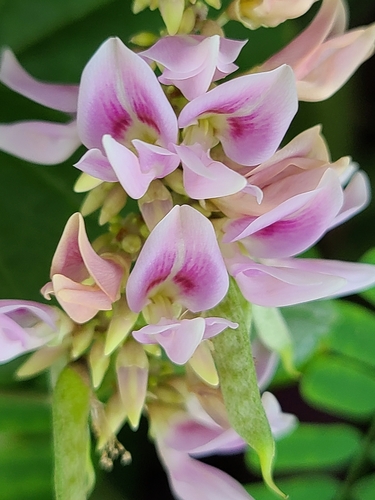
Pterocarpus mildbraedii
Harms
Camwood

Charles J Sharp (via Wikimedia Commons)

(c) 106611639464075912591, some rights reserved (CC BY-NC-SA), uploaded by 106611639464075912591

(c) Nolan Exe, some rights reserved (CC BY), uploaded by Nolan Exe
What to Eat
Edible parts: Leaves, Vegetable
The leaves are cooked and eaten as a vegetable, commonly used in soups and sold in local markets.
Where to Find It
A tropical plant. It grows in lowland evergreen and semi-deciduous forest in West Africa. It grows up to 1,250 m above sea level. In Tanzania it is restricted to 300-600 m. It can tolerate acid soil.
Africa, Benin, Cameroon, Central Africa, Central African Republic, CAR, Côte d'Ivoire, East Africa, Equatorial Guinea, Gabon, Ghana, India, Ivory Coast, Liberia, Nigeria, Sierra Leone, Tanzania, Togo, West Africa,
How to Identify
A tree. It grows 35 m tall. The trunk is 20 m tall and 80 cm across. The bark is pale grey and exudes a red gum when cut. The leaves are compound and 35 cm long. There are 7-15 alternate leaflets with one at the end. These are oval and 6-14 cm long by 3-7 cm wide. They have a round base and taper to the tip. The flowers are in a group 5-15 cm long. The fruit is a round pod 10-12 cm long and with a broad thin wing. There is usually one seed.
Nutrition Score: 42/100
| Part | Moisture | kJ | kcal | Protein | Vit A | Vit C | Iron | Zinc |
|---|---|---|---|---|---|---|---|---|
| Leaves | 85 | 237 | 57 | 3.8 | — | — | 4.7 | 3.1 |
How to Grow
Plants can be grown by seed. It can be cut back and allowed to re-grow. Plants can be budded. Plants can be grown from stem cuttings.
Propagation: Seed - it has a hard seedcoat and may benefit from scarification before sowing in order to speed up and improve germination. This can usually be done by pouring a small amount of nearly boiling water on the seeds (being careful not to cook them!) and then soaking them for 12 - 24 hours in warm water. By this time they should have imbibed moisture and swollen - if they have not, then carefully make a nick in the seedcoat (being careful not to damage the embryo) and soak for a further 12 hours before sowing.
Medicinal Uses
Leaves of the species are used as ingredients in the preparation of oha soup in Nigeria. Leaf extracts are also used in traditional medicine for pain management. However, studies have shown the leaves to be high on hydrogen cyanide and oxalate. In Ghana, it is considered to be suitable as a shade tree in cocoa plantations.
Other Uses
There are two very conflicting reports for the wood of this species, as detailed below. It is possible that the reports are based on the two subspeciies and that the wood of trees from west Africa (subspecies mildbraedii) is soft and white, whilst that from east Africa (subspecies usambarensis) is red and heavy. The whitish wood is soft. It is of little commercial value. The tree is rarely exploited for its timber, although in Tanzania it is used to make mortars. The red wood of the subspecies usambarensis (Verdc.) Polhill (as found in east Africa) is hard and heavy. It is used for timber, building poles, pestles and carving. The wood is used for fuel and to make charcoal. The trees have been either planted or retained in cocoa plantations in order to provide shade.
Production
It grows quickly. There is a flush of edible leaves during the dry season.
Other Information
It is only used in some places. Leaves are sold in local markets.
Notes
Also as Papilionaceae. There are about 60 Pterocarpus species.
Names & Synonyms
Aguaya, Mbel afum, Oha, Padouk blanc, Urube
References (15)
- Akpanyung, E. O. et al, 1995, Chemical composition of the edible leaves of Pterocarpus mildbraedii. Plant Foods for Human Nutrition (Formerly Qualitas Plantarum), Volume 48, Number 3
- Burkill, H. M., 1985, The useful plants of west tropical Africa, Vol. 3. Kew.
- Chapman, J. D. & Chapman, H. M., 2001, The Forest Flora of Taraba and Andamawa States, Nigeria. WWF & University of Canterbury. p 186
- FAO Corporate Document Repository. The Major Significance of 'Minor' Forest Products. Appendix 3
- Grubben, G. J. H. and Denton, O. A. (eds), 2004, Plant Resources of Tropical Africa 2. Vegetables. PROTA, Wageningen, Netherlands. p 441
- Guil-Guerrero, J. L., et al, 2001, Edible Wild Plants. in Recent Progress in Medicinal Plants Vol. 8 Sci. Tech publishing, Texas
- Mercy, N. A., et al, 2016, Survey of Wild Vegetables in the Lebialem Highlands of South Western Cameroon. Journal of Plant Sciences 4(6): 172-184
- Okafor, J. C., 1978, Development of Forest Tree crops for Food Supplies in Nigeria. Forest Ecology and Management 1:235-247
- Okafor, J. C., Conservation and use of traditional vegetables from woody forest species in southeastern Nigeria. FAO
- Okigbo, B.N., Vegetables in Tropical Africa, in Opena, R.T. & Kyomo, M.L., 1990, Vegetable Research and development in SADCC countries. Asian Vegetable Research and development Centre. Taiwan. p 42
- Oniang’o, R., Grum, M. and Obel-Lawson, E., editors. 2008. Developing African leafy vegetables for improved nutrition. Regional workshop, 6-9 December 2005. Rural Outreach Program, Nairobi, Kenya. p 3
- Onuminya, T. O., et al, 2017, Comparative proximate and Phytochemical Analysis of leafy vegetables in Lagos State. Nig. J. Pure and Applied Sci. Vol. 30 Issue 3: p 3097f
- Smith, F. I. and Eyzaquirre, P., 2007, African leafy vegetables: Their role in the World Health Organization's global Fruit and Vegetables Initiative. AJFAND, Vol. 7 No. 3
- Udo, E. S., et al, 2009, Life-form and Density of Valuable Non-timber Plants in Ukpom Community Forest, Akwa Ibom State, Nigeria. African Research Review 3(3) p 7
- Vivien, J. & Faure, J.J., 1985, Abres des forets dense d'Afrique Centrale. Agence de Cooperation Culturelle et Technique. Paris. p 358