Funtumia elastica
(P. Preuss) Stapf
Lagos silk rubber, West African rubber tree
(c) John P, some rights reserved (CC BY-NC), uploaded by John P
(c) John P, some rights reserved (CC BY-NC)
What to Eat
Edible parts: Bark, Caution
No edible uses are known.
Where to Find It
A tropical plant. It grows in deciduous forest. It grows in drier regions and secondary forests. In Nigeria it has been recorded at 750 m above sea level. In Yunnan.
Africa, Asia, Cameroon, Caribbean, Central Africa, Central African Republic, CAR, China, Congo, Dominica, East Africa, Gabon, Guinea, Guinée, India, Indonesia, Kenya, Liberia, Malaysia, Nigeria, Senegal, Sao Tome and Principe, SE Asia, Sierra Leone, Singapore, Sudan, Tanzania, Uganda, West Africa*, Zimbabwe,
How to Identify
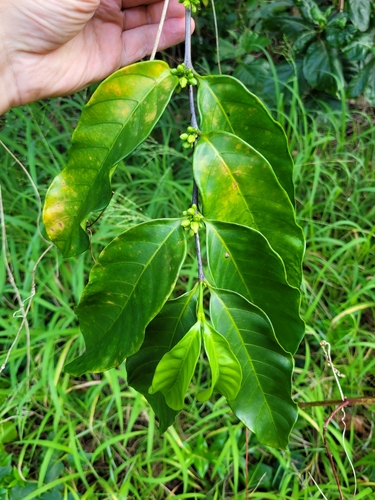
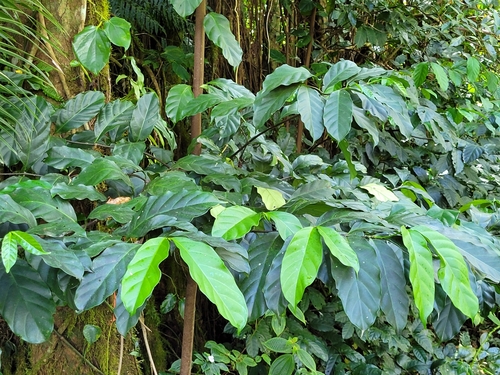
A tree. It grows up to 30 m high. The trunk is 50 cm across. The leaves are oblong and 6-27 cm long by 2-10 cm wide. The edges are wavy. The leaves are opposite. The flowers are tube shaped and green to white. The fruit are follicles 8-19 cm long. They are woody.
How to Grow
Plants can be grown from seed.
Propagation: Seed.
Medicinal Uses
The bark is strongly astringent, laxative, and vermifuge, and is included in preparations for blennorrhoea and painful menstruation. Pounded and taken in spirit, it is used to treat haemorrhoids. The latex is applied externally to cracked sores on the feet, cutaneous fungal infections, and general sores. The leaves contain several alkaloids and are used to treat chest complaints, particularly whooping cough. Young leaves are taken by mouth or administered by enema to treat diarrhoea, and when mixed with kaolin they are also given by enema. Young leaves combined with those of Phyllanthus muellerianus are taken to improve male fertility. The seeds contain an unidentified alkaloid and have attracted commercial interest as a substitute for Strophanthus seed as a source of strophanthin, which is used like digitalin to treat heart conditions.
Other Uses
The bark produces a white latex that coagulates readily. It is of very high quality but low-yielding compared to Hevea brasiliensis. The seed pods contain a fine white floss used for stuffing pillows and cushions, preferred over Bombax and Ceiba floss in some parts of Africa, with spinning trials suggesting suitability for commercial use. The seeds contain about 26% oil, but bitterness in the cake makes it unfit for food. The wood is white, soft, and undifferentiated between sap and heartwood; it is not durable but is used for carving spoons, bowls, and other household utensils, and as timber for beams and rafters. It was historically common for making Asante stools in Ghana and is still occasionally used for this purpose. It is well suited to match manufacture, both for inner and outer boxes and for match splints, and is considered superior to Gmelina arborea as a fuel.
Wikipedia
Source ↗Funtumia elastica (also known as the bush rubber tree or silkrubber) is a medium-sized African rubber tree with glossy leaves, milky sap, and long woody seedpods. The bark is used in the traditional medicine of tropical Africa. It is economically important in West African countries such as Ghana, where it is commonly known as the ofruntum.
Production
It is fast growing. Plants flower and fruit November to March.
Other Information
It is cultivated.
Notes
There are 2 Futumia species. They are in tropical Africa. It is a source of rubber.
Names & Synonyms
Damba, Debo, Ire rubber, Ire, Mutondo, Ndamba, Ngonga, Pohon karet sutra, Sekelay, Yamoa
References (10)
- Ambasta, S.P. (Ed.), 2000, The Useful Plants of India. CSIR India. p 228
- Burkill, I.H., 1966, A Dictionary of the Economic Products of the Malay Peninsula. Ministry of Agriculture and Cooperatives, Kuala Lumpur, Malaysia. Vol 1 (A-H) p 1056
- Chapman, J. D. & Chapman, H. M., 2001, The Forest Flora of Taraba and Andamawa States, Nigeria. WWF & University of Canterbury. p 165
- Harris, D. J., 2002, The vascular plants of the Dzanga-Sangha Reserve, Central African Republic. National Botanic Garden of Belgium, 2002. – 274 pages p 50
- Hawthorne, W.& Marshall, C., 2013, Nimba Western Area Iron Ore Concentrator Mining Project Environmental and Social Impact Assessment. AcelorMittel Liberia. p 480
- Proc. Linn. Soc. London (Oct.):2. 1900 (Hooker's Icon. Pl. 27:t.1694-2695. 1901)
- Sukarya, D. G., (Ed.) 2013, 3,500 Plant Species of the Botanic Gardens of Indonesia. LIPI p 297
- Vivien, J. & Faure, J.J., 1985, Abres des forets dense d'Afrique Centrale. Agence de Cooperation Culturelle et Technique. Paris. p 30
- World Checklist of Useful Plant Species 2020. Royal Botanic Gardens, Kew
- Zeven, A. C. & de West, J. M. J., 1982, Dictionary of cultivated plants and their regions of diversity. Wageningen. p 122


