Caloncoba echinata
(Oliver) Gilg
Gorli shrub
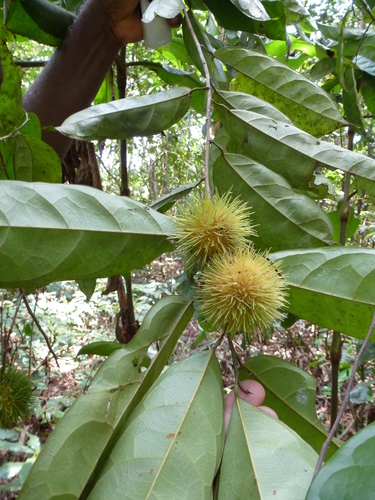
(c) Carel Jongkind, some rights reserved (CC BY-NC), uploaded by Carel Jongkind

(c) ehoumanevans, some rights reserved (CC BY)
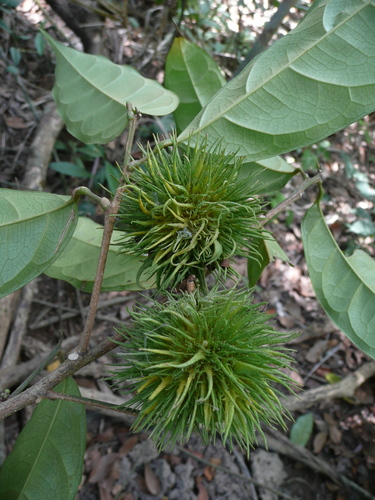
(c) Carel Jongkind, some rights reserved (CC BY-NC), uploaded by Carel Jongkind
What to Eat
Edible parts: Fruit
The fruit are eaten fresh and also used to prepare a sweet drink.
Where to Find It
A tropical plant. It grows in the under-storey of closed rain-forest.
Africa, Cameroon, Central Africa, Côte d'Ivoire, Ghana, Guinea, Guinée, Hawaii, Ivory Coast, Liberia, Nigeria, Pacific, Puerto Rico, Sierra Leone, USA, West Africa, West Indies,
How to Identify
A tree. It grows 8 m tall. It does not have thorns on its branches. The leaves are thin and leathery. They are 15 cm long and oblong. They have a short point at the tip. They are wedge shaped at the base. The flowers are white and have short stems. The fruit is round and very spiny. It is yellow or orange and filled with many seeds.
Medicinal Uses
The oil is used in medicine, and the seeds contain chaulmoogric acid traditionally used in the treatment of leprosy.
Notes
There are 10 Caloncoba species. They are in Africa. They grow in tropical and southern Africa. The oil is used in medicine. The seeds contain chaulmoogric acid used in the treatment of Leprosy. Also put in the family Flacourtiaceae.
Names & Synonyms
Dooh, Fen-kone, Flanchu, Ghogble, Katupo, Komehumda, Kulukenyo, Nikawumbi
References (9)
- Abbiw, D.K., 1990, Useful Plants of Ghana. West African uses of wild and cultivated plants. Intermediate Technology Publications and the Royal Botanic Gardens, Kew. p 46
- Barwick, M., 2004, Tropical and Subtropical Trees. A Worldwide Encyclopedic Guide. Thames and Hudson p 302
- Burkill, H. M., 1985, The useful plants of west tropical Africa, Vol. 2. Kew.
- Burkill, I.H., 1966, A Dictionary of the Economic Products of the Malay Peninsula. Ministry of Agriculture and Cooperatives, Kuala Lumpur, Malaysia. Vol 2 (I-Z) p 1607
- Fl. trop. Afr. 1:118. 1868
- Jardin, C., 1970, List of Foods Used In Africa, FAO Nutrition Information Document Series No 2.p 123
- Little, E. L., et al, 1974, Trees of Puerto Rico and the Virgin Islands. USDA Handbook 449. Forestry Service. p 586 (As Oncoba echinata)
- Staples, G.W. and Herbst, D.R., 2005, A tropical Garden Flora. Bishop Museum Press, Honolulu, Hawaii. p 338
- World Checklist of Useful Plant Species 2020. Royal Botanic Gardens, Kew


