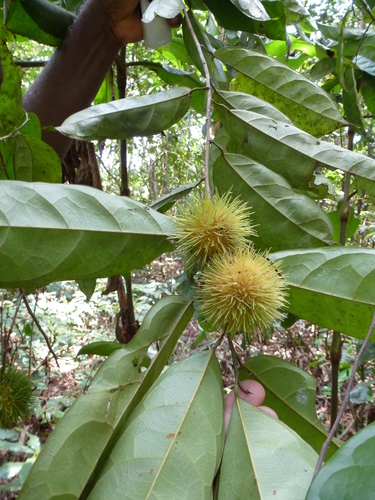
Caloncoba glauca
(P. Beauv.) Gilg
Otiosa
AchariaceaeFruit

iNaturalist · cc-by-nc
(c) Bart Wursten, some rights reserved (CC BY-NC), uploaded by Bart Wursten
(c) Bart Wursten, some rights reserved (CC BY-NC), uploaded by Bart Wursten

iNaturalist · cc-by-nc
(c) Bart Wursten, some rights reserved (CC BY-NC)
(c) Bart Wursten, some rights reserved (CC BY-NC)
What to Eat
Edible parts: Fruit
The fruit is edible.
Where to Find It
It is a tropical plant. It grows on the fringes of the forest in West Africa.
Africa, Benin, Cameroon, Central Africa, Congo, Congo DR, Côte d'Ivoire, Gabon, Ghana, Guinea, Guinée, Ivory Coast, Nigeria, Togo, West Africa,
Countries: Angola, Burkina Faso, Burundi, Benin, Botswana, Congo (DRC), Central African Republic, Congo (Republic), Cote d'Ivoire, Cameroon, Cape Verde, Djibouti, Algeria, Egypt, Eritrea, Ethiopia, Gabon, Ghana, Gambia, Guinea, Equatorial Guinea, Guinea-Bissau, Kenya, Comoros, Liberia, Lesotho, Libya, Morocco, Madagascar, Mali, Mauritania, Mauritius, Malawi, Mozambique, Namibia, Niger, Nigeria, Rwanda, Seychelles, Sudan, Sierra Leone, Senegal, Somalia, South Sudan, Sao Tome & Principe, Eswatini, Chad, Togo, Tunisia, Tanzania, Uganda, South Africa, Zambia, Zimbabwe
How to Identify
A small tree. It grows 15 m tall. The leaves are narrowly oval. They are 10-25 cm long by 4-8 cm wide. There are teeth along the edge. The flower petals are white. The stamens are orange. The fruit is a round capsule 6-7 cm long by 5-6 cm wide.
Medicinal Uses
The plant is used in traditional medicine.
Notes
It is used in medicine.
Names & Synonyms
Caloncoba dusenii Gilg.Oncoba glauca (P. Beauv.) PlanchVentenatia glauca P. Beauv.
References (3)
- Abbiw, D.K., 1990, Useful Plants of Ghana. West African uses of wild and cultivated plants. Intermediate Technology Publications and the Royal Botanic Gardens, Kew. p 46
- Burkill, H. M., 1985, The useful plants of west tropical Africa, Vol. 2. Kew.
- Jardin, C., 1970, List of Foods Used In Africa, FAO Nutrition Information Document Series No 2.p 123