Toxicodendron acuminatum
(DC.) C. Y. Wu & T. L. Ming

gbif · cc0
President and Fellows of Harvard College
President and Fellows of Harvard College
What to Eat
Edible parts: Stems, Leaves
Known Hazards
Where to Find It
It is a subtropical plant. It grows in hill and mountain forests between 1,600-2,600 m above sea level in Tibet.
Asia, Bhutan, China, Himalayas, India, Nepal, Northeastern India, Tibet,
Countries: United Arab Emirates, Afghanistan, Armenia, Azerbaijan, Bangladesh, Bahrain, Brunei, Bhutan, China, Georgia, Indonesia, Israel, India, Iraq, Iran, Jordan, Japan, Kyrgyzstan, Cambodia, North Korea, South Korea, Kuwait, Kazakhstan, Laos, Lebanon, Sri Lanka, Myanmar, Mongolia, Maldives, Malaysia, Nepal, Oman, Philippines, Pakistan, Qatar, Saudi Arabia, Singapore, Syria, Thailand, Tajikistan, Timor-Leste, Turkmenistan, Turkey, Taiwan, Uzbekistan, Vietnam, Yemen
How to Identify
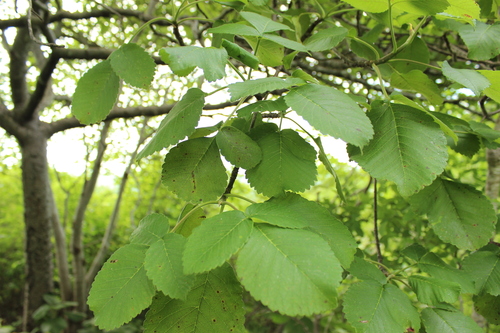
A small tree. It grows 4-7 m tall. The leaf stalks are 4-7 cm long. The leaves are compound and 16-28 cm long. There are 9-18 leaflets opposite each other along the stalk an one at the end. The leaflets are 5-11 cm long by 2-5 cm wide and they get larger towards the tip. The flowers are yellowish green. The fruit is oval and fleshy and 4-5 mm long by 5-6 mm wide.
Notes
There are about 200 Rhus species.
Names & Synonyms
Chhimhruk
Rhus acuminata DC.Rhus succedanea var. acuminata (DC.) Hook.f.Toxicodendron caudatum C. C. Huang & T. L. MingToxicodendron succedaneum var. acuminatum (DC.) C. Y. Wu & T. L. Ming
References (2)
- Lalfakzuala, R., 2007, Ethnobotanical usages of plants in western Mizoram. Indian Journal of Traditional Knowledge. Vol 6(3) pp 480-493 (As Rhus acuminata)
- Prodr. 2:68. 1825 (As Rhus acuminata)