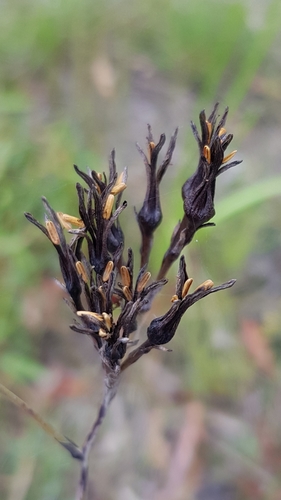
Haemodorum spicatum
R. Br.
Born, Blood roots

(c) Loxley Fedec, some rights reserved (CC BY-NC), uploaded by Loxley Fedec

(c) Loxley Fedec, some rights reserved (CC BY-NC)

(c) Kimberly Emerson, some rights reserved (CC BY-ND), uploaded by Kimberly Emerson
What to Eat
Edible parts: Bulbs - spice
The bulbs are eaten raw or roasted and have a mild onion flavour. They are used as a spice and add colour to food.
Where to Find It
It grows in Western Australia in a Mediterranean climate. It needs a well drained soil. It can tolerate light frosts. It can grow on poor sandysoils.
Australia*,
How to Identify
A herb which keeps growing from year to year. It forms a bulb. Plants grow to 2 m tall. There are 3-4 leaves. These are 20-30 cm long by 0.1-0.2 cm wide. They are cylindrical and dark green. Plants flower after fire. The flower are on long slender flowering stalks. These are branched and 30-80 cm long. The flowers are 0.5 cm long and grey-brown. The flowers never open. Flowers are pollinated by native bees.
How to Grow
Plants can be grown from seed or bulbils.
Medicinal Uses
The bulbs are traditionally used for food purposes.
Wikipedia
Source ↗Haemodorum spicatum is a plant in the Haemodoraceae family native to south Western Australia.
Notes
There are about 20 Haemodorum species. They are mostly in Australia.
Names & Synonyms
Meen, Bohn, Mardja
References (5)
- Bonney, N., 2012, Edible Wild Native Plants for Southern Australia. p 110
- Daw, B., Walley, T. & Keighery, G., 2001, Bush Tucker. Plants of the South-West. Department of Conservation and Land Management. Western Australia. p 22
- Hibbert, M., 2002, The Aussie Plant Finder 2002, Florilegium. p 118
- Paczkowska, G. & Chapman, A.R., 2000, The Western Australian Flora. A Descriptive Catalogue. Western Australian Herbarium. p 67
- RIRDC, 2010, New Root Vegetables fo the Native Food Industry, Australian Government RIRDC Publication 9/161