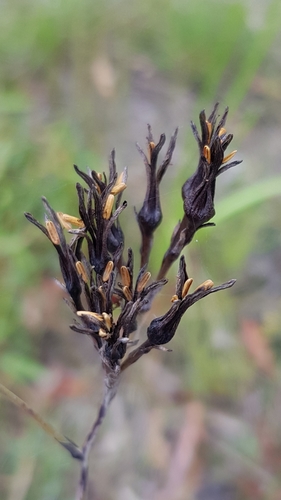
Anigozanthos flavidus
Redoute & DC.
Tall kangaroo-paw

(c) Ian Cowan, some rights reserved (CC BY-NC), uploaded by Ian Cowan

(c) pimelea, some rights reserved (CC BY), uploaded by pimelea

(c) Rosario, some rights reserved (CC BY), uploaded by Rosario
What to Eat
Edible parts: Root
The tuberous root is eaten.
Where to Find It
A temperate plant. It can grow on a range of soils and climates. It does well in a gritty, well-drained soil. It needs an alkaline pH. It does well in full sun but can grow in light shade. It can be damaged by frost. They grow in a Mediterranean climate. It suits hardiness zones 8-9.
Australia*, Tasmania,
How to Identify
A clumping plant which keeps growing from year to year. The rhizome is thick. It grows 30-60 cm tall. The leaves are 1 m long by 2-4 m wide. There is a sheath at the base. The flower stems are 2 m high. They are branched. The flowers are like tubes and 3-4 cm long. They are covered with hairs. The flowers are yellow-green but can be red or pink.
How to Grow
Plants can be grown by seed or division.
Wikipedia
Source ↗Anigozanthos flavidus is a species of plant found in Southwest Australia. It is member of the Haemodoraceae family. It is commonly known as the tall, yellow, or evergreen, kangaroo paw. The specific epithet, flavidus, refers to the yellow flowers of this plant. A member of the genus Anigozanthos (kangaroo- and cats-paws) that has an evergreen clump of strap-like leaves, up to 1 metre long and 0.02 m wide, growing from an underground rhizome around 0.05 m in diameter. The rhizome allows the species to regenerate after drought or fire. Each plant may produce over 350 flowers, on up to 10 long stems, these appear during the summer of the region. Pollen is distributed by birds as they plunge into the flowers to reach the nectaries. Flowers are frequently yellow and green, but may present in shades of red, pink, orange, or brown. It is found along roadsides, along creeks, and in forests and swamps, and other unshaded winterwet habitat. The species occurs in a range from Two Peoples Bay in the southeast, throughout the Warren and southern Jarrah Forest, to Waroona on the Swan Coastal Plain. It was previously endemic to the region, but is now naturalised in New South Wales. This kangaroo paw is now widely cultivated in the Eastern states of Australia and the United States of America. Anigozanthos flavidus hybridises with other members of the genus, and is used in the development of cultivars. It is a hardy plant, tolerant of a wide range of soil types and condition, that may live for around 30 years in a garden. It is propagated from seed or sections of the rhizome. The first description of the species was by Augustin Pyramus de Candolle in 1807. This was published in Redouté's Les Liliacees with an illustration by that artist.
Notes
There are 11 Anigozanthos species.
Names & Synonyms
References (17)
- Bircher, A. G. & Bircher, W. H., 2000, Encyclopedia of Fruit Trees and Edible Flowering Plants in Egypt and the Subtropics. AUC Press. p 28
- Bodkin, F., 1991, Encyclopedia Botanica. Cornstalk publishing, p 85
- Bonney, N., 1997, Economic Native Trees and Shrubs for South Australia. Greening Australia (SA) inc. Campbelltown SA 5074 p 30
- Cundall, P., (ed.), 2004, Gardening Australia: flora: the gardener's bible. ABC Books. p 157
- Elliot, W.R., & Jones, D.L., 1982, Encyclopedia of Australian Plants suitable for cultivation. Vol 2. Lothian. p 199
- Greig, D., 1996, Flowering Natives for Home Gardens. Angus & Robertson. p 51
- Heywood, V.H., Brummitt, R.K., Culham, A., and Seberg, O., 2007, Flowering Plant Families of the World. Royal Botanical Gardens, Kew. p 369
- Hibbert, M., 2002, The Aussie Plant Finder 2002, Florilegium. p 29
- Lamberton, K (Ed.), 2004, The Australian gardening encyclodepia. Murdoch Books, NSW Australia. p 167
- Lavelle, M., 2008, Wild Flowers of Australia and Oceania. Southwater. p 89
- Leiper, G & Houser, J., Mutooroo. Plant Use by Australian Aboriginal People. Assembly press, Queensland.
- Lim, T. K., 2015, Edible Medicinal and Non Medicinal Plants. Volume 9, Modified Stems, Roots, Bulbs. Springer p 9
- Llamas, K.A., 2003, Tropical Flowering Plants. Timber Press. p 224
- Lord, E.E., & Willis, J.H., 1999, Shrubs and Trees for Australian gardens. Lothian. p 148
- Paczkowska, G. & Chapman, A.R., 2000, The Western Australian Flora. A Descriptive Catalogue. Western Australian Herbarium. p 62
- P. J. Redoute, Liliac. 3: t. 176. 1807
- Rolsh, 1994, Wildflowers of the Western State, Rolsh Productions Albany WA. p 18