Madhuca pasquieri
(Dubard) H. J. Lam
Zi jing mu
(c) 丁洪波, some rights reserved (CC BY-NC), uploaded by 丁洪波

Wikimedia Commons - Lưu Ly

Wikimedia Commons - Hungda
What to Eat
Edible parts: Seeds - oil
The seeds contain an edible oil that can be extracted by pressing; traditionally, fruit bats drop the seeds from eaten fruit and these are collected for oil production.
Where to Find It
A tropical plant. The occur in forests in southern China and Vietnam between 0-1100 m. In Yunnan.
Asia, China, Indochina, SE Asia, Vietnam,
How to Identify
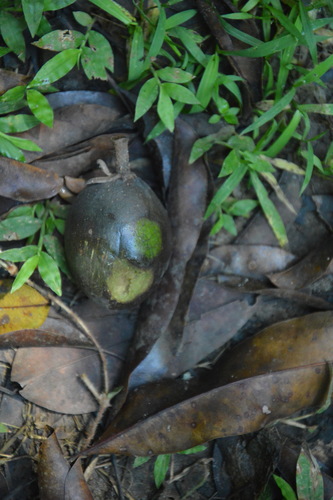
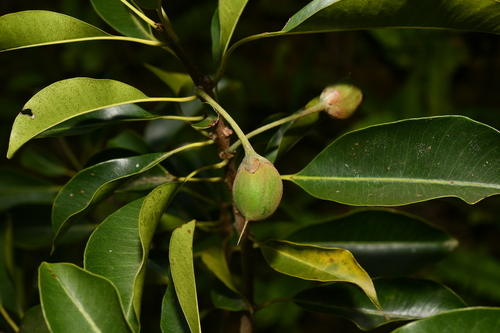
A tree. It grows to 30-40 m tall. Trunk to 60-120 cm across, bark blackish. The small branches have lenticels and are rust coloured. The leaves can be scattered or clustered at the ends of branches. The fruit can be oval and 2-3 cm long by 1.5-2 cm wide. The fruit is rust coloured. The layer around the seeds is fleshy. The seeds are like an ellipse and 1.8-2.7 cm long by 1-1.2 cm across with an oblong scar.
How to Grow
Fruit bats drop the seeds of the fruit they have eaten and these seeds are collected and pressed into oil.
Medicinal Uses
The leaves are used to treat burns.
Other Uses
The seeds contain 30% edible oil. It is used for lighting and in the chemical industry. The pinkish-red wood is hard, heavy, fine-grained, resistant to termites. A valuable timber, it is used for construction, railway sleepers, furniture, and ship-building.
Wikipedia
Source ↗Madhuca pasquieri is a species of plant in the family Sapotaceae. It is found in China and Vietnam. It is threatened by habitat loss and overharvesting for its timber.
Other Information
It is an attractive oil.
Names & Synonyms
Lau, Illipe de Tonkin, Sen dua, Sen mat
References (6)
- Bull. Jard. Bot. Buitenzorg, sér. 3, 7: 182. 1925
- FAO Forestry Department. Non-wood forest products in Indochina - Focus Vietnam 5.4 Edible Plant Products (As Bassia pasquieri)
- Ferns, Tropical Plants
- Flora of China. Vol. 15 p 206 and Flora of China. www.eFloras.org
- Hu, Shiu-ying, 2005, Food Plants of China. The Chinese University Press. p 620
- Van Sam, H. et al, 2004, Trees of Laos and Vietnam: A Field Guide to 100 Economically or Ecologically Important Species. Blumea 29 (2004) 201-349